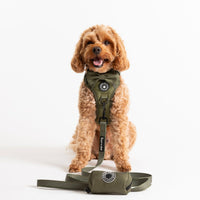



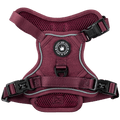
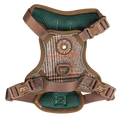
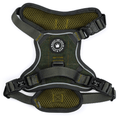
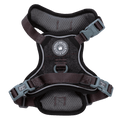
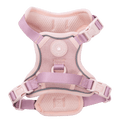

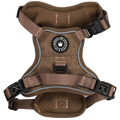
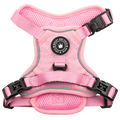









The clocks go back at 2am on Sunday 25 October 2026, and for lots of us that means the after-work walk suddenly happens in the dark. The short answer to walking your dog safely after sunset: make you and your dog easy to see, keep your dog close near roads, stick to routes you know well, and check their kit fits before you leave the house.
Here is how we approach darker walks, from the route you pick to the reflective details on your dog's harness and lead.

Before you head out: a two-minute kit check
A harness that has worked loose is easy to miss in a dim hallway, so it is worth doing your checks in good light before you go.
- Fit. You should be able to slide two fingers under every strap without forcing them. If you are buying a new harness, measure your dog's neck and chest first and check both against the size chart. Sizes are a general guideline, as individual dogs vary.
- Buckles and clips. Make sure every buckle has clicked shut and the lead clip is properly closed on the D-ring.
- Collar and ID tag. Check the tag is on and readable. Our guide on what to put on a dog tag covers the details.
- A torch and your phone. Charged, and somewhere you can reach them easily.
Not sure how a harness should sit? Our measuring and fitting video shows it step by step.
Be seen: help drivers spot you both
Roads are the biggest worry on most dark walks, and drivers can only avoid what they can see. The Highway Code asks pedestrians to wear something light-coloured, bright or fluorescent in poor daylight, and reflective materials when it is dark. That advice applies to you as much as your dog.
- Wear something reflective yourself. A reflective armband or jacket on the person holding the lead makes the whole pair easier to pick out.
- Carry a torch or wear a head torch. It helps you see the path, spot what your dog is sniffing, and find whatever needs picking up.
- Add reflective details to your dog. A reflective harness, lead or collar catches headlights from cars coming towards you.
- Cross near street lights. If there is no crossing nearby, a lit spot gives traffic a better chance of seeing you.
Choose your route with the dark in mind
A route that feels lovely at midday can be a different walk at 6pm in November. A few simple swaps help:
- Pick familiar, well-lit streets and paths where you know the kerbs, potholes and gates.
- Choose routes with a pavement where you can. If there is no pavement, the Highway Code says to keep to the right-hand side of the road so you can see oncoming traffic.
- Save unlit fields, woods and towpaths for daylight hours, such as a longer weekend walk.
- Let someone know where you are going if you are walking somewhere quiet.
Keep your dog close near traffic
The Highway Code asks dog parents to keep their dog on a short lead on pavements, roads and paths shared with cyclists or horse riders. After dark that matters even more, because a dog stepping off the kerb is much harder for a driver to see.
- Shorten your hold on the lead as you approach roads, driveways and junctions.
- If your dog's harness has a back handle, use it for an extra steady hand when you cross.
- Think twice about letting your dog off the lead in the dark, even in a place you know. It is harder to keep an eye on them and harder for them to see you.
If you are unsure how long a lead to use for town walking, our guide to choosing a dog lead walks through the options.
Wet, windy evenings
Autumn rain makes everything darker. Wipers, glare on wet roads and steamed-up windscreens all make pedestrians harder to spot, so on rainy nights it is worth being even more visible and even more careful at crossings. On very cold nights, our guide on how cold is too cold to walk your dog is a helpful read, and if your lead tends to come home soaked, have a look at our waterproof dog leads guide.
When muddy kit needs a wash, wash it on a cool wash, ideally inside our laundry bag.
How reflective dog kit helps (and what it can't do)
Reflective material does not glow on its own. It bounces light back towards wherever the light came from, so it shines brightest when car headlights or a torch beam fall on it. That makes it brilliant near traffic, where headlights are pointing straight at you, but it will not light up a dark field by itself. Our kit is reflective, not light-up, so pair it with your own torch.

Across our range, this is where you will find reflective details:
| Item | Reflective detail | Example |
|---|---|---|
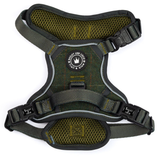
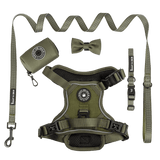
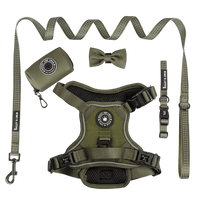
| Trail & Glow harnesses | Reflective strips along the front and back | The Khaki One harness |
| Trail & Glow leads | Reflective light stitching | The Khaki One 5ft lead |
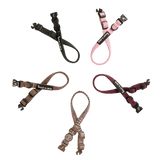
| Trail & Glow collars | Reflective light stitching | The Khaki One collar |
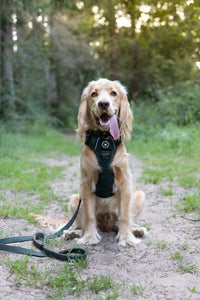
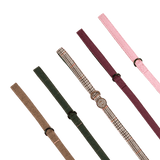
One detail worth knowing: not every lead in our range is reflective. Our tweed leads, such as Forest Tweed and Plum Tweed, are all about texture and comfort, and they aren't reflective. If dark walks are a big part of your week, look for "Trail & Glow" and "reflective" in the product description, or pair a Trail & Glow tweed harness (which has the reflective strips) with a reflective Trail & Glow lead such as Wanna-Bee.
Quick questions
Do reflective dog harnesses light up?
No. Reflective strips and stitching bounce light back from headlights or a torch. They do not produce light themselves, which is why we always suggest carrying a torch too.
Is a harness or a collar better for walks in the dark?
You can use both: a collar for the ID tag and a harness for the lead. A Trail & Glow harness adds reflective strips along the front and back, plus a handle to hold when crossing roads.
What should I do if my dog is nervous on dark walks?
Keep walks short, calm and on familiar routes while your dog gets used to the new routine. If your dog seems genuinely distressed, have a chat with your vet.
Darker evenings don't have to mean shorter, more stressful walks. With a bit of planning and kit that helps you both stand out, the after-work walk can stay one of the nicest parts of the day.