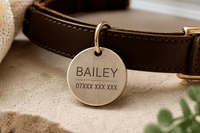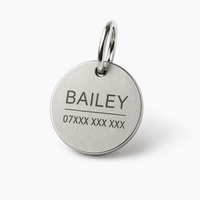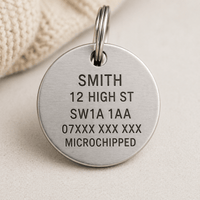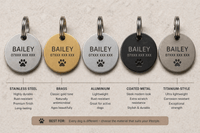











The best UK dog tags all do the same handful of things right, and seeing the real thing is the fastest way to understand what works. This guide shows real Bailey & Coco tags in silver, black and rose gold, with the exact layouts UK owners ordered for their own dogs.
Looking at a blank product photograph is one thing. Seeing how a tag reads with actual text on it is another. When you are choosing a dog tag, the single most useful piece of information is usually not the spec sheet. It is seeing a real tag with real text, on a real collar, on a real breed, and working out whether that pattern would suit your dog.

Quick answer: Dog ID tags UK owners order typically carry the same pattern: surname on line 1, house number and postcode on line 2, mobile on line 3, dog's name on the reverse. Real examples with the 38mm Bailey & Coco tag across silver, black and rose gold.
The dog tag layouts UK owners actually order
This guide collects examples from across our range and from real customer orders (with permission). If you want to see all three finishes side by side in one place, our engraved dog tag collection shows them together.
Example layouts that actually work on a 38mm tag
Every example below is a working layout on our 38mm stainless steel blank. The front carries three lines of identification; the reverse carries the dog's name. Details are anonymised where needed.
The classic three-line layout
The most common pattern we see in the UK, and the one we recommend as a default:
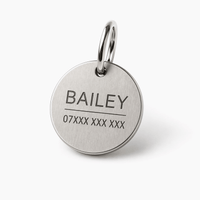
The most common UK dog ID tag layout: surname, house number and postcode, mobile number on the front - dog's name on the reverse.
- Line 1: WILLIAMS
- Line 2: 12 BA1 2LR
- Line 3: 07700 900123
On the reverse: MOLLY. Sixteen characters for the surname, ten for the address line, twelve for the phone. It fits cleanly at a generous font size, reads at arm's length, and meets the Control of Dogs Order 1992 in the smallest number of characters possible.
The short-surname example
- Line 1: HUGHES
- Line 2: SW4 9AB
- Line 3: 07900 123456
A shorter surname and a central London postcode leave room for slightly larger text. On the reverse: BOBBY 2022. Some owners add the dog's year of birth for emotional value. It changes nothing practical but is often requested.
The long-surname example
- Line 1: SUTHERLAND-H.
- Line 2: 46 BS8 1TH
- Line 3: 07711 222333
Compound surnames like "Sutherland-Hughes" or "Mackenzie-Brown" are common. We either shorten the second name to an initial (above) or keep the full name at a slightly reduced font. Either way the tag stays readable.
The couple layout
- Line 1: SMITH / JONES
- Line 2: 8 M14 5JL
- Line 3: 07777 888999
When two owners share a dog and go by different surnames, the slash-separated pattern works well. Line 1 uses both surnames; Line 3 is the primary contact mobile. The reverse carries the dog's name.
Silver tag examples

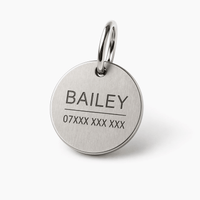
Silver is our most-ordered finish. The example above shows the classic three-line layout on a 38mm silver stainless steel blank. The engraved letters show as a soft matte against the polished face, producing clear contrast without shouting.
Real breed pairings we see regularly on silver tags:
- Golden Retrievers with heritage plaid or tan leather collars
- Labradors (any colour) with plain black or brown leather
- Cockapoos and Cavapoos with soft pastel tweed
- Dachshunds with charcoal or mulberry tweed
- Border Collies with plain black nylon or leather
The silver engraved dog tag pairs with every collar in our range and every mainstream collar from other brands.
Black tag examples

Black tags show the engraving in bright silver against a matte black face. This is the highest-contrast combination of the three finishes, and it is the example owners gravitate towards for dogs that walk in low light.
Typical black tag pairings:
- Black Labradors (tag reads clearly against a dark coat)
- Working Border Collies (tag survives farm work visually)
- Dogs walked before sunrise or after sunset (especially in autumn and winter)
- Anyone who wants a quiet, modern look on a tan leather collar
The black engraved dog tag is the pick we recommend for dawn-and-dusk walkers, and for owners whose dog's coat would otherwise hide a silver face.
Rose gold tag examples

Rose gold is the warmest finish in our range and the most-gifted example customers choose. It reads as premium at a glance and pairs especially well with darker coats and warmer-toned collars.
Rose gold example pairings:
- Ruby Cavapoos, red Cockapoos, chestnut Spaniels
- Dachshunds (red, chocolate, dapple)
- Dogs wearing mulberry tweed or heritage plaid collars
- Gift orders where the recipient's collar style is unknown
The rose gold engraved dog tag is the example that shows up most often in customer photos, particularly on Instagram where the warm tone photographs beautifully.
Example text choices by owner situation
Not every owner has the same contact setup. Real customer examples by situation:
Single owner, simple setup
Line 1 surname, Line 2 full postcode and house number, Line 3 mobile. Reverse: dog's name. This is the majority pattern and the one that works across every scenario.
Travelling owner or caravan owner
Some owners include the county on Line 2 alongside the postcode, for context when the dog is walked away from home. Example: "WORCESTERSHIRE" plus "07700 900123" leaves no doubt about the dog's home region even from a tag found a hundred miles away.
Multi-dog household
Each dog carries the same front layout (identical owner details) and the reverse varies with the dog's name. Matching finishes look smart when all dogs walk together.
Rescue dog or foster dog
Rescue and foster dogs benefit from the owner's (or foster family's) details on the front, with the dog's name on the reverse once it is settled. Some rescues initially use a tag with the charity's contact details and then swap once the adoption is confirmed.
Cheap vs quality dog tag example
| Element | Cheap tag example | Quality tag example |
|---|---|---|
| Line 1 text | Cramped, forced small font | Surname at full readable size |
| Line fit | Text touching tag edge | Comfortable margin on both sides |
| Letter depth | Surface scratch, visible to angle | Deep cut, visible at any angle |
| Font | Generic pre-set | Serif for names, sans for numbers |
| Reverse side | Blank or logo | Dog's name at larger size |
| Edge finish | Sharp, unpolished | Polished smooth |
| Visual impression at 1m | Hard to read | Clear and legible |
Examples by breed size
The 38mm size works across the great majority of UK breeds from toy to working, but the visual impression varies. A 38mm tag sits proportionally on:
- Toy breeds (Chihuahua, Yorkie, small Cavalier): a clear, readable disc that does not overwhelm a narrow collar
- Small breeds (Dachshund, Cockapoo, Cavapoo): proportional and balanced
- Medium breeds (Spaniels, Border Collies, Westies): easy to read from a distance
- Large breeds (Labradors, Retrievers, Huskies): generous visual presence without being oversized
For deeper detail on why 38mm works across this range, see our dog tag engraving guide.
Examples of what not to engrave
Three patterns we see in customer orders that we recommend editing before submission:
- "If found please call" uses most of a line that could carry the phone number itself. Skip the instruction, just include the number.
- "Microchipped" as a warning. Outdated advice that takes a line.
- Full address spelled out. A 30-character address line engraves at a small font; a postcode plus house number does the same legal job in half the space.
What UK delivery should look like for a personalised order
A good UK custom tag brand dispatches from the UK, offers free delivery on a reasonable order value, and takes returns on a personalised item if the fit is not right. It catches typos before the laser runs, re-engraves without fuss if something slips through, and stands behind the durability of its engraving.
Bailey & Coco dispatches from our UK studio with free delivery on orders over £50 and hassle-free returns within 30 days. If there is a typo on the order, tell us within 24 hours and we will re-engrave at no charge.
Pick the example that suits your dog
If the examples above resonate with your situation, the layout is likely right for you. If nothing fits quite naturally, our team can hand-set a specific layout that matches your needs, including unusual character counts, long surnames, or multi-owner setups.
Shop the full engraved dog tag collection, hand-finished in the UK in silver, black and rose gold, with free delivery on orders over £50.
Related reading
- Personalised Dog Tags: The Complete UK Buyers Guide
- Custom Dog Tags UK: Your Personalisation Options Explained
- Best Dog Tags UK: Owner-Tested Picks
- UK dog tag guide
- dog tag engraving guide
- engraved dog tags UK buyers guide
Example scenarios from real customer orders
Beyond the common three-line layouts, real UK owners order tags for specific life situations. Five we hand-fitted in recent months, anonymised.
The dog walker example
A professional dog walker who takes multiple dogs out daily asked for a tag on their personal dog that included "DOG WALKER" on the reverse. It helps strangers who find the dog understand why the person is often with different dogs. Unusual but sensible for the context.
The rescue-in-transit example
A foster family received a dog from a rescue still under charity contact. We engraved the foster family's contact on the front (as the day-to-day carer) and "Foster dog - [charity name]" on the reverse. Once the adoption finalised we produced a replacement tag with the permanent owner's details.
The second-home example
An owner with a primary home in London and a weekend cottage in Cornwall ordered two tags for the same dog. Each tag carried the relevant local contact for the location. The owner swapped the tag on the Friday drive down and again on the Sunday drive back.
The multi-generational family example
A three-generation household (grandparents, parents, children) asked for a tag with the primary carer's phone (grandmother) on line 3 but the family surname on line 1. The tag covers the dog regardless of which family member is walking it.
The named-in-memoriam example
After losing one of their two dogs, an owner requested that their surviving dog's tag carry both dog names on the reverse, joined by an ampersand. The surviving dog continues to wear the tag. The engraving commemorates the lost dog quietly on a piece of kit that continues to serve.
Common mistakes we see in example tag layouts
Looking at hundreds of customer submissions, five mistakes appear repeatedly. Each one reduces how well the tag actually does its job.
- Copy-pasting the entire address including "Street" and city name. The 30-character address line disappears into tiny font. House number plus postcode is enough.
- Putting the dog's name on line 1 instead of the owner surname. Cute for a novelty item, wrong for a legal ID tag.
- Using a phone number without the area code. Local works for local callers; a finder on the other side of the country cannot dial a number without the prefix.
- Writing "Please return" on the tag. Wastes a line on information the finder already knows.
- Engraving only the postcode with no house number. A postcode covers up to 100 houses in some cases. The house number narrows it to one.
Decision guide: pick the example layout that fits your situation
Match your situation to the closest example from the four standard patterns below.
Pattern A: Classic three-line (most common)
- Line 1: surname
- Line 2: house number and postcode
- Line 3: mobile phone
- Reverse: dog's name
- Suits: 80% of UK owners with one dog at a settled home
Pattern B: Couple layout
- Line 1: two surnames with slash separator
- Line 2: house number and postcode
- Line 3: primary contact mobile
- Reverse: dog's name
- Suits: shared-dog households where both surnames matter
Pattern C: Travelling owner
- Line 1: surname
- Line 2: county or region (not street postcode)
- Line 3: mobile phone
- Reverse: dog's name
- Suits: owners who travel the UK often; the county helps a finder miles from home
Pattern D: Multi-dog household
- Same front for every dog in the household
- Reverse varies per dog with each name
- Matching finishes for visual consistency
- Suits: homes with two or more dogs sharing the same owner
An example tag walk-through: from blank to finished
Many owners ask what the finished tag actually looks like at each stage. A typical order goes through five production steps.
Step 1: blank selection
A 38mm stainless steel blank comes off the batch that has passed our depth and weight checks. It is plain, polished, with no markings. The blank is identical for silver, black and rose gold orders until finish is applied.
Step 2: finish application
Silver tags ship on the bare polished steel. Black tags go through a matte coating process. Rose gold tags receive a sealed finish that gives the warm pink tone. All three finishes are applied before engraving.
Step 3: engraving layout
Our design software receives the customer's exact text from the order. The layout is hand-reviewed by a team member to confirm line spacing, character count, and readability. Any flags are sent back to the customer before the next step.
Step 4: laser engraving
The laser cuts the letters into the tag face. On a black tag, the coating is removed where the letters sit, revealing the silver metal underneath. On silver and rose gold, the laser cuts into the finish producing the characteristic matte letter against the polished face.
Step 5: hardware and dispatch
A 250kg-tested split ring is attached. The tag is visually inspected for depth, clarity and finish consistency. It is then packaged in our branded pouch and dispatched from our UK studio, usually within one working day.
What the finished tag feels like
Customers who receive a Bailey & Coco tag typically describe three things: the weight is balanced (heavier than a plated tag, lighter than a brass one), the letters feel distinctly ridged under a fingernail, and the finish holds clean reflection in daylight. These are the signals of a quality production run rather than marketing claims.
Why looking at real examples matters
Dog tag listings typically show a blank tag or a generic placeholder text. Real tags with real owner text tell you something different. You see the actual weight of a surname on line 1, the way a postcode sits with a house number, how the 38mm face handles the full three-line layout under each of the three finishes. That is why our product pages carry verified customer photos and why this guide includes real layout examples.
If none of the patterns fit your specific situation, contact our team with the details and we will hand-set an example layout for your review before the tag ships.
See also our complete UK personalised dog tags guide.
Frequently asked questions
What does a real UK dog tag typically say?
Surname on line 1, house number and postcode on line 2, mobile phone number on line 3, and the dog's name on the reverse. This layout fits the 38mm tag cleanly and meets UK legal requirements under the Control of Dogs Order 1992.
Can I see examples of each finish before ordering?
Yes. Our product pages show each finish with example text at real scale, and the collection page shows all three side by side.
What layout works for a compound surname?
Either shorten the second half to an initial ("Sutherland-H.") or keep the full name at a slightly reduced font size. Our team hand-fits the layout so the text stays legible.
What if my dog has two owners?
Use a slash separator on line 1 ("SMITH / JONES") and the primary contact mobile on line 3. Line 2 stays as house number and postcode.
Can I add a year of birth or message on the reverse?
Yes. The reverse commonly carries the dog's name, sometimes with a year or short message ("Molly 2022" or "Much loved"). The team hand-fits the content.
Do real customers include the dog's name on a tag?
Most do, on the reverse. A dog's name alone is not legally sufficient under the Control of Dogs Order 1992, but it helps a finder approach the dog calmly.
Which finish is most commonly ordered?
Silver is our most-ordered finish overall. Rose gold is the most-gifted. Black is the most-ordered for dogs that walk in low light or have dark coats.
Can I see customer photos of real tags?
Yes. Our product pages carry verified buyer photos on each finish, showing the tag at real scale on real collars.
Are the example photos on the product page real customer tags?
Yes, where possible. We feature customer photos with permission. The example text shown on stock product photography is representative rather than a real customer's details.
Can I send my own layout mockup?
Yes. Owners with a specific layout in mind can add notes at checkout or email us the sketch. Our team hand-fits the layout and confirms before the laser runs.
What's the most unusual example you have engraved?
A three-line layout in Welsh, a tag with the dog's nickname translated into Hindi on the reverse, and a tag for a working service dog carrying only the handler's ID number. Each served a specific practical purpose.