














A noisy dog tag is almost always a hardware problem, not a metal problem. The jingle comes from two tags (or a tag and a buckle) striking each other with every step, not from a single tag making sound on its own. The fix is nearly always to reduce the number of metal-on-metal contact points, stabilise the tag against the collar, or move to a single deep-engraved tag sized correctly for the dog. None of the common quick fixes (tag silencers, tape, rubber bumpers) need to compromise legibility or break UK dog tag law.
The jingling tag is one of the quiet irritations of UK dog ownership. It wakes you up at 5am when the dog stretches, it carries through the house on a thin wood floor, and it is the background noise of every evening walk. Most owners put up with it because the alternative (no tag) is illegal and the solutions on Google range from questionable to unreliable. In practice, two or three tidy fixes cover almost every case.

Quick answer: the jingle comes from two pieces of metal hitting each other. Remove any second or duplicate tag, sit the primary tag flush against a padded collar, and switch to a single deep-engraved stainless steel tag. Three structural fixes that keep you inside UK law and keep the tag fully legible.
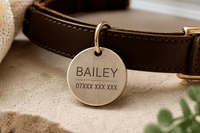
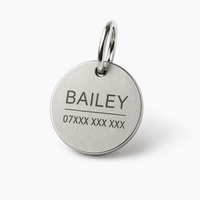
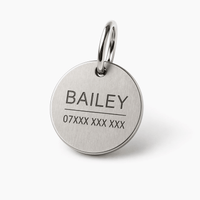
If you are already on the hunt for a quieter tag setup, the engraved dog tag collection is a single well-balanced 38mm tag designed to sit flat against the collar without a second piece of metal for it to strike.
Key facts about noisy dog tags in the UK
- Tag jingle is caused by metal-on-metal contact, most often between two tags or between the tag and a metal buckle.
- A single tag against a padded fabric collar sits almost silent during normal walks.
- UK law (Control of Dogs Order 1992) allows any tag material and any surface treatment as long as the owner's details are legible.
- Tag silencers and rubber bumpers are legal but can trap moisture and accelerate tarnish on lower-grade metals.
- Deep laser-engraved stainless steel is the quiet, low-maintenance path across years of ordinary UK wear.
Who this guide is for
UK owners whose dog's tag is loud enough to be a daily nuisance, and owners of multi-dog households where the jingle is multiplied by two or three. This covers why the noise happens, the quick fixes you can try tonight, and the structural fixes that solve the problem without compromising legibility. Our advice draws on testing noise levels across real collar setups in our UK studio.
Why dog tags get loud
Three root causes cover almost every jingly collar.
Two tags striking each other
This is the single most common cause. Owners often run a council-issued microchip registration tag alongside the main ID tag, or keep a vaccination tag, a rabies tag (for international travel), or a charity tag on the same ring. Two pieces of metal on a moving collar create more noise than a single piece of metal five times its size. Every step rings.
Tag swinging against a metal buckle
On collars with a solid-metal buckle or metal hardware sitting close to the D-ring, a single tag can still produce noise by striking the buckle on every step. This shows up more on narrow collars where the D-ring sits closer to the buckle, and on collars with solid-metal centre buckles rather than plastic side-release clips.
Heavy tag on a narrow collar
Heavy solid-brass or oversized tags swing harder than weight-balanced stainless steel tags of the same diameter. The extra swing increases contact force against any nearby hardware, which makes even a single tag noticeably louder on narrow collars.
Bottom line: the jingle is almost never about the tag itself. It is about what else is on the collar and how the tag is hanging.
Quick fixes you can try tonight

Take the second tag off
If the collar has two or more tags, remove all but the primary ID tag. The microchip registration paper tag is not legally required to be worn; the microchip itself does the legal work. Vaccination and rabies tags are only needed for international travel paperwork and can live on the passport folder rather than the collar. A single tag cuts the noise dramatically.
Check the split ring is closed flush
A split ring that has not closed fully can rattle on its own and can let the tag swing in an uneven arc that hits the buckle on one side. Run a fingernail around the ring to check. If it catches, use a flat edge to press it closed.
Sit the tag flush against the collar
A tag that sits at a right angle to the collar (hardware facing outward) swings in a bigger arc than a tag sitting flat against the fabric. Twist the split ring once and check that the tag sits against the collar with the engraved face outward. Gravity and soft fabric do most of the noise absorption from there.
Switch to a padded fabric collar
Hard nylon or leather collars reflect sound; padded fabric collars absorb it. If the dog is on a flat leather or plain nylon collar and the jingle is loud, a soft-padded collar alone makes an audible difference.
Structural fixes that actually last
Two fixes solve the noise problem without coming loose after a few weeks.
Move to a single deep-engraved tag
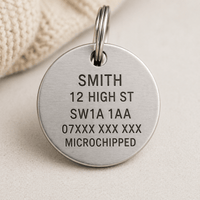
Deep laser engraving on a 38mm stainless steel tag carries all your UK-required details (surname, address, mobile, dog's name) without needing a second tag on the ring. A single well-made tag replaces two or three smaller stamped tags and removes the metal-on-metal contact that made the noise.
Our engraved range does exactly this job: one tag, three lines of owner details on the front, dog's name on the back, hand-finished in the UK. See the engraved dog tag collection.
Use a fabric collar with a plastic side-release clip
Swapping a solid-metal buckle collar for a fabric collar with a plastic clip removes the other half of the metal-on-metal contact. The tag is still on the D-ring but has no metal to strike against on every step. This combination (single tag plus plastic-clip collar) is usually close to silent on normal walks.
Tag silencers and bumpers: what to know

Rubber or silicone tag silencers are the most common third-party fix. They work by wrapping around the edge of the tag so two tags cannot make metal contact. Three things to know before using one.
They work, but only for two-tag setups
A silencer only helps if there is a second piece of metal for the tag to strike. On a single-tag setup the silencer does nothing and adds bulk.
They can trap moisture
A rubber silencer around the edge of a low-grade tag traps moisture between the rubber and the tag face. On unsealed brass or aluminium this accelerates tarnish and can dull the engraved face within months. On sealed stainless steel the effect is cosmetic rather than structural.
They change the readability of the edge
If the silencer covers the edge text (for example, a full UK postcode that runs close to the edge on a small tag), the tag becomes less immediately legible to a finder. A finder should not need to peel a rubber bumper to read an address.
A better approach: remove the second tag
The cleaner fix is structural, not additive. Silencing two tags with rubber still leaves two tags on the ring, each adding weight and reducing legibility. One well-made tag with no silencer is quieter, cleaner and easier to read.
What UK law says about quiet tags
The Control of Dogs Order 1992 is material-agnostic. It requires the owner's name and address to be on the tag (or on the collar itself) and legible, but it does not require the tag to be any particular shape, size or finish. A rubber silencer does not break the law as long as the text is still legible. A single deep-engraved stainless steel tag with no second tag is fully compliant.
For the full legal read, see UK dog tag law explained. For the front/back layout that makes a single tag carry everything, see what to put on a dog tag.
Silent tag options that are not worth the trade
Two ideas float around UK dog forums that look quieter but come with real downsides.
Collar-embroidered-only (no tag at all)
Some owners switch to a collar with their phone number embroidered into the fabric and remove the tag entirely. This can meet the law (the requirement is for the information to be on the collar or on the tag), but it has real drawbacks. Embroidered text fades faster than engraved metal in UK rain, cannot be updated if the phone number changes without a new collar, and is easy for a tired finder to miss in the dark.
Silicone-wrapped full-face tags
Full-silicone wraps go further than edge silencers and cover most of the tag face. They are almost fully silent but the engraved text is harder to read and the silicone traps moisture across the whole face. Within twelve months the face is usually dull and the engraving harder to pick up.
Bottom line: the cleanest quiet setup is a single well-made engraved tag on a soft-padded collar with a plastic side-release clip. No gimmicks, no silencers, no legibility trade.
Troubleshooting a persistent jingle
| Symptom | Likely cause | Fix |
|---|---|---|
| Sharp repeated clink on every step | Two tags on the ring | Remove second tag; keep one deep-engraved |
| Duller but constant rattle | Tag striking metal buckle | Switch to plastic side-release clip collar |
| Noise only at fast pace | Heavy tag on narrow collar | Replace with 38mm stainless steel (8-10g) |
| Quiet but persistent tick | Split ring not fully closed | Close ring flush with a flat tool |
| Noise at night when settling | Hard floor reflecting tag hitting buckle | Remove collar overnight; leave it on the crate or hook |
For a comparison of materials in UK weather (which also affects noise over time as finishes degrade), see brass vs stainless steel dog tags.
What a silent collar setup looks like
Bringing it all together, the quietest UK tag setup is small in number of pieces and high in quality per piece.
- One tag, not two or three.
- 38mm stainless steel, 8-10 grams, deep laser-engraved.
- Fitted on a small-gauge split ring that closes flush.
- Sat flat against the collar with the engraved face outward.
- On a padded fabric collar with a plastic side-release clip.
That setup is close to silent on normal walks, fully legible to a finder, compliant with UK law, and maintenance-free across years of ordinary wear.
The clean next step
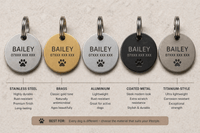
Most UK owners with a noisy tag replace the whole tag rather than trying to silence the setup piece by piece. Our engraved dog tag collection is a single 38mm stainless steel tag, hand-finished in the UK, in silver, black and rose gold, with free delivery on orders over £50. Combine with a padded fabric collar and the jingle usually disappears.
Noise profile over the day
A jingly tag is not a single noise; it is a signature that changes through the day. Three noise moments are worth mapping because each has a slightly different fix.
Morning first-movement
The loudest moment for many owners is the first morning stretch, when the dog rises from its bed and the tag hits the first clear metal contact. If the noise wakes you before the alarm, the fix is usually the simplest: remove the collar overnight and put it back on before the first walk.
Walk pace
During a steady-pace walk, the noise is the rhythmic clink owners hear through their own footsteps. This is the noise most owners want to eliminate; it is almost always a two-tag or tag-on-buckle issue.
Full-speed play
At full speed (off-lead running, fetch, dog-park play), the noise peaks but is less bothersome because it is lost in the broader activity. Owners rarely try to silence the full-speed noise directly.
Targeting the walk-pace noise as the primary complaint usually fixes the morning noise and the play noise as a side effect.
Room acoustics in a UK home
A UK home on a wood floor or laminate reflects tag noise. A UK home on carpet absorbs it. The same tag setup on a family house with carpet through the living areas sounds quieter than on a flat with polished concrete or wood. Knowing which room the noise feels worst in is part of the fix: if it is only bad at 5am on the bedroom floor, the fix is removing the collar overnight rather than re-engineering the tag system.
Dogs that settle on owner's furniture
If the dog sleeps on the sofa or in the bedroom, the collar usually comes off at night in those households anyway. A quiet overnight is straightforward. The remaining walk-pace noise is what the full tag setup needs to address.
Dogs that sleep in a crate
Crates amplify metal-on-metal noise because the tag can contact the crate bars. The fix is usually either removing the collar in the crate or lining the crate opening where the dog sleeps so the tag does not swing against metal. Both are cheap and immediate.
Second-dog noise considerations
A single noisy tag is a minor irritation. Two noisy tags in the same house compound it, and three dogs make it impossible to ignore. Multi-dog households benefit most from the structural fix (one deep-engraved tag per dog, padded fabric collars, plastic side-release clips). The noise reduction is not additive; it compounds, and two silent dogs read as genuinely silent rather than "less noisy than three loud dogs".
Why we do not sell silent tags as a product category
A silent-by-design tag exists as a category: typically a full-silicone tag or a cloth-pouch tag that sits inside a small collar loop. We have tested both and chosen not to stock them for the same reason we do not stock printed tags: the readability drops past a point we are comfortable shipping. A finder who needs a scanner to read a silicone tag through the wrap, or needs to unzip a cloth pouch to find a tag, is being asked to do work the tag should be doing on its own.
Our stance is that the noise problem is real but the solution is structural rather than material. A single well-made tag on a well-chosen collar is close to silent without compromising the tag's primary job.
The first-walk check
After fitting a new tag setup, take the dog for a standard ten-minute walk and listen. Three things to notice.
- At a steady walking pace, can you hear the tag? If yes, the tag is still making contact with something.
- On a shake or head-turn, is there a sharp clink? If yes, the split ring is not fully closed or is too heavy for the D-ring.
- On a stop-and-sit, does the tag make one ring and stop? Or does it ring multiple times? Multiple rings means the tag is striking the buckle on each settle.
These three observations catch almost every remaining noise issue. The fixes (close the ring, remove a second tag, switch to a plastic-clip collar) are usually already on the list above.
Related reading
- Dog Tags for Small Dogs UK: Sizing, Weight and Ring Fit
- Engraved vs Printed Dog Tags: Which Lasts in the UK
- Brass vs Stainless Steel Dog Tags: The UK Comparison
- complete UK guide to engraved dog tags
- dog tag engraving guide
- engraved dog tags UK buyers guide
Frequently asked questions
Why is my dog's tag so loud?
Almost always because there are two tags on the ring or the tag is striking a metal buckle. A single tag on a padded fabric collar with a plastic clip is close to silent on normal walks.
Is it legal to remove the tag to stop the noise?
No. The Control of Dogs Order 1992 requires the tag whenever the dog is in public. The fix is to make the tag quieter, not to remove it.
Do silencers work?
Edge silencers reduce metal-on-metal noise between two tags. They do little on single-tag setups and can trap moisture against lower-grade metals, accelerating tarnish.
What is the quietest type of dog tag?
A single 38mm stainless steel engraved tag on a soft-padded fabric collar with a plastic side-release clip. No second tag to strike against, no metal buckle to hit, no rubber silencer needed.
Does a heavier tag make more noise?
Yes, on narrow collars. Heavy solid-brass or oversized tags swing harder than weight-balanced stainless steel, and the greater swing increases the contact force on any nearby hardware.
Can I put the tag inside a pouch on the collar?
Some owners do. It meets the law as long as the text is still legible, but a finder may not check a pouch before looking for an exposed tag. A quiet exposed tag is usually better than a silent hidden one.
Does a silicone cover reduce legibility?
Full-face covers yes; edge silencers usually no. Full silicone traps moisture and dulls the engraved face over months, which makes the tag harder to read over time.
How do I quiet two dogs in the same house?
One deep-engraved tag per dog, plastic-clip padded collars on both, and split rings checked for flush closure. Two silent tag setups side by side stay silent together.