

































UK dog tag law, set out in the Control of Dogs Order 1992, requires any dog in a public place to wear a collar with the owner's name and address either inscribed on the collar itself or on a plate or badge attached to it. A phone number is not legally required but is strongly recommended. The microchip requirement is separate. Narrow exceptions exist for assistance dogs, working farm dogs, and dogs being used lawfully for the capture or destruction of vermin.
UK dog tag law is one of those rules that most owners half-know and nobody has read. It has been on the books since 1992, has not changed meaningfully since, and affects every dog that goes into a public place in England, Scotland, Wales or Northern Ireland. This guide walks through the exact wording, what it means in practice, the narrow exceptions, the fines, and how the law fits alongside the separate microchip requirement.

Quick answer: UK dog tag law under the Control of Dogs Order 1992 requires any dog in a public place to wear a collar with the owner's name and address on it. A tag is the most practical way to meet the rule. A phone number is strongly recommended but not legally required.
The letter of UK dog tag law
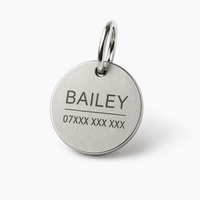
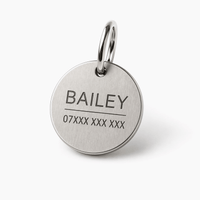
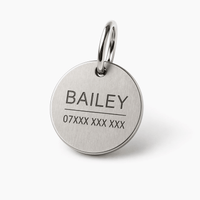
If you want to see a tag that meets the Control of Dogs Order 1992 out of the box, our engraved dog tag collection carries owner details across three finishes on a 38mm stainless steel blank.
The exact wording of the law
The Control of Dogs Order 1992 is the statutory instrument that governs dog identification on UK streets. The relevant line reads, in substance:
What UK dog tag law requires: owner's name and address on the collar, either inscribed on the collar itself or on a tag attached to it. A phone number is strongly recommended.
"Every dog while in a highway or in a place of public resort shall wear a collar with the name and address of the owner inscribed on the collar or on a plate or badge attached thereto."
Short, clear, barely changed in decades. In plain English, every dog going out in public needs a collar with owner identification on it, either engraved into the collar itself or carried on an attached tag.
What counts as "a highway or a place of public resort"
The law covers public places broadly. In practice this means:
- Roads, pavements and footpaths
- Parks and open spaces
- Public transport (trains, buses, the Underground)
- Beaches, including dog-friendly beaches
- Commons and heaths
- Cafés, pubs and other public-access premises where dogs are allowed
Your own home, private garden, and private land where you have permission are not covered. The law kicks in the moment the dog steps into public space.
What has to be on the tag
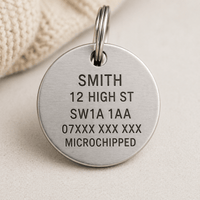
The statutory requirement is name and address. In practice, most UK owners engrave:
- Line 1: Owner surname (the "name" in the Act)
- Line 2: House number and postcode (the "address")
- Line 3: Mobile phone number (not legally required but strongly recommended)
A phone number is not required by the Control of Dogs Order 1992, but every UK vet, the Kennel Club, and every major rescue charity recommends including one. A stranger who finds your dog needs a way to contact you, and a phone number is faster than a written letter to an address.
For the exact layout on a 38mm tag, see our guide to what to put on a dog tag.
The narrow exceptions to the law
Certain categories of dog are exempt from the collar and tag requirement:
- Assistance dogs registered with an Assistance Dogs UK member organisation (guide dogs, hearing dogs, service dogs)
- Dogs being used for sporting purposes (the term is narrow and covers specific licensed activities)
- Dogs being used for the capture or destruction of vermin (lawful use, typically agricultural)
- Packs of hounds (again, with specific licensing)
- Dogs being used for the driving or tending of cattle or sheep
- Dogs being used by a shepherd, drover or master of a hunt
The exceptions are genuinely narrow. The everyday pet dog, however well-trained, is not in any of these categories and the tag rule applies.
The fine for failing to comply
Under the Control of Dogs Order 1992, failing to have a compliant tag on your dog in public is an offence. The maximum fine on summary conviction is Level 3 on the standard scale. At current rates this is £1,000, though fines imposed in practice are typically much lower when enforcement happens.
The fine for no dog tag in the UK: Level 3 on the standard scale, maximum £1,000. Fines in practice are usually much lower.
Enforcement is patchy. Most UK owners will never be fined for a missing tag. But the financial risk is not the real reason to comply. The real reason is that a tag is how a stranger contacts you when your dog is found. A missing tag turns a quick phone call into a vet trip, a microchip scan, a database lookup, and a much slower return.
The microchip requirement, explained

UK law also requires every dog to be microchipped, under the Microchipping of Dogs (England) Regulations 2015 and equivalent legislation in Scotland, Wales and Northern Ireland. The key points:
- Every dog must be microchipped by 8 weeks of age
- The chip carries your contact details on a central database
- You must keep the database entry up to date (this is where most owners slip)
- Failing to comply can result in a fixed penalty notice and, if not addressed, a fine up to £500
The microchip and the tag are complementary, not alternatives. The microchip is what a vet or rescue centre uses when your dog has been scanned. The tag is what a neighbour, dog walker or passer-by uses before the dog gets to a vet. Both are UK legal requirements, and both matter.
Cheap tag vs quality UK-compliant tag
| Requirement | Cheap tag | Quality UK-compliant tag |
|---|---|---|
| Owner name visible | Yes initially, fades fast | Yes, for lifetime of dog |
| Address visible | Yes initially, fades fast | Yes, for lifetime of dog |
| Legible at arm's length | Often not after 6 months | Yes, across years |
| Meets Control of Dogs Order 1992 | Marginally, while new | Yes, for the full life |
| Split ring security | Unrated | 250kg tested |
| Stays on the collar | Often fails | Designed to stay |
| Replacement when lost | Start from scratch | Match to original order |
What the law does not specify
The Control of Dogs Order 1992 is deliberately light on technical detail. It does not specify:
- The material of the tag
- The production method (engraving, stamping, printing)
- The font size or layout
- The exact wording beyond "name and address"
In principle, a hand-written tag would technically comply. In practice, "legible" is the implicit standard. A tag that a stranger cannot read is not meeting the purpose of the rule, even if it technically has the information on it. This is why deep laser engraving on stainless steel is the de facto standard for UK dog tags: it stays legible for the lifetime of the dog.
Special cases and edge cases
Dogs on the underground and public transport
Public transport counts as a public place. A dog on a train, the Tube, or a bus needs to be wearing a compliant tag. Transport for London's rules permit dogs but do not exempt them from the Control of Dogs Order.
Dogs on holiday in the UK
The law applies across England, Scotland, Wales and Northern Ireland. A dog on holiday in the Lake District or the Scottish Highlands still needs a compliant tag. Some owners engrave a holiday phone number on a supplementary tag for this reason.
Rescue and foster dogs
A dog in the UK in a public place needs a compliant tag regardless of its legal ownership status. If a foster family is walking the dog, the foster family's contact details are what go on the tag. Once adoption is finalised, the tag is replaced with the new owner's details.
Dogs on private land
Your own garden, private land where you have permission, and inside your home are not public places. The tag rule does not apply. In practice, most owners leave the tag on the collar permanently because the dog moves between private and public space constantly.
Working dogs and farm dogs

The Control of Dogs Order 1992 has specific exceptions for dogs "used for the driving or tending of cattle or sheep" and dogs "used lawfully for the capture or destruction of vermin". These are narrow categories that cover working farm dogs engaged in their work.
A sheepdog working a flock on a hill is within the exception. The same sheepdog on a Sunday walk with the family in the village is not. The exception follows the activity, not the dog. Farm owners usually keep compliant tags on their working dogs anyway because the dogs move between work and pet contexts.
How a modern engraved tag meets the law
A deep laser-engraved stainless steel dog tag meets the Control of Dogs Order 1992 because it carries the required information in a form that stays legible across the lifetime of the dog. Specifically:
- Owner surname is engraved on Line 1
- Owner address (house number + postcode is accepted) is engraved on Line 2
- Phone number (recommended) is engraved on Line 3
- The engraving is deep enough to stay legible through ordinary wear
- The tag is attached to the collar by a secure split ring
For the full buyers guide covering how to pick a tag that meets the law reliably, see our engraved dog tags UK guide.
What UK delivery and returns should look like
A good UK dog tag brand dispatches from the UK, offers free delivery on a reasonable order value, and takes returns on a personalised item if the fit is not right. It also stands behind the durability of the engraving: a tag that fades before the lifetime of the dog is a tag that stops meeting the law.
Bailey & Coco dispatches from our UK studio, with free delivery on orders over £50 and hassle-free returns within 30 days. Our engraved tags are cut deep on stainless steel specifically so the law-compliant information stays legible for years.
A tag that stays legal
UK dog tag law is simple to comply with if you start with a tag built to stay readable. Deep laser engraving on stainless steel, three legible lines on the front, the dog's name on the reverse.
Shop the full engraved dog tag collection, hand-finished in the UK in silver, black and rose gold, with free delivery on orders over £50.
Related reading
- Microchip vs Dog Tag: Do You Still Need Both in the UK?
- Personalised Dog Tags: The Complete UK Buyers Guide
- Best Dog Tags UK: Owner-Tested Picks
- UK dog tag guide
- dog tag engraving guide
- engraved dog tags UK buyers guide
Real owner scenarios under UK dog tag law
Four situations where owners ask us how the Control of Dogs Order 1992 applies to their specific case.
The new puppy owner
A first dog, usually at 8-12 weeks. The tag is required from the first public walk. Microchip is required separately by 8 weeks. Both matter; neither replaces the other. Most new owners need both sorted before the first vet visit.
The house-move scenario
Owners who move house often forget the tag needs updating. The microchip database update is widely known; the tag is often overlooked. A tag with an old address still meets the letter of the law (owner's name and address are on it) but the practical function (getting the dog home) is broken.
The rescue adoption
The dog comes with the rescue charity's details on its tag. From the moment the dog enters the adopter's home, the law technically requires the tag to carry the new owner's name and address. A replacement tag is a day-one priority, not a later task.
The dog walker or groomer's liability
Professional dog handlers have asked us whether they bear liability for a client's dog wearing a non-compliant tag while in their care. The primary liability rests with the owner under the 1992 Order. A good handler still checks tags at pickup as a courtesy.
Common mistakes about UK dog tag law
Five misconceptions we encounter regularly.
- "My dog is microchipped so I don't need a tag." Wrong in law and in practice. Both are required by different pieces of legislation, and they solve different parts of the lost-dog problem.
- "A dog's name on the tag is enough." No. The Control of Dogs Order 1992 requires the owner's name and address, not the dog's.
- "I only need the tag if I'm in a park." No. The law covers every public place, including pavements, public transport and cafés.
- "Assistance dog exemption covers my emotional-support dog." Usually not. The exemption is narrow and applies to dogs registered with Assistance Dogs UK member organisations or equivalent recognition.
- "My insurance requires an engraved tag so the law must too." The law requires the information; the law does not mandate engraving specifically. In practice, engraving is the most durable way to meet the rule, which is why insurers and vets recommend it.
Decision guide: does your setup meet UK law?
Walk through each question. If you answer yes to all four, your dog's setup is compliant.
1. Microchip
- Chipped by 8 weeks of age? → yes, move on
- Not chipped? → book the vet appointment today
- Chipped but database entry out of date? → update the database entry now (most databases allow online update for a small fee)
2. Collar with identification
- Dog wears a collar with an attached tag in public? → yes
- No tag on the collar? → fix today
3. Tag content
- Owner surname on the tag? → yes
- Address (house number + postcode, at minimum) on the tag? → yes
- Missing either? → replace the tag
4. Tag readability
- Tag readable at arm's length in daylight? → yes
- Faded, worn, or unreadable? → replace the tag (a tag that cannot be read is not meeting the purpose of the rule)
A quick compliance checklist
Three items to check every 12 months. Each takes under a minute.
- Tag readable. Read the tag at arm's length in daylight. If the text is vague, the tag is no longer meeting the purpose of the rule.
- Microchip database current. Log into your chip database and confirm the phone and address match reality. Most databases allow online update for under £10.
- Details match across both. The tag and the chip database should carry the same current details. Mismatched information (new address on chip, old on tag) creates confusion if the dog is found.
This annual routine keeps both legal requirements working together. Most slips happen when one is updated and the other is forgotten.
See also our why UK dogs need both a microchip and a tag.
Frequently asked questions
What does UK dog tag law actually require?
The Control of Dogs Order 1992 requires any dog in a public place to wear a collar with the owner's name and address on it, either inscribed on the collar itself or on a plate or badge attached to it. A phone number is not legally required but is strongly recommended.
Is an engraved dog tag a UK legal requirement?
A tag with the owner's name and address is. An engraved tag is the most practical way to meet the rule, but the law does not specify the production method. What it does require, by implication, is that the information stays legible.
What is the fine for no dog tag in the UK?
The maximum fine is Level 3 on the standard scale, currently £1,000. In practice, fines imposed are usually much lower. Enforcement is patchy.
Does a microchip replace the tag requirement?
No. The microchip (required under separate legislation) and the tag (required under the Control of Dogs Order 1992) are both UK legal requirements. The microchip is for scanning by professionals; the tag is for reading by the public.
Are there exceptions to the UK dog tag law?
Yes, narrow ones: assistance dogs, working farm dogs engaged in driving or tending cattle or sheep, dogs used lawfully for capture of vermin, packs of hounds under licence, and sporting dogs in licensed activities. Everyday pet dogs are not exempt.
Does the law apply in Scotland, Wales and Northern Ireland?
Yes. Equivalent legislation applies across the UK. A dog in any public place in the UK needs a compliant tag.
What counts as the owner's "address" on the tag?
The statute says "address" without specifying format. In practice, house number plus postcode is accepted. A full spelled-out address uses more characters than most 38mm tags allow legibly.
Does the tag have to be readable to be legal?
The statute requires the information to be "inscribed". Case law on what counts as sufficient is limited. In practice, a faded or unreadable tag is not meeting the purpose of the rule, even if the information is technically there.
Does the law apply to a dog in my car?
The 1992 Order applies "in a highway or in a place of public resort". A moving car on a public road is a grey area, but most interpretations treat the dog as in transit to or from a public place, so the tag should be on. In practice, the tag stays on the collar at all times except when the collar is being removed for washing or fitting.
What if my dog is wearing the collar at a puppy class?
Puppy classes are usually in rented halls or rooms, which are public-access premises. The tag should be on. Most puppy class trainers will also encourage tags as part of the good-practice habit from the start.
Is there a grace period for tag law enforcement?
No statutory grace period. In practice, enforcement is patchy and a warning is more common than a fine, but the offence technically exists from the moment the dog enters a public place without a compliant tag.