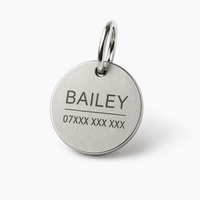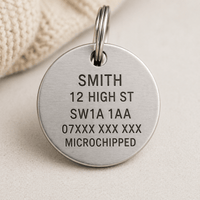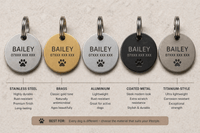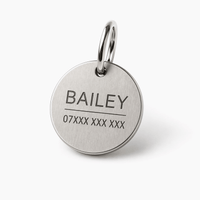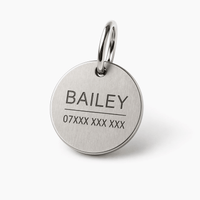












Every Bailey & Coco engraved dog tag starts as a blank 38mm stainless steel disc in our UK studio and leaves the studio as a deep laser-engraved, sealed, ready-to-wear tag in a single working day. The process is deliberately small-batch and physical: a person checks the engraving brief, a fibre laser cuts the characters, a technician seals the surface, and another person matches it to the correct split ring before it goes into a box. None of the steps are outsourced and none of them are automated end-to-end. It is the quietest reason our tags look the same in year three as they do on day one.
Most UK owners do not need the tag to be made in a particular way; they need the tag to work. What the studio process actually delivers is a consistency that is hard to manufacture remotely. The engraving file stays on record for the dog, so a replacement three years later reads the same as the original. The tag ring is matched to the intended collar type. The sealant is applied the same way on every tag rather than drifted across a 10,000-unit run. These are small details that compound into a tag that outlasts the collar it came with.

Quick answer: a Bailey & Coco engraved dog tag is made in our UK studio using deep laser engraving on sealed 316-grade stainless steel, dispatched in a single working day, and recorded on file for consistent replacements years later.
If you would rather skip the story and see the finished tag, the engraved dog tag collection shows all three finishes at size.
Key facts about the studio process
- Every engraved tag is produced in our UK studio rather than drop-shipped from overseas.
- The base blank is 38mm, 316-grade stainless steel, sealed against tarnish.
- Deep laser engraving sets characters 0.1-0.3mm below the polished surface.
- Turnaround is usually a single working day from order to dispatch.
- The engraving file is held on record so future replacements read identically to the original.
Who this guide is for
UK owners deciding between a high-street engraving kiosk, an overseas drop-shipped tag and a studio-made tag, plus readers who simply want to understand what they are getting when they order a premium engraved tag. This walks through the five steps that actually happen in the studio and the detail that distinguishes them from bulk tag production.
Step one: the blank arrives, graded and weighed
We do not cut our own blanks. The blanks arrive from a specialist UK metal supplier as 38mm 316-grade stainless steel discs, each one weighed to confirm it sits within the 8-10 gram target for the finish. Any blank outside that range goes back: weight tolerance is the detail that makes a tag sit correctly on a narrow collar versus swing heavy on every step.
Why 316-grade
316 stainless steel is a marine-grade alloy that resists corrosion in salt water, chlorine and prolonged UK damp. A 304 blank (more common on cheaper tags) is less resistant in salt-heavy environments. For dogs that swim at the beach or walk daily in the rain, the grade matters.
Why 38mm
38mm is the smallest diameter that reliably carries three legible lines of owner details at a font a stranger can read at arm's length. We tested 32mm, 35mm and 38mm blanks side by side and the legibility gap at two metres under a phone torch was the deciding factor.
For a deeper read on sizing by breed, see the dog tag size guide UK.
Step two: the engraving brief is checked

When a customer places an order, the engraving details are typed into the product page. Before the tag reaches the laser, a person in the studio reads the brief and checks three things.
Does the layout fit the tag cleanly
Three lines on the front and one on the back is the default. If a customer has entered a long address that will crowd the third line, the studio reformats to "house number plus postcode" rather than shrinking the font past legibility. A tag that reads at arm's length always wins over a tag that crams the full line.
Does the phone number read as a phone number
UK mobile numbers are typed in a handful of different formats. The studio standardises to "07xxx xxx xxx" so a finder can dial the number without guessing spaces or brackets.
Is the dog's name sensible on the reverse
Short names look right at the larger reverse font; very long names are reformatted to fit without looking squashed. If a customer has entered something that will not engrave cleanly (a non-standard character, a very long phrase), the studio emails before engraving rather than guessing.
This is a small step and adds a few minutes per order. It is also the single detail that makes the difference between "a tag" and "a tag that fits the dog it is for".
Step three: the laser engraves the tag
The fibre laser system we use produces a deep, narrow engraving channel on stainless steel by vaporising a thin layer of metal. Two parameters matter.
Depth
We cut each character 0.1-0.3mm below the polished surface. This is deep enough to keep the character out of reach of normal collar abrasion for years. Shallower engraving (as seen on many drop-shipped tags) can polish out after 12-18 months of daily use on an active dog.
Character shape
The laser path is programmed per font to produce a clean-sided character rather than a rounded channel. A clean-sided engraving catches light more sharply under angled torch light, which is why a deep-engraved tag is easier to read at distance in the dark than a shallow diamond-drag character.
For the fuller comparison between engraving methods, see engraved vs printed dog tags and the dog tag engraving guide.
Step four: sealing and finish

After engraving, each tag is sealed against the low level of surface oxidation that any steel can develop in sustained UK damp. The seal is thin, clear and flexible rather than thick and lacquer-like; it sits with the surface rather than on top of it. For rose gold and black finishes, the sealant also protects the PVD-coated top layer that produces the colour.
Silver finish
The natural stainless steel colour, sealed clear. Neutral, timeless and the easiest match across coat colours and collar types.
Black finish
PVD-coated in matte black over the stainless steel core. Produces the highest visual contrast under torch light, which is why it is the finish we recommend for low-light walkers. The black coating is physically bonded to the metal rather than painted, so normal collar contact does not chip the surface.
Rose gold finish
PVD-coated in a warm rose-gold tone. The closest stainless steel equivalent to polished brass without the tarnish. Our most-gifted finish because it looks premium in photos and suits a wide range of coat tones.
Step five: the split ring and box
A tag is only as reliable as the ring that holds it to the collar. The studio fits each tag with a matched-gauge stainless steel split ring sized for UK collar D-rings. Oversized or heavy-gauge rings (common on cheap tags) can force narrow D-rings open or bind against collar stitching; under-sized rings open under everyday movement and are the biggest single cause of lost tags. The correct gauge opens with a flat tool and closes flush by hand.
Once the ring is fitted, the tag is checked one last time for engraving clarity, surface finish and ring security, then packaged in a small protective sleeve and dispatched the same working day where possible.
What this process means for the customer
The studio process produces three outcomes that matter in practice.
A tag that reads the same in year three
Deep engraving, sealed surface and correct split ring combine to produce a tag that is functionally the same on day 1,000 as it was on day one. Most owners only replace because they change number or upgrade finish, not because the tag has failed.
A replacement that matches the original
Because the engraving file is held on record against the order, a replacement tag six months or three years later reads identically. If a customer loses a tag and needs a spare, the studio does not re-key the details; it reads the original engraving file.
A tag that suits the collar it is going on
The brief check at step two, the weight check at step one, and the ring match at step five all serve one goal: a tag that fits the actual collar the customer uses. Bulk-produced tags skip this step and the tag fits the average collar rather than the specific one.
What the studio process does not do
Honesty about the trade-off.
- The tag does not offer full-colour printing or photos. Engraving is monochrome by nature. Photo and logo tags need a printed process; see engraved vs printed dog tags.
- The tag is not cheaper than drop-shipped alternatives on day one. The £12-£25 UK range reflects studio time, 316-grade blanks and sealed finish.
- Turnaround is a single working day, not instant. A high-street kiosk can produce a tag while you wait; a studio tag is ordered online and posted.
For owners who genuinely need a photo tag or need a tag in thirty minutes, a drop-shipped or kiosk tag can be the right short-term choice. For a primary ID tag that lasts years, the studio tag is the one to buy.
Why we do it this way
We run the studio process because we could not find a volume-supplier route that produced a tag we were happy to send to our own dogs. The variation in blank weight, the drift in engraving depth across a 10,000-unit run, the wrong-gauge rings and the inconsistent sealing all added up to a tag that looked fine on day one and was mediocre on day 300. The studio process costs more per tag but holds the quality line every order.
That is also why we record the engraving file: the tag a customer ordered three years ago is still the tag we can reproduce today, in the same layout, on the same blank. It is one of the quiet details that makes a tag a piece of kit rather than a consumable.
The bigger picture

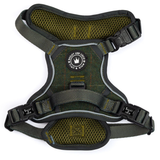
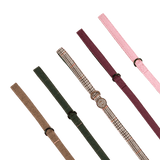
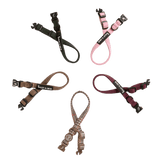
A Bailey & Coco tag is one small part of a broader range of UK dog kit that goes through the same studio discipline. The tag is the piece most customers notice first because it is the detail a stranger reads if the dog is ever found. The same standards that go into the tag go into the harnesses, leads and collars that sit alongside it.
For the full story of what a B&C tag is made of and why, the luxury dog tags UK guide covers the material and finish choice in more depth.
Bottom line: a Bailey & Coco tag is a small object made with attention because the tag is the piece doing the real work when everything else goes wrong.
The clean next step
If the studio process is the reason you want a tag that lasts, the engraved dog tag collection holds silver, black and rose gold finishes, hand-finished in the UK on 38mm sealed 316-grade stainless steel, with free delivery on orders over £50 and a single-working-day studio turnaround.
The day in the studio
A working day in the studio runs in a predictable rhythm. Orders placed through the website queue overnight and are downloaded first thing in the morning. The team reads each engraving brief, flags any that need clarification, and sorts the rest into batches by finish (silver, black, rose gold) so the laser is set once per batch rather than re-calibrated per order. Blanks are weighed and visually checked before they go under the laser; any out-of-tolerance blank goes back into the supplier return pile. Engraving runs in mid-morning. After engraving, the tags are sealed, rings fitted, and packaged through the afternoon ready for the late-afternoon courier collection. Orders received by mid-morning are usually dispatched the same day; orders received later ship the following working day.
Two people are usually on shift during the engraving and packaging window. A quiet studio with two experienced operators produces a steadier output than a larger team trying to do too much at once. The scale is deliberate: small-batch production is how we keep the quality line where we want it.
Where the design and engineering decisions were made
Before any tag was produced, several specific choices were settled. The shape, the diameter, the base metal, the finish options, the engraving style, the packaging: each sat as an open question until we tested the alternatives and chose. Three decisions deserve a note because they are the ones that come up most often in customer questions.
Why round
We tested round, rounded-square and bone-shaped blanks. Round won on three criteria: it sits flat against the collar at every orientation, it does not catch on hardware at any specific angle, and it carries three lines of engraving without wasted corner space. Rounded-square came close but lost on the corner-catch issue; bone-shape lost on engraving area and on sitting flat.
Why 38mm
Covered above; 38mm is the smallest tag that reliably carries three legible lines at a font a stranger can read. Smaller diameters failed the legibility test. Larger diameters (42mm and above) looked disproportionate on small-breed collars without adding legibility.
Why three finishes
Silver, black, rose gold. The three cover the aesthetic range most UK owners want: a neutral all-rounder, a high-contrast modern finish, and a warm-toned gift-friendly option. We tested gold (too close to rose gold without adding distinct use cases) and matte grey (too similar to brushed silver in most lighting). Three distinct finishes do more work than five overlapping ones.
Quality control specifics
Three checks happen on every tag before it leaves the studio.
Weight check
Each blank is weighed against the 8-10 gram target band. A blank outside this range does not go under the laser. This is the check that catches supplier variation before it reaches a customer.
Engraving depth spot-check
Within each batch, a representative tag is pulled and measured for engraving depth. Any depth outside the 0.1-0.3mm target band triggers a laser recalibration before the batch continues.
Ring security check
After the ring is fitted, each tag is given a firm tug to confirm the ring has closed fully. Any ring that opens under the tug is replaced before packaging.
These checks add time per order. They also catch issues that would otherwise reach customers and cause replacement orders. The net cost favours doing the checks.
What we learned in the first six months of running the studio
The first six months of studio production surfaced three things we did not fully anticipate.
Engraving brief ambiguity is more common than expected
A significant fraction of orders come with briefs that could be engraved two reasonable ways. Without the human check at step two, we would have shipped tags in the wrong layout for many of these orders. Building the brief check into the process adds five minutes per order and avoids a reorder on the same detail.
Rose gold is more popular than predicted
We expected silver to dominate. Rose gold has tracked higher than expected across gift orders and small-breed orders. The finish is now part of our default photo set because the visual case is strong.
Split ring variation across suppliers is real
Different ring suppliers produce rings with subtly different throat gauges. We now order rings from a single supplier after finding that mixing suppliers produced inconsistent ring-close performance across batches.
Customer communication through the process
Three customer-visible points in the process matter as much as the production detail.
Order confirmation with engraving preview
Customers receive an order confirmation that includes the engraving brief as captured. This is the customer's chance to catch any typo before production.
Brief clarification emails
If the brief is ambiguous, a short email goes out before the tag is engraved. This happens on a small minority of orders but is usually welcomed; customers would rather answer a clarifying question than receive a tag with a guessed interpretation.
Dispatch notification with photo where possible
On higher-value orders (multi-tag gifts, memorial tags), the studio includes a dispatch photograph so the customer can see the finished tag before it arrives. This is not routine on every order but is common on orders where the recipient will not see the tag before the occasion it is for.
Small touches like these are the reason the tag feels like something considered rather than something processed. They are not automated, and we do not intend to automate them further.
Related reading
- Luxury Dog Tags UK: What Makes a Tag Genuinely Premium
- Engraved vs Printed Dog Tags: Which Lasts in the UK
- Brass vs Stainless Steel Dog Tags: The UK Comparison
- complete UK guide to engraved dog tags
- dog tag engraving guide
- engraved dog tags UK buyers guide
Frequently asked questions
Where are Bailey & Coco dog tags made?
In our UK studio. The blanks are sourced from a specialist UK metal supplier, engraved, sealed and dispatched in-house without overseas drop-shipping.
What is the turnaround on a new order?
A single working day in most cases. Orders placed before the daily cut-off usually leave the studio the same day.
What grade of stainless steel do you use?
316-grade, which is a marine-grade alloy resistant to corrosion in salt water, chlorine and sustained UK damp.
How deep is the laser engraving?
0.1-0.3mm below the polished surface. Deep enough to stay out of reach of everyday collar abrasion for years of UK wear.
Do you keep a record of the engraving?
Yes. The engraving file is held on record against the order, so a replacement tag reads identically to the original.
Is black or rose gold a coating or the base metal?
Both are physical PVD coatings bonded to the stainless steel core, not paint. The coating is durable and does not chip under normal collar contact.
Can you produce a photo or logo tag?
Not with engraving. Full-colour tags need a printed process. For the trade-off, see our engraved vs printed dog tags guide.
What is the shipping cost?
Orders over £50 ship free in the UK. Standard shipping applies below that threshold and most tags arrive within the next working day after dispatch.