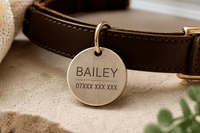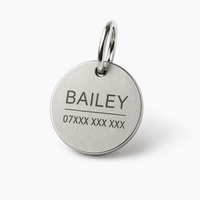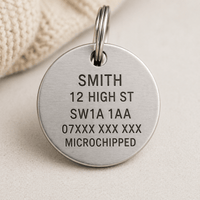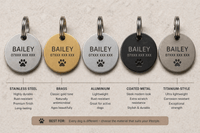






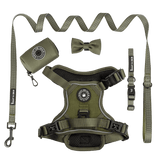


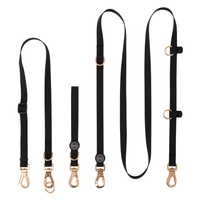


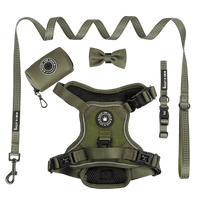

A UK puppy should have a correctly engraved ID tag from the first day it is walked in a public place. The Control of Dogs Order 1992 requires any dog in public to wear a collar with the owner's name and address on it, and the responsibility sits with the owner even if the puppy is only eight or nine weeks old. The practical question is not whether to fit a tag but which size, weight and finish suits a narrow puppy collar without swinging against the hardware on every step.
Bringing home a new puppy is the one moment a tag genuinely is a first-day purchase. A microchip is legally required and does the heavy lifting for lost-dog recovery, but a chip is invisible to the person who actually finds a stray puppy on a path. A readable tag is the piece of kit that turns a panicked phone call into a quiet thirty-minute reunion. Fit it properly and you stop thinking about it.

Quick answer: fit a UK puppy with an engraved tag before the first walk in a public place, typically around 10 to 12 weeks after the second vaccination. Engrave your surname, full address and a mobile number on the front, and the puppy's name on the reverse. Choose a tag under 10 grams on a narrow collar.
If you are still picking out the first set of kit, the engraved dog tag collection sits alongside puppy harnesses and leads as a small, practical first-day purchase.
Key facts about puppy dog tags in the UK
- The Control of Dogs Order 1992 requires any dog in public to wear a collar with the owner's name and address on it.
- Microchipping became compulsory in England, Scotland and Wales in 2016; the tag sits alongside the chip rather than replacing it.
- Puppies are normally walked in public from 10-12 weeks, after the second vaccination clears.
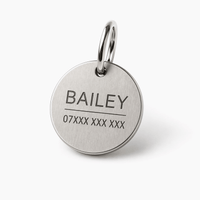
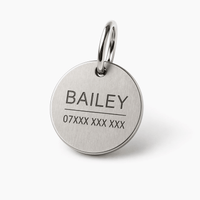
- A 38mm stainless steel engraved tag weighs around 8-10 grams, light enough for a narrow puppy collar.
- The owner's surname, address and mobile number fit cleanly on the front; the puppy's name sits on the reverse at a larger font.
Who this guide is for
New UK puppy owners fitting a first tag, and owners replacing an early stamped tag that has started to fade. This covers the legal basics, the timing around first walks, what to engrave, and the practical weight and layout choices that matter on a narrow puppy collar. Our guidance draws on studio testing of tag weights across real puppy-sized collars.
When to put a tag on a puppy
Three separate moments matter, and they come in a specific order.
First: the moment the collar goes on at home
Many UK owners put the first soft collar on a puppy in the first days at home for acclimatisation, long before any public walks. Fitting a tag at this stage is optional. The puppy is indoors, supervised, and the legal requirement does not apply in private. Most owners leave the tag off the first collar because a wriggling young puppy can catch a tag on soft furnishings, crate bars or each other during litter-style play.
Second: the first time the puppy leaves the front gate
This is the point where the tag becomes legally required. The Control of Dogs Order 1992 covers any dog in a public place, including being carried, sitting in a car at a petrol station, or on a lead on your own front path if it is accessible to passers-by. Vet visits before the second vaccination often involve carrying the puppy through a car park. Fit the tag before the first carry.
Third: the first proper walk after vaccinations
Around 10 to 12 weeks, once the second vaccination clears, most UK vets sign off on public-ground walks. By this point the tag has already been on the collar for a few weeks and both the puppy and the collar hardware have settled in. The tag now earns its place as the piece of kit that gets the puppy home if a lead slips from a hand in a distracted moment.
Bottom line: the tag goes on before the first public outing, not on the first week home. That gives the puppy a few indoor-only weeks to settle before the collar takes on extra weight.
What to engrave on a puppy tag

The engraving serves two jobs: meeting the legal minimum, and making it as easy as possible for a finder to return the puppy. The layout below covers both in three or four short lines.
Front of the tag (owner details, three lines)
- Line 1: your surname (Smith) or surname with initial (A. Smith).
- Line 2: house number and postcode (14 SW1A 1AA). Full address also works.
- Line 3: a mobile number in full UK format (07xxx xxx xxx).
Back of the tag (puppy's name)
Put the puppy's name on the reverse in a larger font. This makes calm identification easier for a finder ("is this Luna?") and works as a quiet visual check that you picked up the right tag from an engraving kiosk.
For the full legal breakdown on exactly what the Control of Dogs Order 1992 requires, see UK dog tag law explained. For a worked example of the layout, see what to put on a dog tag.
What not to put on a puppy tag
- Not the microchip number. Anyone who finds the puppy scans the chip at a vet; the number on the tag is redundant and takes up a line.
- Not the date of birth or breed. Neither helps a finder return the puppy and both waste engraving space.
- Not a full email. Emails take up too many characters and are slower to act on than a phone number.
- Not the word "chipped". It does not add anything a finder will act on.
Weight, size and fit on a narrow puppy collar

Puppy collars are usually 10-15mm wide, with narrow D-rings and smaller split rings than adult collars. Three details matter when matching a tag to that hardware.
Tag weight under 10 grams
A 38mm stainless steel engraved tag sits around 8-10 grams. That is light enough to hang without dragging a narrow collar crooked. Heavier solid-brass tags can weigh 15-18 grams and swing harder on every step, which young puppies feel against the neck.
Split ring sized for narrow D-rings
The tag comes on a small split ring designed to fit narrow puppy D-rings without binding. Cheap oversized split rings can force the tag to sit at an awkward angle and drag against the collar stitching. If a ring needs pliers to open, it is too heavy-gauge for a puppy collar.
38mm diameter over smaller sizes
A smaller tag diameter might look proportional on a tiny puppy, but it forces the engraving font down to a size that a stranger cannot read at arm's length. A 38mm tag carries three legible lines of owner details without crowding. For a full sizing read across breeds, see the dog tag size guide UK.
If the puppy is very small (Chihuahua, toy Poodle, mini Dachshund) and the 38mm tag feels too large visually, the best engraved dog tags for small dogs UK guide walks through finish choice on narrow collars in more detail.
Finish by coat tone
Finish is the one decision where puppy owners regularly swap later. Three rules cover most cases.
- Silver suits every puppy coat and every collar colour. It is the safest default pick.
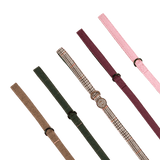
- Rose gold flatters warm coats (ruby Cavalier, red Cockapoo, apricot Cavapoo, chestnut Dachshund) and pairs with tan leather or plaid tweed.
- Black reads at longest distance in low light and suits dark-coated puppies where a silver face would disappear against the fur.
The three finishes sit in the same engraved range: the silver engraved dog tag, black engraved dog tag, and rose gold engraved dog tag.
A sample layout for a first puppy tag
| Side | Line | Example |
|---|---|---|
| Front | 1 | A. SMITH |
| Front | 2 | 14 SW1A 1AA |
| Front | 3 | 07700 900 123 |
| Back | 1 | LUNA |
That layout meets the Control of Dogs Order 1992, fits on a 38mm tag at a font a stranger can read, and leaves the back clear for the puppy's name.
Getting the tag onto the collar safely

Fitting a split ring to a narrow puppy D-ring is a thirty-second job with a flat-headed tool or a sturdy nail. A few habits help on the first fit.
- Open the split ring with a flat edge, not your fingernails. The gauge is small but sharp at the cut.
- Wind the split ring onto the D-ring until both ends pass through; a half-turn gets it about halfway.
- Check the tag sits flat against the collar with the front facing outward before letting go.
- Tug the tag once to confirm the ring has closed fully. A puppy that shakes its head will find a partially closed ring quickly.
Once fitted, the tag stays on the collar from this point onward. It does not need to come off between walks.
How long a puppy tag should last
A well-engraved stainless steel tag is designed to stay legible across years of ordinary UK wear. A puppy who grows into an adult dog usually keeps the same tag for the whole of their time on that collar. The two reasons owners reorder are not tag failure: they are upgrading from a first stamped tag to a deeper engraved one, or replacing a lost tag after a ring failure.
If a tag does start to fade inside twelve months, it is a sign the engraving depth was too shallow on the original tag rather than a sign that the metal has failed. Deep laser engraving on stainless steel sets the characters below the polished surface so everyday wear against collar hardware rarely reaches them.
Replacing a lost puppy tag
Tags are lost in two predictable moments: the first rough play session where another dog's teeth catch the ring, and the first walk after the collar has been removed for a wash and reattached in a hurry. A spare tag kept at home is a ten-minute fix rather than a trip to the high street engraver.
Our engraved range is held as blank stock and engraved per order in our UK studio, so a replacement tag is usually in the post within one working day and reads the same as the original because the digital layout file is stored by order.
The bigger picture: tag plus chip plus collar
A tag is one of three layers of UK dog identification. Microchipping is mandatory from eight weeks; the tag is required whenever the dog is in public; and a well-fitted collar is the thing that holds them both. None of the three replaces the others.
For a read across the full system of UK dog tag law, see UK dog tag law explained, and for sizing the collar itself, the dog tag size guide UK covers puppy collars through adult sizes.
Bottom line: fit a 38mm stainless steel engraved tag, under 10 grams, on the puppy's collar before the first walk in public. Engrave your surname, address and mobile on the front and the puppy's name on the back. That is the one-time decision that does the job for years.
The straightforward next step
Most UK puppy owners want the tag sorted before the puppy arrives so everything is ready for the first walk. Our engraved dog tag collection holds silver, black and rose gold finishes, hand-finished in the UK, with free delivery on orders over £50. All three finishes sit on the same 38mm stainless steel blank and are sized correctly for a narrow puppy collar.
First-week-at-home reality for a UK puppy
The first week at home is rarely a week for fitting hardware. New puppies settle, feed, sleep, and slowly acclimatise to the sound of the household. Most UK owners put a soft collar on the puppy in the first few days without any tag at all; the collar is about getting the puppy used to wearing something rather than about identification. The tag arrives in the second week, once the collar has stopped being a novelty and the puppy has accepted it as part of the routine.
That sequence matters because fitting a tag on a completely unfamiliar collar on day one can make the whole experience harder for the puppy. A heavier tag swings unpredictably in a way the puppy cannot yet tolerate, and any collar adjustment takes longer when the tag is in the way. The ten-day gap between fitting the collar and fitting the tag is a small detail that often produces a calmer puppy on the first walk.
A puppy-sized layout that grows into an adult tag
A tag engraved for a puppy rarely needs to change when the dog reaches adulthood. The owner's details (surname, address, mobile) do not depend on the dog's age, and the dog's name is the one field that is set on day one and never changes. The same 38mm tag fitted at twelve weeks can serve through into the dog's teens without replacement. That is part of why the investment in deep engraving makes sense at the puppy stage: the tag is being bought once, not yearly.
Puppy collar growth and tag fit
Puppies grow through two or three collars between first fitting and adulthood. Each collar transition is an opportunity to check the tag fit.
Puppy soft collar (8-16 weeks)
Usually 10-15mm wide on a fabric base. The 38mm tag fits comfortably and the split ring sits cleanly on the narrow D-ring. Tag weight is the key variable; at 8-10 grams the tag sits correctly.
Adolescent collar (4-8 months)
Often 15-20mm wide as the puppy grows. Same tag, same ring. The extra collar width absorbs the tag weight comfortably.
Adult collar (8+ months)
Typically 20-25mm wide for medium breeds, more for large breeds. The same 38mm tag is now visually proportional against a bigger collar, but the legibility and weight remain unchanged. No tag replacement needed.
For the full sizing read at each stage, see the dog tag size guide UK.
What to do if the puppy is still tiny at twelve weeks
Some small and toy breeds are genuinely small at the first-walk stage. A twelve-week Chihuahua can weigh under two kilograms and sit on a 10mm collar. The temptation is to order a smaller tag. The better call is to order the same 38mm stainless steel tag at 8-10 grams, check that it sits against the collar rather than hanging away from it, and watch the first few walks for any obvious discomfort. In practice, almost all toy-breed puppies adapt to the tag inside a few days and the tag stays on the collar for the rest of their lives.
If the tag visibly drags the collar off-centre or the puppy scratches at it repeatedly, the fix is usually to tighten the collar by one hole rather than replace the tag. A loose collar amplifies any weight a tag adds.
Common puppy tag mistakes
Three patterns we see repeatedly in replacement orders for young dogs.
A stamped aluminium tag from a supermarket
Cheap and fast but almost always the wrong long-term choice. The stamping is shallow, the aluminium fades quickly in UK rain, and the split ring is usually oversized for a puppy D-ring. Most owners replace inside six months.
A tag engraved with the puppy's name on the front only
Attractive but not legally compliant. The Control of Dogs Order 1992 requires the owner's name and address on the tag, not the dog's name. A tag with only the puppy's name on the front is both illegal and practically useless if the puppy is found.
An oversized fun-shaped tag
Bone-shaped, heart-shaped, or novelty tags in unusual sizes often look cute at the puppy stage but do not survive a year of chewing from litter-mates, catching on furniture, or everyday collar wear. They also almost always compromise engraving legibility.
For the full picture of what actually works and what does not, see the engraved dog tags UK buyers guide.
Related reading
- Dog Tags for Small Dogs UK: Sizing, Weight and Ring Fit
- Best Engraved Dog Tags for Small Dogs UK: Aesthetic Picks for Narrow Collars
- Do Dogs Need Tags in the UK? The Clear Answer
- complete UK guide to engraved dog tags
- dog tag engraving guide
- engraved dog tags UK buyers guide
Frequently asked questions
When should I put a tag on my puppy in the UK?
Before the first walk in a public place, which is usually 10-12 weeks after the second vaccination. The Control of Dogs Order 1992 applies the moment the puppy is in public, including being carried through a car park.
Is a tag required if my puppy is microchipped?
Yes. The microchip meets a separate legal requirement (compulsory microchipping) and is invisible to anyone who finds a stray puppy. The tag does the visible identification work on the collar.
What should a UK puppy tag say?
Your surname, address (including postcode) and a mobile number on the front; the puppy's name on the reverse in a larger font. That meets the legal minimum and makes it easy for a finder to act.
What size of tag suits a puppy?
A 38mm stainless steel engraved tag at around 8-10 grams fits narrow puppy collars without swinging hard against the hardware. Smaller tags force the font below legible distance.
Should I put the microchip number on the tag?
No. Anyone finding the puppy scans the chip at a vet. The number on the tag is redundant and takes space away from contact details.
Can I put the puppy's name on the front?
It is allowed but not recommended. The legal minimum is the owner's name and address. Putting the puppy's name on the reverse at a larger font keeps the front clear for contact details.
What finish suits a puppy with a dark coat?
Black. It reads at longer distance in low light and does not visually disappear against a dark coat the way silver can.
What if I lose the tag in the first few weeks?
Order a replacement. Our engraved tags are held as blank stock and engraved per order in our UK studio, so a replacement is usually in the post within one working day with the same layout as the original.