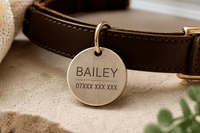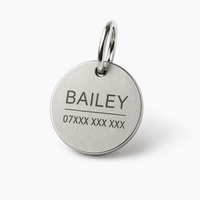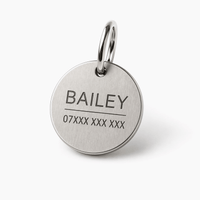












For a UK small dog, the right tag is 38mm in diameter, under 10 grams in weight, and fitted on a split ring that sits cleanly on a narrow D-ring without binding. That combination keeps the tag legible at arm's length, stops it swinging hard against the collar hardware on every step, and lets the dog carry a full three lines of owner details without forcing the font below readable size. Sizing a small-dog tag is mostly an exercise in resisting the urge to go smaller.
Small breeds make up the majority of UK pet dogs. Chihuahuas, Yorkies, mini Dachshunds, Pomeranians, Maltese, Bichons, small Cavaliers, Shih Tzus and small Cockapoos all share the same practical problem when it comes to tags: a collar narrow enough to suit the breed, hardware small enough to fit the collar, and a tag readable enough to actually work if the dog is ever found. The wrong tag swings, twists, or is too small to read. The right one fades into the background.

Quick answer: 38mm diameter, 8-10 gram weight, stainless steel core, small-gauge split ring. That combination suits the great majority of UK small-dog breeds and carries three lines of owner details at a font a stranger can read.
If you want to see sizing in context before choosing, the engraved dog tag collection shows the full set alongside representative small-dog collar sizes.
Key facts about sizing dog tags for UK small dogs
- The 38mm diameter is the smallest size that carries three legible lines of owner details at readable font.
- Tag weight under 10 grams suits narrow 10-15mm puppy and small-breed collars.
- Stainless steel offers the best strength-to-weight ratio among durable tag materials.
- Small-gauge split rings fit narrow D-rings without binding or sitting at an angle.
- A 38mm tag reads cleanly at arm's length; smaller tags force the font down past legibility.
Who this guide is for
UK owners of small-breed dogs sizing a first tag, or replacing an off-the-shelf tag that swings too hard or fades quickly. Whether you have a Chihuahua, a Yorkie, a mini Dachshund or a Cavapoo, this guide covers weight thresholds, ring fit and legibility on narrow collars. Our recommendations are grounded in studio testing across real small-dog collars.
Why smaller tags rarely work on small dogs
The intuitive approach is to scale the tag to the dog. A 25mm tag on a Chihuahua feels proportional in hand. In use, three practical problems show up.
Font size drops below legible distance
A 25mm tag cannot carry three lines of owner details (surname, address, mobile) at a font a stranger can read at arm's length. The engraving kiosk fits everything in by shrinking the font, which makes the tag technically correct and practically useless. A finder standing a metre away cannot tell what it says without lifting the puppy.
Information gets dropped
The other route kiosks take is to drop a line. On a 25mm tag, the postcode is often the casualty. A tag that reads surname plus mobile is shorter than the law requires and weaker in practice: a mobile that is ignored, out of battery, or abroad leaves the finder with no way to reach the owner.
Readability in the dark
Evening walks in winter are a real UK use case. A 38mm tag catches torch light across the full face; a 25mm tag either reflects less or presents text too small to read in the light a phone torch throws at five metres. Legibility at distance is where tag size genuinely pays back.
Bottom line: 38mm is the smallest tag that genuinely works on a small dog. Anything smaller looks proportional and reads poorly.
Weight: the threshold that matters

Narrow collars respond badly to heavy tags. On a 10mm collar, a 15-gram tag swings hard enough to pull the buckle off-centre with every step. Three weight bands matter in practice.
Under 10 grams: comfortable on narrow collars
Our 38mm stainless steel engraved tag sits around 8-10 grams. At that weight it hangs neutrally on a 10-15mm collar and does not pull the buckle out of line. Small dogs carry it for years without any visible effect on the collar hardware.
10-15 grams: borderline
Some stamped-brass high-street tags fall into this band. On narrow puppy collars the swing is noticeable on every step. On medium small-dog collars (15mm+) the weight is manageable but still more than ideal.
Above 15 grams: wrong size of tag
Solid-brass tags on narrow collars, or oversized adult tags fitted to small-dog hardware, sit in this band. The collar distorts over time and the split ring starts to open its throat under sustained stress. This is the weight band that causes ring failures and lost tags.
For a full read on material and weight trade-offs, see brass dog tags UK.
Ring fit on narrow hardware

The split ring is the part of the tag system that fails first on small dogs. Two details matter.
Ring gauge matches the D-ring
A heavy-gauge split ring forces a narrow D-ring open or binds against the collar stitching. A light-gauge ring threads through cleanly and sits flush. Our engraved tags ship with a ring gauge that matches narrow puppy and small-breed D-rings without modification.
Ring throat closes fully
Half-closed rings are the main cause of lost tags on small dogs. If the ring needs pliers to open, the throat is likely overbuilt for a narrow D-ring. Conversely, if the ring can be opened with a fingernail, the throat will work open under everyday movement. The correct gauge needs a flat edge to open and closes flush by hand.
Tag ring failures are one of the most predictable causes of lost tags on small dogs. For a read on how owners lose tags and what to do about it, see dog tag keeps falling off.
Sizing by breed
Real-world fit across common UK small breeds.
| Breed | Typical collar width | Recommended tag |
|---|---|---|
| Chihuahua | 10mm | 38mm, 8-10g |
| Yorkshire Terrier | 10-12mm | 38mm, 8-10g |
| Mini Dachshund | 12-15mm | 38mm, 8-10g |
| Pomeranian | 10-12mm | 38mm, 8-10g |
| Maltese / Bichon | 12-15mm | 38mm, 8-10g |
| Small Cavalier | 15mm | 38mm, 8-10g |
| Shih Tzu | 15mm | 38mm, 8-10g |
| Small Cockapoo / Cavapoo | 15-18mm | 38mm, 8-10g |
The table is short on variety for a reason: a single 38mm stainless steel tag at 8-10 grams suits almost every UK small breed. The variable is finish and layout, not size.
Layout on a small-dog tag
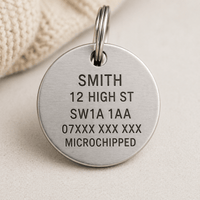
Three readable lines front, one line back. That is the layout we recommend for small-dog tags on a 38mm blank.
Front
- Line 1: surname (SMITH) or initial plus surname (A. SMITH).
- Line 2: house number and postcode (14 SW1A 1AA).
- Line 3: mobile number in full UK format.
Back
Dog's name in a larger font. This makes approach easier for a finder and is the small detail that turns identification into recognition.
For the full engraving layout read, see what to put on a dog tag. For the deeper UK legal context, see UK dog tag law explained.
Finish on a small-dog tag
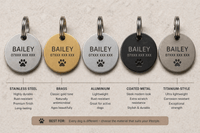
Size gets you a readable tag. Finish gets you a tag that looks right against the dog's coat and collar. Three practical rules.
- Silver is the lowest-risk pick across breeds and coat colours.
- Rose gold flatters warm coats and heritage collar colours.
- Black reads in low light and suits dark-coated dogs that would hide a silver face.
The three finishes sit on the same stainless steel blank: the silver engraved dog tag, black engraved dog tag, and rose gold engraved dog tag.
For a finish-by-breed deep dive including Cavaliers, Cockapoos, Dachshunds and more, see best engraved dog tags for small dogs UK.
Common small-dog tag mistakes

Three patterns we see repeatedly on replacement orders.
A tag that is too small
Under 30mm, the font drops below readable distance. The tag meets the law in the strictest sense but fails the practical test of actually being useful to a finder.
A stamped high-street tag on a narrow collar
Stamped aluminium or thin brass tags fade in UK rain and often arrive on an oversized split ring. The ring throat works open inside months and the tag is lost on a muddy walk.
A heavy solid-brass tag on a narrow D-ring
The brass swings on every step, distorts the collar buckle over months, and accelerates wear on the D-ring. If the collar is showing uneven wear on one side, a heavy tag is often the cause.
For a fuller read on durable material choice in UK weather, see the dog tag engraving guide.
Bottom line on small-dog sizing
Bottom line: for almost every UK small-dog breed the right tag is 38mm, 8-10 grams, stainless steel core, with a light-gauge split ring. Finish varies by coat colour and owner preference. Everything else (engraving layout, legal compliance, long-term readability) follows from getting the size right.
The clean next step for a small-dog owner
Our engraved range is the single 38mm stainless steel tag sized correctly for narrow UK collars, hand-finished in the UK in silver, black and rose gold. The engraved dog tag collection lists the three finishes with free delivery on orders over £50 and a UK studio turnaround that usually puts the tag in the post within one working day.
Why small-dog owners often buy twice
A pattern we see repeatedly in small-dog orders: the tag arriving is the second or third attempt, not the first. The first tag was usually a stamped aluminium piece from a supermarket or a pet-chain kiosk bought the week the puppy arrived. It faded, lost contrast, or the ring failed inside a year. The second tag was usually sourced from a more considered retailer but still fell into one of the classic small-dog sizing errors: too small in diameter, too heavy in weight, or fitted with an oversized split ring that opened within months. The third tag is the one that sticks.
This is not a criticism of owners making the first two choices. It reflects a market that sells small-dog tags on the wrong assumption (smaller dog = smaller tag) and a lack of clarity about what the tag actually needs to do. An owner who starts from the practical brief (readable at arm's length, light enough not to swing, ring that holds) arrives at the 38mm stainless steel tag directly. An owner who starts from the visual brief (looks proportional on the dog) often passes through two tags before landing on the working one.
Beyond weight: hardware compatibility on narrow collars
Weight is the most-discussed variable for small-dog tags, but compatibility with the specific collar hardware is the variable that usually fails in practice. Three pieces of narrow-collar hardware interact with the tag.
D-ring opening size
A narrow collar D-ring often has an internal opening of 4-6mm. A split ring with a throat wider than the D-ring gap jams awkwardly; a ring smaller than the gap can slide and twist. The correct match is a ring whose closed diameter sits comfortably inside the D-ring with a small clearance - usually 10-12mm external diameter works across most UK narrow collars.
Buckle distance
On a narrow collar the buckle sits closer to the D-ring than it does on a wide adult collar. The tag can swing into the buckle on fast walks. A shorter tag-to-collar gap (achieved by the split ring sitting directly on the D-ring rather than on a doubled-up connector) reduces this contact.
Stitching thickness
Heavy stitching near the D-ring can catch the split ring and hold the tag at an angle. On a new narrow collar, run the ring through the D-ring once and check it settles flat. If it catches, switch to a lighter-gauge split ring.
Multi-dog households with different sizes
Households with a small and a large dog on separate walks face a specific tag-fit challenge: the same tag model does not always suit both dogs. The small dog needs the 8-10 gram, 38mm setup described above; the large dog can usefully take a heavier tag or a different finish without the weight issues. In practice, the 38mm stainless steel tag works well on both because it scales down visually without scaling up the weight. Across our order data, multi-dog households are one of the strongest cases for stainless steel: the same tag spec covers both dogs and simplifies replacement planning.
Small-dog coat tone and finish pairing
A small-dog tag is visible against the coat on every walk. Finish choice carries more weight than on a large dog where the tag sits against a bigger visual backdrop.
White or cream coats (Maltese, Bichon, West Highland)
Silver is the lowest-risk pick; rose gold adds warmth that flatters cream coats. Black produces the strongest visual contrast and is often chosen for modern fabric collars.
Red or tan coats (small Cavalier, Cavapoo, red Pomeranian)
Rose gold is the natural match. Silver is neutral. Black is rarely chosen because it over-contrasts the warm coat.
Dark coats (black Pomeranian, black-and-tan Dachshund, black Yorkie)
Black disappears against dark fur and is the worst aesthetic pick despite being practically fine. Silver is the everyday choice; rose gold adds a warm accent that can work well on black-and-tan coats.
Replacement patterns on small-dog tags
Small-dog tags fail in patterns that differ from large-dog tags. Three reasons we see small-dog replacement orders, in order of frequency.
- Lost ring, lost tag. A split ring that worked open on a rough play session accounts for roughly half of small-dog replacement orders.
- Faded from a stamped original. Customers replacing a first stamped tag with a deep-engraved tag account for roughly a quarter.
- Owner change (move, number change, new phone). The remaining quarter are tags that still work but carry out-of-date details.
None of the three require a different size or weight of tag. The replacement is usually the same 38mm stainless steel tag with updated engraving.
Why 38mm is rare on the UK small-dog market
Many UK retailers sell tags at 20-30mm for small dogs, on the reasoning that smaller dogs take smaller tags. Our testing found that below 30mm, the practical legibility drops in ways the product photograph does not show. We stock only the 38mm size for small dogs because the legibility trade at smaller diameters is not one we are comfortable shipping. Your judgement may differ, but the testing behind the decision is consistent: 38mm is the smallest tag that does the finder-returns-the-dog job reliably.
A simple sizing spot-check at home
A quick home check any owner can run before ordering a new tag. Lay the dog's existing collar flat on a table and place a 50p coin (which is very close to 38mm across the flats) where the tag would sit. Step back to roughly arm's length and look at the coin. If it looks proportional and clearly visible against the collar, a 38mm tag will do the same. If the coin looks oversized against the collar, the collar is unusually narrow and a closer look at a specialist small-breed tag retailer is worth doing. In our experience, the 50p test works on virtually every UK small-breed collar wider than 8mm, which covers nearly every commercial small-dog collar on the market.
Related reading
- Best Engraved Dog Tags for Small Dogs UK: Aesthetic Picks for Narrow Collars
- Dog Tags for Puppies UK: When to Fit One and What It Should Say
- My Dog Tag Is Too Noisy: Quiet Fixes for UK Owners
- complete UK guide to engraved dog tags
- dog tag engraving guide
- engraved dog tags UK buyers guide
Frequently asked questions
What size dog tag is right for a small UK dog?
38mm in diameter and 8-10 grams in weight. That is the smallest size that carries three legible lines of owner details and the lightest weight that hangs correctly on a narrow collar.
Is a smaller tag better for a smaller dog?
No. Below 30mm the font drops below readable distance and information often gets dropped. A 38mm tag suits almost every UK small-dog breed.
What weight of tag is too heavy for a small dog?
Over 15 grams is too heavy for narrow collars; the tag swings on every step and accelerates hardware wear. Under 10 grams is the comfortable zone.
What material is best for a small-dog tag?
Stainless steel. It offers the best strength-to-weight ratio and does not tarnish in UK rain the way unsealed brass does.
How do I know the split ring is safe on a narrow D-ring?
The correct gauge needs a flat edge to open and closes flush by hand. A ring that opens with a fingernail is too light; one that needs pliers is too heavy for narrow hardware.
What should I engrave on a small-dog tag?
Surname, address with postcode, and a mobile number on the front. The dog's name on the reverse at a larger font.
Do small dogs need a different collar for a tag?
No, provided the existing collar has a secure D-ring. A well-sized 38mm tag at 8-10 grams sits cleanly on narrow puppy and small-breed collars.
Can I put two tags on a small-dog collar?
You can, but it is not usually necessary. Two tags on a narrow collar add weight, jingle more, and offer no extra ID value once the first tag carries full contact details.