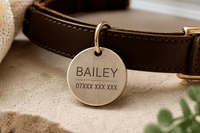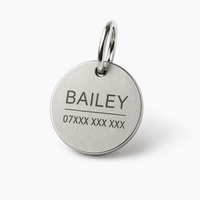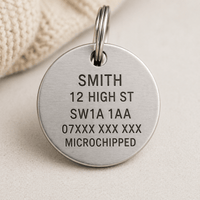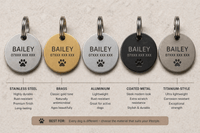












Dog tags keep falling off for one of five reasons: the split ring has opened under load, the collar D-ring is bent or worn, the tag is too heavy for the collar hardware, the ring and D-ring are mismatched sizes, or the dog's play style repeatedly catches the tag. Each has a specific fix. The good news is that none of them require replacing the whole collar; most are solved with a better split ring and a five-minute inspection.
A tag that falls off is not a small problem. It is the exact moment the tag stops doing its job. If your dog slips a gate with a tag that is sitting in your hallway, the tag is providing zero protection. Most owners have experienced this at least once, and most assume the tag itself is the problem. Usually, it is not. This guide covers the five real causes and the five real fixes, based on the patterns we see across tens of thousands of Bailey & Coco customer orders.

Quick answer: When a dog tag keeps falling off, the fix is almost always the hardware rather than the tag itself. Replace the split ring with a 250kg-rated ring, check the collar D-ring, and make sure the ring size matches.
Why a dog tag keeps falling off
If the fix turns out to be the tag itself, our engraved dog tag collection ships with a split ring strength-tested to 250kg and hardware we have inspected before dispatch.
Fix 1: Inspect the split ring
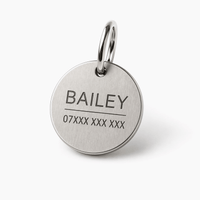
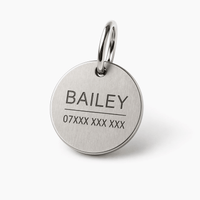
The split ring is the small hardware loop that connects the tag to the collar's D-ring. It is the most common failure point on any dog tag, and it is the part most owners never look at until it fails.
The #1 reason dog tags keep falling off: the split ring has opened under load. Replace with a 250kg-rated stainless steel split ring and the problem usually ends.
A healthy split ring should be visibly closed, with the two ends of the ring touching. If you can see a gap, the ring has already started to open. Under repeated load (every time the dog moves), that gap widens. Eventually the tag rotates off the D-ring and falls.
How to check if the ring is failing: twist the ring to see both ends. If there is any visible gap, it has already started to open. Replace today.
How to check a split ring in 20 seconds
- Hold the tag between finger and thumb.
- Twist the ring slightly to see both ends.
- If the ends have separated at all, the ring is compromised.
- If the ring shows any sign of stretch or warp, replace it.
Replacement rings are inexpensive and sold at most pet shops. A ring strength-tested to 250kg (the rating we use across Bailey & Coco hardware) is the standard worth buying. Cheap rings are usually unrated and are why so many tags fail.
Fix 2: Check the collar D-ring
The D-ring is the metal loop on the collar that the split ring attaches to. A worn or bent D-ring is the second most common cause of a tag that keeps falling off.
Two patterns to look for. The first is a D-ring that has bent out of shape, usually caused by a dog pulling against a collar connection rather than a harness. A bent D-ring no longer presents a closed loop to the split ring, so the split ring can work its way off.
The second is a D-ring that has worn thin at the contact point with the split ring. This is a classic "old collar" issue. If the collar is more than two or three years old and used daily, the D-ring will eventually wear to the point where it fails. A new collar solves it; a new tag on an old collar does not.
Fix 3: Match the ring size to the D-ring

A surprisingly common cause of tags falling off is a mismatch between the split ring size and the collar D-ring. A ring that is too small for the D-ring cannot close fully around it. A ring that is too large swings freely and catches on everything.
The fix is to match the internal diameter of the ring to the cross-section of the D-ring. Most UK collars use either a small (6-8mm cross-section D-ring) or medium (10-12mm) hardware size. A split ring rated for that D-ring size closes neatly around it and stays closed.
Every Bailey & Coco tag ships with a ring sized for standard D-ring and O-ring collars, so this is not a problem on our tags. It is a common problem on tags bought from marketplaces where the ring and collar are not matched.
Fix 4: Check the tag is not too heavy for the collar
Weight matters. A heavy tag on a narrow or lightweight collar swings repeatedly against the hardware, accelerating wear on both the split ring and the D-ring. Over time this loosens the connection and the tag starts to work free.
Our 38mm stainless steel engraved tags are weight-balanced for use across narrow puppy collars through to full working-dog collars. The key number is collar width. On a collar narrower than 15mm, a heavy novelty brass tag will stress the hardware; a 38mm stainless steel tag will not.
For deeper context on sizing and fit, see our dog tag size guide.
Fix 5: Watch the dog's play style
Some tags fall off because of where the dog plays. Rough-and-tumble at the park, tag-grabbing between dogs, branches catching on a run through dense undergrowth: these are mechanical causes that no amount of hardware will fully eliminate.
Two practical adjustments help:
- Slide-on tag instead of hanging tag. A slide-on tag threads through the collar directly and cannot be grabbed by another dog's teeth or caught on a branch. Worth considering for high-play dogs.
- Remove the tag during off-lead play. Some owners attach the tag only for walks in public (which meets the UK legal requirement) and remove it during high-intensity off-lead play at home or in a fenced area.
Neither is a substitute for a good split ring and a sound D-ring. But for dogs that genuinely lose tags repeatedly despite quality hardware, these are the two fixes that address the mechanical cause.
Cheap vs quality fix: what actually stops a tag falling off
| Issue | Cheap fix | Real fix |
|---|---|---|
| Split ring opening | Squeeze it closed with pliers | Replace with 250kg-rated ring |
| Bent D-ring | Bend it back | Replace the collar |
| Worn D-ring | Ignore it | Replace the collar |
| Ring/D-ring mismatch | Force a tight ring on | Match the ring size correctly |
| Tag too heavy | Live with it | Switch to a 38mm stainless steel tag |
| Rough play | Hope it stays on | Slide-on tag or removable for play |
| Recurring loss | Buy cheap replacements | Upgrade full hardware |
What the best hardware looks like

A good split ring has three features. The first is a high-strength alloy that does not deform under load. The second is a tight, closed end with no visible gap. The third is a size matched to the D-ring it will attach to.
We produce our split rings to a 250kg strength rating, the same standard we apply across our collars and harnesses. This is above what most dogs will ever put on the ring; the safety margin is the point. A ring that meets the dog's actual load has no margin for wear. A ring rated five to ten times above the load lasts the lifetime of the dog.
When the tag itself is the problem
Most tags fall off because of the hardware around them, not the tag itself. But there are two patterns where the tag is the problem.
The first is a tag with an oversized or undersized attachment hole. If the hole is too large, the split ring can rotate freely within it and work its way off. If the hole is too small, the ring is forced open to fit, weakening it before it is even on the collar.
The second is a tag made of very soft metal. A soft aluminium tag will flex under load, and the flex gradually widens the attachment hole. This is a slow failure mode that often looks like a split ring issue but is actually the tag.
Our 38mm stainless steel tags are milled with a precision attachment hole sized to our split rings, so this failure mode is eliminated. It is a common issue on cheaper aluminium tags sold via marketplaces.
A short maintenance routine
Once the hardware is right, keeping it right takes about two minutes per month. The routine:
- Check the split ring for gap or stretch
- Check the D-ring for bend or wear
- Check the tag attachment hole is still round, not oval
- Replace any component that has started to fail
Two minutes a month is cheaper than replacing a lost dog tag every six months, and cheaper than the worry of a dog slipping a gate with nothing on the collar.
When to replace vs when to fix
Three rules of thumb:
- Replace a split ring whenever you see a visible gap or stretch. These are cheap and pre-emptive replacement is always the right call.
- Replace a collar whenever the D-ring has bent or worn. A collar is the foundational piece; a compromised collar compromises everything attached to it.
- Replace a tag only if the attachment hole has deformed, the engraving has faded, or the tag itself has bent. If the tag is physically sound but keeps falling off, the cause is almost always the ring or D-ring.
What UK delivery and returns should look like
A good UK dog tag brand dispatches from the UK, offers free delivery on a reasonable order value, and takes returns on a personalised item if the fit is not right. It catches typos before the laser runs and stands behind the hardware it ships.
Bailey & Coco dispatches from our UK studio, with free delivery on orders over £50 and hassle-free returns within 30 days. Our split rings are strength-tested to 250kg before they leave the studio, which removes the most common reason tags fall off in the first place.
A tag that actually stays on
Most tag-loss problems are hardware problems, not tag problems. Fix the ring, fix the D-ring, and the tag stays on. If your current tag keeps failing despite the fixes above, the hardware around it is probably not rated for daily use.
If you are ready to upgrade the whole set, shop the engraved dog tag collection. Hand-finished in the UK with 250kg-rated split rings and free delivery on orders over £50. Our buyers guide walks through the full set of quality criteria if you want the deeper read.
Related reading
- Dog Tag Size Guide UK: What Size Tag Your Dog Needs
- Strength Tested to 250kg: How We Test Every Bailey & Coco Dog Tag
- Best Dog Tags UK: Owner-Tested Picks
- UK dog tag guide
- dog tag engraving guide
- engraved dog tags UK buyers guide
Real owner scenarios: where tags actually go missing
Four patterns we see when owners contact us about lost tags.
The puppy that plays rough
A three-month-old Labrador pulls on everything, including other dogs' tags at the park. Ring-and-ring clashes loosen both tags. Fix: a slide-on tag for the puppy, or supervised removal during rough play.
The escape artist
Some dogs (we see this most with Huskies and small terriers) are chronic escape artists. They back out of collars, wriggle through hedges, and lose tags in the process. Fix: martingale-style collar that does not loosen, and a secure 250kg split ring.
The dog-walker's van
Dogs picked up by walkers who travel with multiple dogs in one van often lose tags to van-floor snags. Fix: ask the walker how they secure dogs during transport; a simple tag-check on pickup saves the problem.
The senior dog that scratches
An older dog with collar-loosening scratch habits can loosen the ring over time. Fix: monthly ring check, and if the collar sits slightly looser, a smaller-diameter collar that stops the tag swinging.
Common mistakes when tags keep falling off
Five mistakes owners make when trying to fix recurring tag loss.
- Buying another cheap ring to replace the failed one. If the cheap ring failed, a cheap replacement will fail too. Upgrade the ring spec, not just the ring.
- Using pliers to squeeze a stretched ring closed. The metal has fatigued. Squeezing it does not restore its strength; it only delays the next failure.
- Adding a second ring "for security". Two rings create two failure points and catch on collar hardware. One quality ring is safer.
- Assuming the tag is too heavy when it is the ring. The ring is the failure point 9 times out of 10. The tag weight rarely causes falls.
- Ignoring the D-ring on the collar. A worn D-ring loses tags regardless of the ring or tag quality. Replace the collar if the D-ring has bent or worn thin.
Decision guide: which fix to try first
Work through the checks in order. Stop at the first one that shows a problem.
Check 1: Split ring gap (takes 20 seconds)
- Any visible gap in the ring? → Replace the ring with a 250kg-rated one
- Ring closed and sound? → Go to check 2
Check 2: Collar D-ring wear
- D-ring bent or thinning at the contact point? → Replace the collar
- D-ring looks new? → Go to check 3
Check 3: Tag attachment hole
- Hole oval rather than round, indicating the ring has worn the tag? → Replace the tag
- Hole still perfectly round? → Go to check 4
Check 4: Ring/D-ring size match
- Ring loose around the D-ring (can slide off without force)? → Switch to a smaller ring
- Ring tight and correctly sized? → Go to check 5
Check 5: Play style or escape behaviour
- Dog plays rough at the park? → Switch to a slide-on tag
- Dog escapes collars? → Switch to a martingale or better-fitting collar
A pre-emptive check every six months
Most tag losses can be prevented with a short regular check. Two minutes every six months catches the hardware wear that leads to sudden tag-loss in year two or three.
- Split ring check. Twist to see both ends. Replace if any gap.
- D-ring check. Sight along the collar to see if the D-ring is bent. Feel for thin wear spots. Replace the collar if either is present.
- Tag attachment hole. Still round? If oval, the ring has worn the tag face and the tag is close to failure.
- Collar fit. Two-finger rule still applies (two fingers fit between collar and dog's neck without force). A loose collar lets the tag swing more and accelerates ring wear.
Two minutes, twice a year, prevents most tag-loss events. Owners who do this catch hardware issues before they cause a lost tag.
See also our dog tag size guide for UK collars.
Frequently asked questions
Why does my dog's tag keep falling off?
The split ring has usually opened under load. Other causes: the collar D-ring is bent or worn, the ring and D-ring are mismatched, the tag is too heavy for the hardware, or the dog's play style catches the tag repeatedly.
How do I stop my dog's tag from falling off?
Replace the split ring with a 250kg-rated ring, check the collar D-ring for wear, and make sure the ring size matches the D-ring. If the problem continues, consider a slide-on tag or removing the tag during off-lead play.
What is the strongest split ring for a dog tag?
A 250kg-rated stainless steel split ring, like the ones we ship with every Bailey & Coco engraved dog tag. Anything rated lower is the most common failure point on a cheap tag.
Should I use two split rings for extra security?
Not usually. Two rings create two potential failure points and catch on collar hardware. A single high-quality ring is more secure than two cheap rings.
Can a bent D-ring on the collar cause tags to fall off?
Yes. A D-ring that is bent out of shape no longer presents a closed loop, so the split ring can work free. Replace the collar if the D-ring has bent or worn thin.
Is a slide-on tag better than a hanging tag?
For dogs that play rough or catch their tag on branches, yes. Slide-on tags thread through the collar directly and cannot be grabbed or caught. They are not necessary for most dogs, but they solve a specific problem.
How often should I check my dog's tag and collar hardware?
Once a month is plenty. A 20-second visual check of the split ring, D-ring and tag attachment hole catches problems before they fail.
Will a heavier tag help keep it from falling off?
No, the opposite. A heavier tag stresses the hardware and accelerates wear on the split ring and D-ring. A weight-balanced 38mm stainless steel tag works with the collar, not against it.
Can a tag fall off if I use a harness instead of a collar?
The tag should live on the collar, not the harness. Harnesses are removed when the dog is home; collars usually stay on. If the tag is on a removed harness, the dog is unidentified while the harness is off. Keep the tag on the collar.
Should I put the tag in a sealed pouch?
No. A sealed pouch covers the information, defeating the purpose. A good engraved tag needs no protection; the letters sit below the polished surface and cannot rub off.
What do I do if my dog has lost three tags in six months?
The hardware is almost certainly the problem, not bad luck. Replace the collar (D-ring wear), upgrade to a 250kg-rated split ring, and consider a slide-on tag if the dog plays rough. One round of proper replacements almost always solves chronic tag loss.