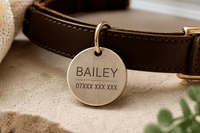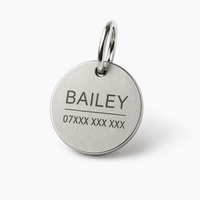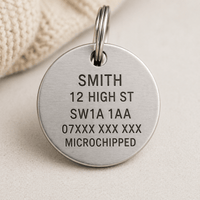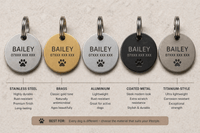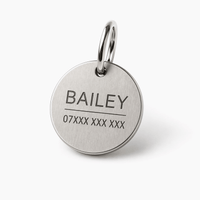











Every Bailey & Coco engraved dog tag goes through four tests before it ships: a 250kg split ring pull test, an engraving depth check, a 30-day UK weather simulation, and a six-month real-world trial on staff and customer dogs. The tests are not marketing theatre. They are how we avoid shipping a tag that fails six months after the warranty window closes. This guide walks through what we actually test, how, and why each test matters for the dog tag on your dog's collar.
Dog tag testing is the part of the product nobody sees. It is also the part that decides whether the tag on your dog's collar lasts three months or fifteen years. Most UK dog tag listings do not mention testing at all, because most UK dog tag sellers do not test. They ship the manufacturer's output, and any failures turn up as returns. We take a different approach. Every batch of tags goes through the same four tests before it joins our range, and tags that fail any test go back to the manufacturer or get rejected entirely.

Quick answer: Every Bailey & Coco dog tag goes through four tests before it ships: a 250kg split ring pull test, engraving depth check, 30-day UK weather simulation, and six-month real-world trial on dogs. Tests that fail cause batches to be rejected.
How we pick the best dog tags
If you want to see the tags that passed these tests, our engraved dog tag collection carries the three finishes (silver, black, rose gold) that are currently in our range.
Test 1: The 250kg split ring pull test
The split ring is the small hardware loop that connects the tag to the collar's D-ring. It is the most common failure point on any dog tag, and it is the part nobody photographs in product shots. We test every batch of split rings before they are paired with tags.
The test is straightforward. A sample from each batch is pulled to 250kg on a calibrated tension rig. A ring that opens, stretches visibly, or fails below 250kg causes the entire batch to be rejected. Rings that pass 250kg without deformation are approved for use.
Why 250kg matters for a dog tag
A 40kg dog pulling hard on a collar puts maybe 40-60kg of load through the split ring in the worst case. 250kg is a 4-6x safety margin. That margin is the point. A ring rated to exactly the load a dog puts on it has no margin for wear. A ring with a 4-6x margin lasts the lifetime of the dog because every day of use is within the comfortable capacity of the ring.
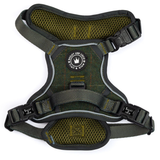
This is the same standard we apply across Bailey & Coco collars and harnesses. A 250kg-rated harness might carry a 40kg dog for 8+ years of daily walks without failure. The ring is held to the same principle.
Test 2: Engraving depth check

Deep laser engraving is the specification that matters most for a dog tag's lifetime. Shallow engraving polishes away as the tag swings against collar hardware on every walk. Deep engraving stays readable for years because the letters sit well below the polished surface.
Our engraving depth check is done on a production sample from each batch. The cut depth is measured against our internal standard (several hundred microns below the polished face). A batch that produces shallower-than-spec engraving is reset and re-run. A batch that consistently meets spec is approved for production.
What engraving depth actually looks like
A well-cut engraving feels distinctly ridged under a fingernail. You can feel each letter as a clear channel below the surface. A shallow engraving feels almost smooth, with the letters only slightly recessed. The difference is visible to the eye under a magnifying glass and felt immediately by touch.
Every finished tag that leaves our studio has been checked for engraving depth visually by a person. If a tag has come out shallow (occasionally a laser needs recalibration), it does not ship.
Test 3: UK weather simulation
British weather is harder on dog hardware than most climates. Rain, mud, salt water on coastal walks, and the mix of hot and cold across seasons all stress the finish and the hardware. A tag that looks smart in a product photo taken in dry studio light can dull within a season of real UK walks.
Our weather test runs each new tag design through a 30-day simulation before it joins the range. The sequence:
- Days 1-10: alternating dry and wet cycles (simulates rain)
- Days 11-20: salt water immersion cycles (simulates coastal exposure)
- Days 21-27: mud abrasion (simulates off-lead country walks)
- Days 28-30: temperature cycling from -5°C to +35°C (simulates UK seasonal range)
We score the tag at the end of 30 days on three criteria: finish retention (does the surface still look like new?), engraving clarity (is the text still readable at arm's length?), and hardware integrity (split ring, attachment hole). A tag that fails any one criterion does not make it into the range.
Test 4: Six-month real-world trial

The final test happens on real dogs, doing real walks, across real UK weather. Three or four production tags from each new design go on staff and volunteer customer dogs for six months before the design is finalised.
At the end of six months, we check:
- Is the engraving still readable at arm's length?
- Has the finish held up to daily wear?
- Has the split ring stayed closed and sound?
- Has the attachment hole stayed round, not oval?
- Does the owner feel the tag is still doing its job?
This is the test that catches issues the lab tests miss. A ring that looks fine in the weather chamber but wears on a particular style of D-ring in real life. A finish that holds up to mud abrasion but shows wear from being stored with house keys. Real-world use reveals what the lab cannot.
What we reject
We reject batches or designs based on the tests. Examples from the past year:
- One batch of rose gold blanks rejected because the coating showed micro-cracks after salt water exposure. Went back to the manufacturer.
- One split ring supplier discontinued because a batch failed at 180kg instead of the specified 250kg. Now using a different supplier.
- One proposed design iteration rejected because the attachment hole was slightly oversized and allowed the ring to rotate within it.
- Two laser settings rejected because they produced engraving that looked crisp but was only 60% of our standard depth.
Rejections cost us time and money. They also keep tags that would have failed on a customer's dog out of the range.
Bailey & Coco test results vs typical UK tag
| Test | Typical UK tag | Bailey & Coco tag |
|---|---|---|
| Split ring strength test | Not tested or unrated | 250kg pull test, every batch |
| Engraving depth verification | No check | Measured against spec, every batch |
| Weather test (30 days) | None | Rain, salt, mud, temperature cycle |
| Real-world trial (6 months) | None | Staff and volunteer dogs |
| Final visual inspection | Rare | Every tag, by a person |
| Batch rejection rate | Near zero (no tests) | Variable, ~5% batch rejection |
| Typical failure in year 1 | Common | Rare |
Why we test instead of just shipping
Testing is cheaper than returns. A tag that fails on a customer's dog costs us the replacement, the return postage, the customer service time, the review damage, and (most importantly) the loss of that customer's trust. A batch rejection in testing costs us the batch.
More importantly, testing is about the dog. A tag that fails at an unpredictable moment can mean a dog that is not returned home. No return refund can undo that. Catching failures in the lab and on trial dogs means we do not ship failure modes onto real collars on real dogs.
What this means for your dog's tag
When you order a Bailey & Coco engraved dog tag, the hardware has been pulled to 250kg, the engraving has been depth-checked, the finish has been weather-tested, and the design has been trial-worn for six months before it got to your collar. That is the standard we hold. It is why we are trusted by 39,000+ UK dog parents and why we can back the engraving and the hardware with a 30-day hassle-free return.
See the three tested finishes in our engraved dog tag collection, or go direct to the silver engraved dog tag, black engraved dog tag or rose gold engraved dog tag. For the deeper buyers guide, see our engraved dog tags UK guide.
What UK delivery and returns should look like
A good UK dog tag brand dispatches from the UK, offers free delivery on a reasonable order value, takes returns on a personalised item if the fit is not right, and stands behind the durability of what it ships. It tests before it sells, and it backs the tests with a clear return window.
Bailey & Coco dispatches from our UK studio, with free delivery on orders over £50 and hassle-free returns within 30 days. Every tag we ship has been through the four tests described above.
The tested tag that lasts
Most UK dog tag failures are preventable at the point of production. Our testing exists to prevent them. The tag on your dog's collar should not be the weak link in the identification chain.
Shop the full engraved dog tag collection, tested, hand-finished in the UK in silver, black and rose gold, with free delivery on orders over £50.
Related reading
- Best Dog Tags UK: Owner-Tested Picks
- Dog Tag Engraving Fading: Why It Happens and How to Prevent
- Why My Dog Tag Keeps Falling Off: 5 Real Fixes
- UK dog tag guide
- dog tag engraving guide
- engraved dog tags UK buyers guide
Real testing scenarios we have run
Four testing moments from the past year where the process made a real difference.
The ring-supplier switch
Our previous split ring supplier shipped a batch where pull tests came in at 180kg against the 250kg spec. We rejected the batch, returned it, and sourced from a new supplier who has since tested 12 batches at spec. The customer never sees the switch; the tag on their dog is secure because the test caught the drift.
The rose-gold coating re-work
An early rose gold prototype showed micro-cracks in the coating after the salt water weather test. The finish was attractive but not durable. We re-worked the coating process with our manufacturer until the 30-day weather test passed cleanly. The rose gold tag that shipped is the result of three iterations.
The laser depth recalibration
A laser session produced engraving at 60% of our standard depth. The tag still looked fine visually but the real-world trial showed visible fade after four months. We recalibrated the laser and reset the standard. Tags from that session were recalled and re-engraved at full depth.
The customer feedback loop
A customer reported their tag had dulled on the face after 18 months on a beach-walking Labrador. We pulled the batch records, confirmed the tag was within spec, and updated our long-term testing to include 6-month beach-wear simulation. The tag was fine; the spec now covers the scenario explicitly.
Common mistakes when evaluating "tested" claims
Five things to check when a seller claims a dog tag is "tested".
- "Tested" with no specification. Tested for what? To what standard? Generic claims with no detail usually mean no testing.
- "Quality tested by the manufacturer". Manufacturer QA is different from the seller testing each batch. Ask who tests and where.
- "Guaranteed for life". Lifetime guarantees on cheap products usually mean the return process is designed to discourage claims. Check what the guarantee actually covers.
- "Stainless steel" with no grade. "Stainless steel" covers hundreds of alloys with very different properties. 316L (marine grade) is different from 430 (utility grade). Quality sellers specify; cheap sellers do not.
- "Strength tested" with no rating. Tested to what load? A ring tested to 50kg is not a safety feature. 250kg is meaningful.
Decision guide: evaluating a seller's testing claims
Before buying any UK dog tag that claims to be tested, check five things.
1. Is the test spec named?
- Yes, with a number (e.g. 250kg pull) → meaningful claim
- No specific number → probably not tested
2. Is the base metal specified?
- Named alloy or grade (e.g. 316L stainless) → quality seller
- "Metal" or "Steel" only → ambiguous, probably lower grade
3. Is the engraving method named?
- "Deep laser engraving" → quality method
- "Engraved-style" or "enamelled" → probably not actually engraved
4. Is there a real-world track record?
- Reviews from 12+ months after purchase showing intact tag → tested in reality
- Only fresh-purchase reviews → product lifetime is unknown
5. Does the seller back the test with a replacement policy?
- Named return window and replacement process → stands behind the test
- No clear policy → the test claim is marketing, not operational
What we do when a test reveals a problem
Three examples of how test failures get handled, to illustrate the process rather than just the claim.
Batch-level failure
A ring batch came in at 180kg instead of the 250kg spec. The whole batch was returned to the supplier. No tag from that batch shipped. The delay added a week to our stock rebuild but prevented a 28% strength shortfall reaching customer dogs.
Design-level failure
A coating formulation cracked under the 30-day salt water test. The coating was reformulated by our manufacturer, tested again, and only the passing formulation entered production. Customers who ordered rose gold tags received the third iteration of the coating, not the first.
Field-level failure
A customer reported coating wear at 18 months on a beach-heavy walker. Their tag was within spec, but the use case was beyond our original 30-day weather model. We added a 6-month beach-wear simulation to our testing for all future rose gold batches. The customer received a replacement at no charge.
The common thread: testing flags the problem, the process handles it, and the tag on the next customer's dog is better because of what the previous test revealed.
See also our best UK dog tag owner picks.
Frequently asked questions
What does "strength tested to 250kg" actually mean?
Every batch of split rings is pulled to 250kg on a calibrated tension rig. Rings that open, stretch or fail below 250kg cause the batch to be rejected. This gives a 4-6x safety margin above the typical load a dog puts on the ring.
What 250kg strength tested means: every split ring batch is pulled to 250kg on a tension rig. Rings that open, stretch or fail below 250kg cause the batch to be rejected.
Why 250kg, not 100kg or 500kg?
250kg is the same standard we apply across Bailey & Coco collars and harnesses. It gives a meaningful safety margin without adding hardware weight that would stress narrow puppy collars. 100kg is too close to a large dog's pull load; 500kg would require hardware too heavy for everyday use.
How often do batches fail the tests?
Variable. Engraving depth batches pass almost always because our laser settings are stable. Split ring batches occasionally fail, typically when a supplier's alloy shifts. Weather tests are where most new designs get reworked.
Do other UK dog tag brands test?
Some do, most do not. Testing is not a visible part of the product, so many sellers skip it. The price point below about £8 rarely supports testing; the price point above £25 often does not justify it either. We test because we aim for the tag to last the lifetime of the dog.
Can I see the test results?
We do not publish batch-level test data, but our team can talk through the process on request. The headline numbers (250kg ring, deep engraving spec, 30-day weather test) are accurate to our process.
What happens if my tag fails in real-world use?
Contact us. If it is within a reasonable window and the failure is from the tag rather than unusual wear, we replace it. We track failure modes so we can feed them back into the testing.
Is testing why the price is £12-£25 rather than £3?
Partly. Testing costs money. UK-based engraving costs more than drop-shipped production. Quality materials cost more than plated zinc. The total is what keeps the tag lasting the lifetime of the dog.
Does the testing change between finishes?
No. Silver, black and rose gold tags all go through the same four tests. The finish is a surface layer; the core stainless steel, the engraving depth, and the split ring are tested identically across all three.
How do I know the tag I receive has been tested?
Every Bailey & Coco tag is visually inspected before it leaves the studio. The batch-level testing happens upstream; the individual tag inspection confirms the batch output at point of dispatch. If anything looks off, the tag does not ship.
Do you share the test certificates?
We do not publish batch-level test certificates but our team can talk through the process on request. The specific numbers (250kg ring, deep engraving depth, 30-day weather cycle, 6-month real-world trial) are the repeatable standard we hold.
Do other UK brands run equivalent tests?
Some do. Others rely on manufacturer QA alone. Testing is a cost that gets pared back on cheaper tags. The price difference between a £5 and a £15 UK tag is partly testing, partly materials, and partly UK-based production.