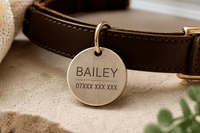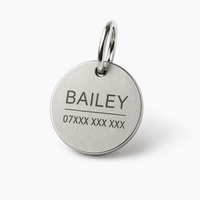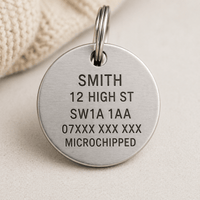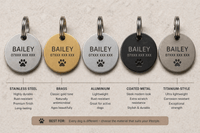












Dog tag engraving fades for three reasons: the engraving was too shallow to begin with, the base metal was too soft to hold the engraving under friction, or the tag was printed or stickered rather than actually engraved. Deep laser engraving on stainless steel is designed to stay legible for years of ordinary wear. If the engraving on your dog's tag has faded within a year, the tag was almost certainly produced using one of the three cheaper methods.
Fading engraving is one of the most common complaints we hear from UK dog owners. The tag looked sharp in the product photograph, looked fine when it arrived, and then, six to twelve months later, the engraving was smooth enough that a stranger could no longer read it. Most owners assume this is just what happens to dog tags. It is not. It is what happens to cheaply-made dog tags, and the difference is structural rather than a matter of luck.

Quick answer: Dog tag engraving fades for three reasons: the engraving was too shallow, the base metal was too soft, or the tag was printed or stickered rather than engraved. Deep laser engraving on stainless steel is designed not to fade.
Why dog tag engraving fades
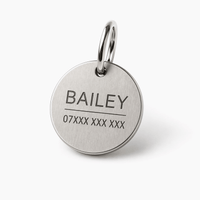
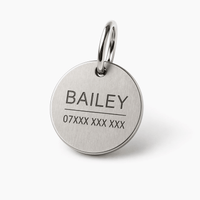
This guide covers why engraving fades, which tags are actually engraved (and which are not), and how to pick a tag that stays readable for the lifetime of the dog. If you already know you want a tag that does not fade, our engraved dog tag collection uses deep laser engraving on a stainless steel blank.
Why engraving fades: the three real causes
Cause 1: Shallow engraving
The single biggest cause of faded engraving is that the engraving was too shallow to begin with. On most cheap tags, the letters are cut or pressed only a few microns below the surface of the metal. Every time the tag swings against the collar hardware, a tiny amount of that surface is polished away. After a few thousand swings (which is a few months of walks), the bottom of the engraving is reached and the letters start to smooth out.
Deep laser engraving cuts the letters well below the polished surface of the metal, often several hundred microns deep. Surface polishing over years does not reach the bottom of the engraving. The letters stay readable.
Cause 2: Soft base metal
The base metal determines how fast surface wear polishes the tag. Soft metals like plated zinc, aluminium and brass wear faster than hard metals like stainless steel. A deep engraving on soft metal will still fade if the metal around it is polishing away at speed. A shallower engraving on stainless steel will often outlast a deep engraving on aluminium.
Our engraved dog tags sit on stainless steel blanks. Stainless steel is hard enough to resist scratches from everyday collar hardware and does not polish meaningfully over years of ordinary wear.
Cause 3: The tag was not actually engraved
Some "engraved" dog tags are not engraved at all. They are printed with ink, stickered with vinyl, or coated with a thin layer that has the appearance of engraving but is not. These will wear off within months, not years. The "fade" is not fading of engraving; it is ink or vinyl coming off the surface.
The test: an engraved tag has letters you can feel with a fingernail, because they sit below the surface. A printed or stickered tag feels smooth across the face. If your dog's tag feels smooth and the information is fading, it was never engraved.
Which production methods fade, which do not

Four production methods are used on UK dog tags. Only two genuinely hold up.
- Laser engraving. A focused beam burns a crisp, deep channel into the metal. Holds up for the full lifetime of the dog on hard metals. This is the method we use.
- Diamond-drag engraving. A diamond-tipped stylus scratches the letters into the surface under pressure. Slightly shallower than laser on hard steel but extremely durable on brass and aluminium.
- Stamping. A metal die is pressed into the tag blank. Shallower and usually limited to soft metals. The stamped letters blur as the tag wears.
- Printing or stickering. Ink or vinyl on top of the metal. Wears off within weeks to months.
If a product listing does not say which method it uses, the safer assumption is that it is one of the cheaper two. For deeper detail on engraving methods, see our dog tag engraving guide.
How to test whether a tag will fade
Before ordering, check the product listing for three signals.
- The method. Does it say "laser engraving" or "diamond drag"? If it says "enamelled", "printed" or "stickered", expect fading.
- The base metal. Is it stainless steel? If so, the engraving should hold. If it is plated zinc, aluminium or brass, expect faster surface wear.
- The warranty. Does the seller back the engraving? A good UK brand will re-engrave or replace if the engraving fades within a reasonable window.
If the listing is silent on all three, look elsewhere. A tag where the seller cannot answer any of those questions is a tag that will probably fade.
Fading: cheap vs quality tag comparison
| Factor | Cheap tag | Quality engraved tag |
|---|---|---|
| Engraving depth | Surface scratch | Deep cut, below polish line |
| Base metal hardness | Soft (aluminium, plated) | Hard (stainless steel) |
| Surface wear rate | Fast | Slow |
| Typical fade window | 3 to 12 months | Lifetime of the dog |
| Can you feel the letters? | Sometimes no (printed) | Yes, distinct ridges |
| Replacement cost | Several times over the years | Rarely needed |
| Hidden cost of fade | Lost dog risk | None |
How to prevent engraving fade
Prevention starts at the point of purchase. Once the tag is on the collar, there is almost nothing an owner can do to stop engraving fade if the production method was wrong. The fix is structural, not behavioural.
How to prevent dog tag engraving from fading: buy a tag with deep laser engraving on stainless steel from a UK engraver. Care afterwards is minimal.
Choose a tag that cannot fade
Deep laser engraving on stainless steel, from a UK engraver who stands behind the work. That is the specification. Anything less and fading is a question of when, not if.
Keep hardware separate from the tag
Small contributions owners can make to slow surface wear: keep the tag out of a keyring with metal clickers or keys in a pocket, rinse salt water off after a beach walk, and avoid wire wool when cleaning mud out of the engraving. These will not rescue a cheaply-made tag but they will extend the life of a well-made one by a small margin.
Inspect at six months
A quick check every six months catches early signs of fade. If the engraving has already started to smooth out on any line, the tag was shallow to begin with. Replace it before it reaches the point where a stranger can no longer read it.
What a faded tag means for a lost dog

A faded tag is a tag that has stopped doing its job. The Control of Dogs Order 1992 does not specify a minimum engraving depth; it only requires that the owner's name and address be on the collar. But a tag that a stranger cannot read is, in practice, not meeting the spirit of the rule.
The practical concern is simpler. If your dog is found by a neighbour, a dog walker or a passer-by, the tag is the thing they will read before they call you. A faded tag is a tag that they cannot read, which means your dog is in the hands of someone who has good intentions but no information. The microchip database is what a vet uses. The tag is what the public uses.
How Bailey & Coco engraves for durability
Our engraved dog tags are deep laser-engraved on a 38mm stainless steel blank in our UK studio. Every tag is checked for engraving depth against a standard before it leaves us. The finishes (silver, black, rose gold) use the same base metal and the same engraving depth, so durability does not change between them.
We also keep a record of what we engrave, so if a tag is ever lost or needs replacing, we can produce a matching new tag that carries the same details in the same layout. The silver, black and rose gold PDPs all show examples of the deep engraving at real scale; see the silver engraved dog tag, black engraved dog tag or rose gold engraved dog tag.
What UK delivery and returns should look like
A good UK dog tag brand dispatches from the UK, offers free delivery on a reasonable order value, and takes returns on a personalised item if the fit is not right. It also backs the engraving itself: if a tag fades within a reasonable window, the seller will replace it.
Bailey & Coco dispatches from our UK studio, with free delivery on orders over £50 and hassle-free returns within 30 days. Our engraving is cut deep on stainless steel and is designed not to fade under ordinary use.
A tag that stays readable
Fade is the slow failure that turns a personalised tag into just a disc. Most fade is preventable: pick a tag that cannot fade, and the problem does not arise.
If your current tag is fading or has faded, it is worth upgrading to a deep-engraved stainless steel tag rather than re-engraving the same blank. Shop the full engraved dog tag collection, hand-finished in the UK in silver, black and rose gold, with free delivery on orders over £50.
Related reading
- Strength Tested to 250kg: How We Test Every Bailey & Coco Dog Tag
- Best Dog Tags UK: Owner-Tested Picks
- Custom Dog Tags UK: Your Personalisation Options Explained
- UK dog tag guide
- dog tag engraving guide
- engraved dog tags UK buyers guide
Real owner scenarios: where engraving fades first
Four common scenarios where owners notice engraving fade, and what caused it in each case.
The coastal dog
Beach walks, salt spray, and sandy play accelerate surface wear on soft metals. A plated tag on a beach-dog fades visibly in three to six months. Stainless steel on the same walks reads clearly after two years.
The farm dog
Working dogs on farms encounter mud, rough ground and constant collar friction. A shallow-engraved tag wears from both the inside (engraving smoothing) and the outside (metal polishing). Deep engraving survives; shallow does not.
The kennel-kept dog
Dogs stored for long periods in kennels or crates where the tag rubs repeatedly against metal bars see accelerated surface wear on one specific part of the tag face. The engraving on that side fades first. Stainless steel minimises this; soft metals do not.
The handbag-rescue dog
Small dogs carried often in bags rub against clasps, zips and other hardware. The tag polishes faster than on a dog that mostly walks. Stainless steel tags and deep engraving handle this cleanly; cheap plated tags do not.
Common mistakes when engraving fades
Five mistakes owners make when engraving has started to fade.
- Scrubbing with wire wool to "clean" the tag. Wire wool polishes the metal, which is exactly the opposite of what a faded tag needs. A soft cloth and warm water is enough.
- Using metal polish on engraved tags. Polish removes surface metal. If the engraving is shallow, polish accelerates the fade.
- Paying to re-engrave over faded engraving. The result is a shallow cut on an already-thinned surface. A replacement tag is better.
- Assuming all fade is equal. Slight surface polishing on stainless steel over years is normal; visible fade on a new tag within months is not.
- Buying a replacement from the same cheap source. If the original faded because of shallow production on soft metal, a like-for-like replacement fades the same way.
Decision guide: replace, re-engrave, or clean
Use the decision guide below based on what your current tag looks like.
If the tag is less than 3 months old and the engraving looks faded
- The tag was shallow or printed to begin with
- Contact the seller for a replacement under warranty
- If no warranty: replace with a deep-engraved stainless steel tag
If the tag is 6-24 months old and looks dull but the engraving is still readable
- Normal surface polishing on a quality tag
- Wipe with a soft cloth; do not use wire wool or polish
- No replacement needed
If the tag is 1-3 years old and the engraving is no longer readable at arm's length
- The engraving has reached the bottom of its depth
- Replace the tag; re-engraving the same blank produces shallower results
- We keep a record of your original order so the replacement matches
If any age tag has mud stuck in the engraving
- Rinse under a tap and wipe with a soft cloth
- Usually restores readability fully
- Not a fade issue at all
A daily-use routine that extends tag life
Once a quality tag is on the collar, ordinary daily habits extend its life measurably. Four routines we recommend.
After beach walks
Rinse the tag under a tap. Salt water is the most aggressive element in UK dog hardware wear. A 10-second rinse removes the salt before it can attack the finish.
After muddy walks
Wipe the tag with a soft cloth. Do not use wire wool, scouring pads or metal polish. A dry microfibre cloth is all that is needed.
During grooming
Groomers sometimes remove the collar for washing and lay it aside with keys or clips. The tag can pick up scratches. Ask your groomer to keep the collar separate or remove the tag before drop-off.
During storage
If the collar comes off for any reason (illness, post-bath drying, overnight), store the collar and tag on a hook or in a pouch, not in a drawer with other metal objects. This prevents surface scratches between uses.
These routines will not rescue a cheap tag whose engraving was too shallow to begin with. On a quality deep-engraved tag they extend the face finish life by years.
Closing thought on fade
Engraving fade is mostly a purchasing decision, not a maintenance decision. The structural choices (deep laser engraving, stainless steel, quality ring) prevent fade better than any after-the-fact care. Good care routines extend the life of a quality tag by a small margin; they cannot rescue a cheap one. Spend the decision effort at point of purchase, and the care required afterwards is minimal.
See also our best UK dog tag picks that do not fade.
Frequently asked questions
Why does dog tag engraving fade?
Three reasons: the engraving was too shallow, the base metal was too soft, or the tag was printed or stickered rather than engraved. Deep laser engraving on stainless steel is designed not to fade.
How long should engraving on a dog tag last?
The lifetime of the dog, on a deep-engraved stainless steel tag. Surface polishing happens slowly over years but the engraved characters sit below the polished face and stay crisp.
Can faded engraving be re-cut?
Usually not well. Re-cutting over faded engraving produces shallow lettering on an already thinned surface. A replacement tag is the better call, and we keep a record so the new tag matches the old one.
Is laser engraving better than stamped?
Yes, for dog tags. Laser engraving cuts deeper and produces a sharper letter edge that survives ordinary wear. Stamping is faster and cheaper but the letters are shallower and blur as the tag ages.
Can I prevent engraving from fading?
The biggest prevention is at the point of purchase: deep engraving on stainless steel. Beyond that, rinsing salt water off after beach walks and avoiding wire wool when cleaning helps slow surface wear.
What does "deep engraving" actually mean?
The engraved channel is cut several hundred microns below the polished surface of the metal. Ordinary collar friction polishes only a few microns per year, so the engraving stays readable across the lifetime of the dog.
Why do some tags say engraved when they are not?
Marketing language is loose on UK marketplace listings. A printed or stickered tag will often be called "engraved-style" or "enamelled" without the actual engraving. The test: if you cannot feel the letters with a fingernail, the tag is not engraved.
Does the finish (silver, black, rose gold) affect fading?
No. All three Bailey & Coco finishes use the same stainless steel core and the same deep laser engraving, so durability does not change between finishes.
Will my tag fade in the dishwasher if I wash it there?
Dishwashers are surprisingly aggressive on metal hardware. Dog tag finishes can dull after repeated dishwasher cycles. We recommend wiping the tag by hand with a soft cloth rather than putting it through a machine.
Can I slow the fade by taking the tag off for walks?
Taking the tag off defeats its purpose (and in public places in the UK is illegal without it). The right approach is to buy a tag that does not need protecting. Deep laser engraving on stainless steel is designed to stay legible in ordinary use.
Does a tag with a protective coating fade slower?
Not meaningfully. Protective coatings wear off before the tag face does. A quality deep-engraved stainless steel tag does not need a coating in the first place.