























Yes. UK dogs need a tag, and a microchip does not replace it. The Control of Dogs Order 1992 requires any dog in public to wear a collar with the owner's name and address on it, and the fine for getting it wrong is up to £2,000. The tag is the cheapest piece of risk management a UK owner buys.
This question sits in Google's suggested searches because thousands of UK owners each year ask it, and the answer online is not always clear. Many owners assume that because microchipping is mandatory, the tag requirement has quietly been replaced. It has not. The two exist alongside each other and cover different situations. A clear understanding of what each one does makes the law easier to follow and makes the tag itself much more useful.

Quick answer: yes, UK dogs need a tag in any public place. The Control of Dogs Order 1992 requires a collar with the owner's name and address. Microchipping is required separately; it does not replace the tag.
If you are ready to fit a first tag, the engraved dog tag collection carries the UK-required details cleanly on a 38mm deep-cut stainless steel blank.
Key facts about whether UK dogs need tags
- The Control of Dogs Order 1992 requires dogs in public places to wear a collar with the owner's name and address.
- Microchipping became compulsory in 2016 (England, Scotland, Wales) and in 2024 (Northern Ireland), but it is additional to the tag requirement, not a replacement.
- Failure to comply with the tag requirement can result in a fine of up to £2,000.
- Limited exemptions apply to working dogs, police dogs, military dogs and assistance dogs in defined scenarios.
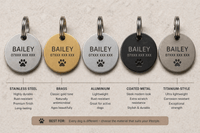
- A 38mm engraved stainless steel tag is the most common UK format that meets the legal minimum.
Who this guide is for
UK owners who are unsure whether their microchipped dog still needs a tag, new owners trying to understand what the law actually requires, and anyone who wants a plain-English summary before ordering their first tag. This covers the legal baseline, the practical reasons the tag still matters, and the shortest path to compliance.
The legal answer in one paragraph
Under the Control of Dogs Order 1992, any dog in a public place in the UK must wear a collar with the owner's name and address on it. This applies regardless of microchip status. The law covers roads, footpaths, parks, beaches, town centres, car parks accessible to the public, and private land to which the public has access. It applies whether the dog is walking, being carried, sitting in a car at a petrol station, or on a lead on your own front path if it opens onto a public road. The fine for non-compliance is up to £2,000.
For the full legal breakdown including exemptions and edge cases, see UK dog tag law explained.
Why microchipping does not replace the tag

A microchip is a small RFID transmitter implanted between the shoulder blades. It holds a unique number linked to a database entry with owner contact details. Microchipping became compulsory in England, Scotland and Wales in 2016, and in Northern Ireland in 2024.
A microchip and a tag do different jobs.
What the microchip covers
A microchip returns the dog to its owner once it is in the hands of someone with a scanner: a vet, a dog warden, or an RSPCA officer. It is invisible from the outside. It only works if the person who has the dog takes it to somewhere with a scanner and the database details are up to date.
What the tag covers
A tag identifies the dog to anyone who finds it on a path or in a park without needing a scanner. It turns a "someone has found your dog" moment into a phone call within five minutes, rather than a wait while a well-meaning finder walks the dog to a vet. In most UK lost-dog cases, the tag is what gets the dog home; the chip is a fallback for when the dog has already ended up in custody somewhere.
The two work together rather than substituting. The law reflects that reality.
Bottom line: a microchip and a tag solve different problems. UK law requires both; practical dog ownership benefits from having both.
What "in a public place" actually means
The phrase catches more situations than most owners realise.
- Parks, paths and beaches: obvious public places. Tag required.
- Car parks accessible to the public: including supermarket car parks and petrol stations. Tag required.
- Your own front path, if it opens onto a public road: classed as public access. Tag required.
- A car on a public road: including while parked at traffic lights. Tag required.
- A dog show or organised event: public event, tag required.
- A fully fenced private garden not accessible to passers-by: not public. Tag not legally required, but most owners leave it on.
- Inside your own home: not public. Tag not legally required.
In practice, most UK owners leave the tag on the collar at all times rather than trying to judge whether a given moment counts as public. That is the simplest route to compliance.
What the tag should actually say
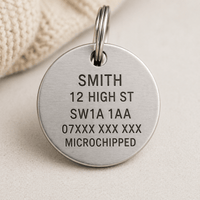
The legal minimum is the owner's name and address. In practice, the most useful layout on a 38mm tag adds a mobile number and the dog's name on the reverse.
Front of the tag
- Line 1: surname (SMITH) or initial plus surname (A. SMITH).
- Line 2: house number and postcode (14 SW1A 1AA), or a short address.
- Line 3: mobile number in full UK format (07xxx xxx xxx).
Back of the tag
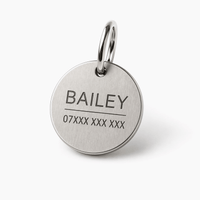
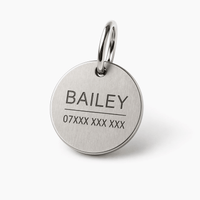
The dog's name in a larger font. This is optional legally but useful in practice; a finder who can call the dog by name gets a calmer outcome.
For the full engraving layout read, see what to put on a dog tag.
What a compliant UK tag looks like

The tag has to meet two practical tests beyond the legal text requirement.
Legibility
A tag whose text has faded past readability no longer satisfies the law. Engraved tags on stainless steel stay legible for years. Printed tags can fade inside a year on active dogs. For the detailed comparison on which method actually lasts, see engraved vs printed dog tags.
Durability
A tag that has broken away from the collar does not meet the requirement either. Split rings need to close flush; the tag itself needs to hold up to collar hardware contact. Most tag failures are split-ring failures rather than tag failures.
Accuracy
Out-of-date contact details meet the letter of the law only if they technically match the owner's current name and address. If you move or change number, the tag needs replacing. A UK studio keeps the engraving file on record, which makes a replacement identical to the original apart from the updated detail.
Exemptions to the tag requirement
The Control of Dogs Order 1992 lists a narrow set of exemptions. None of them apply to most pet dogs in the UK.
- Dogs used on official duties by the armed forces, police or HM Customs and Excise.
- Packs of hounds.
- Dogs used for sporting purposes on the specific day of the sport.
- Dogs being used for cattle or sheep.
- Dogs at the time of emergency.
Assistance dogs wearing harnesses are not automatically exempt; the tag requirement still applies on a collar if the dog also wears a collar. Working farm dogs are often exempt under the cattle or sheep clause during active work but not on general walks.
For almost every UK pet owner reading this, none of these exemptions apply. The tag is required.
What happens if a dog is found without a tag
Two things, in order.
The finder or dog warden scans the chip
If the dog ends up with a vet, dog warden, or an officer carrying a scanner, the microchip is read. The chip company then contacts the registered owner. This can take hours depending on the path the dog takes through the system.
If the chip is not scanned quickly, the dog may enter the stray-dog system
UK councils have statutory duties to hold stray dogs for seven days before rehoming. A dog without a tag that is not scanned quickly can sit in kennels for days. A tag on the collar short-circuits that whole path: the finder calls the owner, the dog is home in the afternoon, no paperwork, no kennels, no stress on the dog.
The practical value of the tag is not in the edge cases but in the common ones. Most lost-dog events are a stranger finding a loose dog on a path and wanting to return it immediately.
The common misconceptions about UK dog tags
Four myths worth clearing up.
"Microchipping replaced the tag"
It did not. Microchipping was added alongside, not instead of, the existing tag requirement. Both laws are still in force.
"The dog only needs a tag if it leaves the garden"
Not quite. Any public place counts, including the front path if it opens onto a road. Most owners leave the tag on at all times rather than try to judge edge cases.
"An engraved chip tag is enough"
A chip tag that only says "I AM CHIPPED" is not enough. The tag must carry the owner's name and address. Some owners add the microchip ID to the tag as an extra line, but it is not a replacement for the legal minimum.
"A woven name on the collar counts instead of a tag"
It can, as long as the information is on the collar itself and remains legible. In practice, embroidered collars fade faster in UK rain than engraved metal tags and cannot be updated without a new collar. Most owners find a tag easier.
A simple path to compliance for new owners
Bottom line: order a 38mm engraved stainless steel tag, engrave surname, address and mobile on the front, fit it before the first public walk, and leave it on the collar. That is the full UK compliance route in one decision.
Our engraved dog tag collection is designed around exactly this layout, hand-finished in the UK in three finishes, with free delivery on orders over £50.
What this costs over the dog's lifetime
One deep-engraved stainless steel tag in the £12-£25 range typically lasts across most of a UK dog's lifetime. The only reasons to replace are a change of phone number or address, a lost tag from a split-ring failure, or a decision to upgrade the finish. Against the cost of a fine (up to £2,000 for non-compliance) or the disruption of a lost dog in the system, the tag is the lowest-cost piece of safety kit a UK owner buys.
Cross-links for further reading
- UK dog tag law explained - the full legal breakdown of the Control of Dogs Order 1992.
- What to put on a dog tag - the layout that fits the legal minimum cleanly.
- Dog tags for puppies UK - timing around the first public walk.
- Engraved vs printed dog tags - which production method actually lasts.
The clean next step
If the answer to "do dogs need tags" is yes (and it is), the next step is ordering a tag that meets the law and holds up to UK weather. Our engraved dog tag collection sits on a 38mm deep laser-engraved stainless steel blank, carries three legible lines of UK-required owner details, and ships with free delivery on orders over £50.
How the law actually gets enforced
Enforcement of the Control of Dogs Order 1992 sits mostly with local authorities and dog wardens rather than the police directly. In practice, most UK owners never encounter enforcement because most dogs without tags are never challenged. The exceptions are worth knowing.
Dog warden inspections
Local authority dog wardens can issue fixed penalty notices for obvious non-compliance during on-site inspections. These are uncommon but do happen in parks, at dog shows and at public events.
When a dog is involved in an incident
If a dog is involved in any other incident (a bite, a traffic accident, straying onto livestock), the absence of a tag becomes an additional finding alongside the main complaint. This is the most common enforcement route in practice.
Council reclaim fees
A stray dog with no tag that is taken into kennels can accrue reclaim fees the owner must pay to retrieve the dog. These are usually £50-£100 depending on the council and the days held. They function as an indirect enforcement of the tag requirement: the tag would have avoided the pick-up.
Across all three, the message is the same: the law is more relevant in moments when something else has gone wrong, and a tag is the single cheapest piece of risk management an owner can buy.
The Scottish and Welsh dimensions
The Control of Dogs Order 1992 applies across the UK, but enforcement intensity varies. Scotland has slightly different dog-fouling and public-space legislation but the same tag requirement. Wales has similar rules to England with additional Welsh-language provisions in specific public contexts. Northern Ireland had a later start on compulsory microchipping (2024) but has had equivalent tag rules for decades.
For practical purposes, a UK owner anywhere on the mainland or in Northern Ireland is covered by the same tag rule. A tag engraved for an English owner works equally well on a walking holiday in the Cairngorms or Snowdonia.
When a dog is genuinely exempt
The exemptions listed in the Control of Dogs Order 1992 are narrow. A few practical notes on what they cover and what they do not.
Working farm dogs
A dog actively working with sheep or cattle during the working day is exempt while on that work. The exemption does not extend to the dog's time off, on the collar, or during non-working movement. In practice, most working farm dogs still wear a tag for the majority of the week.
Sporting dogs on sport days
A dog working at a shoot or field trial is exempt during the active sport. The exemption is narrow and day-specific. A gundog going to the vet with the rest of the kennel is not covered.
Packs of hounds
Foxhounds and other pack hounds at the hunt are exempt. The exemption covers the pack context, not individual hounds in public places outside the hunt.
Police, military and customs
Working dogs on active duty for these bodies are exempt by specific provision. The exemption does not extend to retired working dogs living as pets.
Assistance dogs
There is no blanket exemption for assistance dogs. A guide dog or hearing dog in a harness still needs a tag on its collar if it wears one. Most assistance dogs do wear tags in practice.
If your dog does not fall clearly into one of these narrow categories, the tag rule applies.
Other UK identification requirements that stack on the tag
Three other legal identification layers sit alongside the tag, each doing a slightly different job.
Microchip (compulsory)
Implanted from eight weeks. Database entry must be kept current. Fine of up to £500 for non-compliance.
Rabies vaccination tag (travel only)
Required for dogs travelling internationally under the Animal Health Act. Not required for UK-only dogs, though some owners wear them as a matter of habit.
Council registration tag (Northern Ireland)
Northern Ireland requires a council dog licence and an annual tag separate from the identification tag. Mainland UK has no equivalent licensing at the council level.
The ordinary UK pet-dog owner needs the chip and the ID tag. Travel and Northern Irish owners add a layer on top.
Related reading
- Dog Tags for Puppies UK: When to Fit One and What It Should Say
- Engraved vs Printed Dog Tags: Which Lasts in the UK
- Luxury Dog Tags UK: What Makes a Tag Genuinely Premium
- complete UK guide to engraved dog tags
- dog tag engraving guide
- engraved dog tags UK buyers guide
Frequently asked questions
Do UK dogs need tags if they are microchipped?
Yes. The tag and the microchip are separate legal requirements. The chip returns the dog through a scanner at a vet or warden; the tag returns the dog directly through a finder.
What does UK law require on a dog tag?
The owner's name and address, under the Control of Dogs Order 1992. A mobile number and the dog's name are not required but are recommended in practice.
What is the fine for not having a tag on a UK dog?
Up to £2,000. In practice, fines are more common when a dog has also been involved in another incident, but the liability sits with the owner in any event.
Does a tag need to be worn indoors?
No. The law applies in public places. Most owners leave the tag on the collar at all times for convenience and to avoid forgetting it on the way out.
Is a tag required on a fully fenced private garden?
If the garden is not accessible to the public, no. If it opens onto a public road or footpath, yes.
Does a tag need to be engraved, or can it be printed?
Any method is legal while the text remains readable. Engraved tags stay readable for years; printed tags often fade inside a year on active dogs, which can put the tag out of compliance over time.
Is there an exemption for assistance dogs?
There is no blanket exemption. If the dog wears a collar, the tag requirement applies on the collar. Specific working dog exemptions exist for police, military and shepherding duties.
What is the cheapest way to comply?
A single deep-engraved stainless steel tag in the £12-£25 range that lasts across most of the dog's lifetime. Cheaper printed tags usually cost more over time because of replacement frequency.