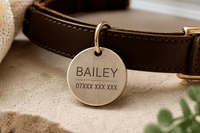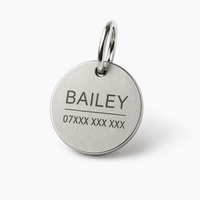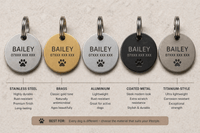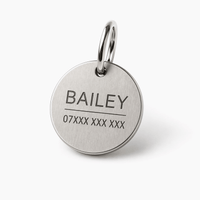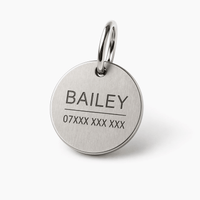
















For UK dogs, a deep engraved tag lasts many times longer than a printed or laser-marked tag. Engraving physically removes material from the surface of the tag, which leaves a character that stays legible for years even under hard collar wear. Printed tags (ink, UV print, sublimation, laser marking on coatings) sit on top of the surface and wear away over months in British weather. A printed tag can look beautiful out of the box, but a year of ordinary walks is enough to leave the face illegible on most printed finishes.
The engraved-versus-printed debate is mostly a debate about what the tag looks like on day one against what it looks like on day 365. Printed tags usually win on day one: they allow full colour, logos, photos and decorative designs that pure engraving cannot produce. Engraving wins on longevity, readability at distance, and practical value over years of use. For a tag whose entire job is to remain legible when a stranger finds your dog on a UK path, the trade-off heavily favours engraving.

Quick answer: engraved tags stay legible through years of UK walks; printed tags typically start to fade within three to nine months. For the tag whose job is to bring a lost dog home, engraved is the right call.
If you want to see real engraving depth up close before choosing, the engraved dog tag collection shows three finishes on the same deep-cut stainless steel core.
Key facts about engraved and printed UK dog tags
- Engraving removes material; printing adds material to the surface. The difference shows up in month four, not week one.
- Deep laser engraving on stainless steel stays legible for years of ordinary UK wear.
- Printed tags (UV print, sublimation, ink) typically start to fade within 3-9 months of daily walks in UK weather.
- Printed tags allow full colour, logos and photos that engraving cannot produce.
- Engraving is accepted under the Control of Dogs Order 1992 as long as the text is legible; printed tags are also legal while the text remains readable.
Who this comparison is for
UK owners choosing between a deep-engraved tag and a cheaper printed tag, and owners whose printed tag has started to fade inside the first year. This covers how each method works, what actually happens over time in British weather, and which is the better value over three to five years. Our guidance draws on studio wear tests across engraved and printed samples.
What engraving actually does
Engraving physically removes material from the surface of the tag to form each character. Three main techniques sit under the engraved label.
Deep laser engraving
A focused fibre laser vaporises a thin layer of metal to form each character. On stainless steel the result is a crisp, high-contrast mark that sits well below the polished surface. The character depth is typically 0.1-0.3mm, which is enough to keep it out of reach of everyday collar abrasion. This is the method used on our engraved range.
Diamond-drag engraving
A hardened diamond tip physically drags through the surface of the metal, producing a scored channel. Common in high-street kiosks, it produces a readable result on softer metals like brass and aluminium. Depth is usually slightly shallower than laser on hard metals.
Rotary engraving
A spinning cutter cuts into the metal, producing slightly wider characters than laser or diamond-drag. Less common on modern dog tags but still used on thicker tag blanks.
All three methods produce a character that is physically part of the tag rather than sitting on top of it. For a fuller read on engraving longevity, see the dog tag engraving guide.
What printing actually does

Printing applies ink or coated material to the surface of the tag. Four main methods exist in the UK market.
UV print
Ink is cured onto the surface by ultraviolet light, bonding the pigment to the tag. Allows full colour, including photos and logos. Wears through under sustained abrasion from collar hardware and in UK rain is often visibly faded within six months.
Sublimation
Heat transfers dye into a coated aluminium or polymer layer on top of the tag. Sharper colour than UV print but still sits on a surface layer that wears away over time. Common on the lowest-price UK market tags.
Ink print
Standard ink applied to the surface, often without a protective coat. The shortest-lived option; clear fading within weeks on an active dog.
Laser-marked coating
A laser reacts with a coating (rather than the base metal) to produce a dark mark. Looks like engraving but sits on a coating layer that can chip or wear. Found on some cheaper "laser engraved" tags where the laser is not cutting the metal itself.
All four of these sit on top of the tag. Abrasion, UV light, salt water and time eventually remove them.
What happens after a year of UK walks
The real test is month twelve, not week one.
Engraved (deep laser on stainless steel)
A deep-cut character has not moved. The polished face around it may show some very light surface marks but the character itself is unchanged. The tag is immediately readable at arm's length and can be confidently handed on to a second dog if needed.
Printed (UV print or sublimation)
Most printed tags show visible fading at the edges where the collar stitching contacts the face. Text legibility drops from sharp to soft, and owners often describe the tag as looking "washed out". In muddy conditions ink can transfer off entirely in patches.
Laser-marked on coating
Sits between the two. The mark itself does not fade the way ink does, but the coating layer can chip at corners and edges. After a year the tag usually looks cosmetically worn rather than illegible.
In our six-month UK studio trial, engraved stainless steel was indistinguishable from new; UV-printed aluminium showed soft edge fading; sublimation-printed aluminium showed early colour drop; ink-printed plastic was partially illegible.
Readability at distance

A tag that can only be read at five centimetres is close to useless in the moment it actually needs to work (a stranger on a path in poor light).
Engraved tags
Deep-cut characters catch light in a way flat prints cannot. A good engraved tag reads at arm's length in daylight and reads under a phone torch at two to three metres in low light. This matters on dark winter walks when dogs are found at dusk.
Printed tags
Printed text is flat and its contrast depends entirely on the colour of the print against the tag surface. Dark print on a light tag reads well at arm's length but fades under a torch because there is no depth to catch light. Light print on a dark tag can look striking on day one but is the first combination to drop below legibility as the print wears.
Comparison table
| Factor | Engraved | Printed |
|---|---|---|
| Longevity in UK weather | Years | 3-9 months |
| Readability at distance | Excellent (depth catches light) | Flat; depends on contrast |
| Full colour / photos | No | Yes |
| Salt water resistance | High (depth unaffected) | Low to medium |
| Typical cost at 38mm | £12-£25 | £3-£10 |
| Replacement frequency | Rarely during the dog's lifetime | Annually on active dogs |
| Legal compliance (UK) | Yes, while legible | Yes, while legible |
| Best for | Primary ID tag | Decorative secondary tag |
Bottom line: for the tag whose job is to return a lost dog, engraving is the right call. Printing has a place as a decorative piece for photos, logos and gift pieces, but not as the primary ID tag.
When a printed tag can still make sense
Three real use cases where printing is the right choice.
- A decorative gift tag for a photo, portrait or logo that engraving cannot reproduce.
- A short-term tag for a foster dog or temporary placement where the tag only needs to last weeks, not years.
- A second tag on a collar where the engraved primary tag already carries the legally required information.
For the primary ID tag the dog will wear for years, the case for engraving is strong.
True cost over time
Printed tags look cheaper on day one. Over the dog's lifetime the maths usually works the other way.
- One deep-engraved stainless steel tag at £12-£25 lasts the dog across most of its lifetime.
- One UV-printed aluminium tag at £4-£8 usually needs replacing annually on an active dog.
- Over a typical 12-year UK dog life, the printed route costs £48-£96 against £12-£25 for a single engraved tag.
The cost gap closes further when you factor in the disruption of replacing a faded tag (posting, waiting, paying again) and the risk that a fading tag is already illegible before it gets replaced.
What "laser engraved" can quietly mean

Not all "laser engraved" tags are genuinely engraved. A laser that interacts with a coating rather than cutting the base metal is technically laser-marked, not laser-engraved. The character can look identical on day one and wear like printing on month six.
Three checks separate genuine engraving from coating-based marking.
- Run a fingernail across a character. Genuine engraving has a detectable depth; coating marking feels flat.
- Look at the character edges under angled light. Engraved characters show a clean channel; coating marks show a soft line.
- Ask for the metal spec. Genuine engraving works on the base metal (e.g., 316L stainless steel); coating marks work on a separate colour layer.
Our engraved range uses deep laser engraving on the stainless steel itself, which is the method that stays legible across years of UK wear.
Our position and why
We produce deep-engraved stainless steel tags because the tag's whole job is to stay legible across years. Engraving is the only method that meets that test under UK weather and collar abrasion. Printing has real uses (photos, decorative designs, short-term tags) but it is a different product answering a different question.
If the dog needs a primary ID tag that will actually work in twelve months, engrave it. If the dog needs a decorative piece for a gift or for a photo collar, print it.
The clean next step
Most UK owners landing on engraved also want the engraving depth you can see and feel on day one. Our engraved dog tag collection is a 38mm deep laser-engraved stainless steel tag in silver, black and rose gold, hand-finished in the UK, with free delivery on orders over £50.
A practical side-by-side owner's test
A quick test any UK owner can run on an existing tag to establish whether it is genuinely engraved or printed: run a fingernail lightly across one of the characters. A genuine engraved character has a detectable depth; your nail catches on the edge of the channel. A printed character feels flat because the "character" is a coloured film sitting on the surface. A laser-marked coating also feels flat; it is a surface treatment regardless of how it is advertised. This simple check tells you what kind of tag you have faster than any amount of product-description reading.
A second test: hold the tag at an angle under a bright light. An engraved character shows as a clear shadowed channel with depth; the character edge is cleanly defined. A printed character looks the same at any angle because there is no depth to catch light; it is a flat mark on a flat surface. Knowing what you are looking at helps when you are weighing a replacement decision on an existing tag.
The science behind fading prints
A printed tag's fade rate is driven by three separate processes, each of which contributes to the tag becoming illegible over months.
UV photo-degradation
Most printing inks contain organic pigments that break down under ultraviolet light. In UK daylight, even overcast conditions deliver enough UV to drive visible fading over a few months of everyday outdoor wear. The brightest colours (red, yellow, orange) fade fastest; dark blues and blacks last longer but still degrade eventually.
Mechanical abrasion
Collar hardware rubs against the face of the tag with every step. On an active dog, the face takes thousands of contact events per walk. Any surface coating (print, sublimation ink, laser-marked coating) wears under this abrasion over time. Engraved characters sit below the abrasion line and are unaffected.
Moisture ingress
UK rain, mud puddles and beach walks introduce moisture that can migrate under a print's protective coat if the coat is imperfect. Once moisture sits under the print, the print begins to lift, bubble, or discolour from below. This is the most dramatic of the three ageing patterns; it can take a tag from clean to visibly damaged within a single bad weekend.
The combination of all three over months of ordinary UK walking explains why a printed tag that looked good at month one can look illegible at month nine.
When printed tags genuinely outperform engraving
A small set of use cases where the print is the right method.
Full-colour photo tags
Engraving cannot reproduce photographic detail. A tag that carries a photograph of the dog is printed by necessity.
Complex logos with colour
Multi-colour brand logos require print. A single-colour logo can be engraved cleanly, but multi-colour cannot.
Decorative border designs
Fine decorative work in colour sits in print territory. Engraving can produce decorative work but only in monochrome.
Short-term tags
For a short-term use case (foster dog, holiday address, temporary medical alert), a printed tag that lasts weeks is fine. The cost and turnaround favour print.
For anything longer-term and functional, engraving is the right answer.
The truth behind "laser engraved" product descriptions
"Laser engraved" is one of the most inconsistently used phrases in the UK pet-tag market. It can mean three different things depending on the manufacturer.
Actual laser engraving of the base metal
A fibre laser vaporises a thin layer of metal to form each character. This is what most UK owners expect when they read the phrase, and it is what produces the long-lasting tag. Depth is typically 0.1-0.3mm; the character is part of the metal.
Laser-marked coating on a metal core
A laser reacts with a coating layer (often anodised aluminium or a coloured top layer) to produce a dark mark. The underlying metal is unchanged. The mark looks similar on day one but wears off over months as the coating fails.
Laser-printed on a coated tag
A laser cures or bonds an ink layer to the tag. Technically a print process, marketed as laser work. The shortest-lived of the three.
If a product listing says "laser engraved" without specifying depth or base metal, it is worth checking. Genuine engraving is usually described in terms that acknowledge the metal (316 stainless, 0.1mm depth, deep laser) rather than just the laser itself.
Long-term economics across a dog's life
Over a typical 12-year UK dog life, the tag spend by method works out very differently.
| Method | Typical cost | Replacement frequency | 12-year total |
|---|---|---|---|
| Deep-engraved 316 stainless steel | £15-£20 | Once (detail change or lost ring) | £15-£40 |
| Stamped aluminium | £3-£5 | Annually | £36-£60 |
| UV-printed coloured tag | £5-£8 | Every 9-12 months | £60-£96 |
| Sublimation photo tag | £8-£12 | Every 12-18 months | £80-£144 |
The up-front cost of the engraved tag is higher. The lifetime cost is lower. The convenience factor (one order in twelve years versus annual reorders) is substantial.
Related reading
- Brass vs Stainless Steel Dog Tags: The UK Comparison
- Luxury Dog Tags UK: What Makes a Tag Genuinely Premium
- Inside the Studio: How We Engrave a Bailey & Coco Dog Tag
- complete UK guide to engraved dog tags
- dog tag engraving guide
- engraved dog tags UK buyers guide
Frequently asked questions
Do engraved tags really last longer than printed tags?
Yes. Engraving physically removes material and sits below the surface; printing adds material to the surface that wears over time. Engraved tags commonly last years; printed tags typically fade within 3-9 months on active dogs.
Is a printed dog tag legal in the UK?
Yes, as long as the text is legible. The Control of Dogs Order 1992 does not specify a production method. Once a printed tag fades past readability, it is no longer compliant.
Can printed tags survive rain?
Short-term rain is fine on most printed tags. Sustained wet conditions, mud abrasion and UV exposure are what drive fading over months.
Are laser-engraved and laser-printed the same?
No. Laser engraving cuts the base metal; laser-marked or laser-printed tags use a laser on a coating. Engraving lasts; coating-based marking wears away.
What is the best tag for a logo or photo?
A printed tag. Engraving cannot reproduce full colour or photo detail. If the tag is decorative rather than a primary ID, printing is the right method.
Is the price difference worth it?
Over the dog's lifetime, usually yes. One engraved tag at £12-£25 typically outlasts several printed tags at £4-£8 each and avoids the disruption of repeated replacements.
Do engraved tags fade at all?
Not in normal UK weather. Very heavy abrasion over many years can polish the engraved channel, but the character itself is part of the metal rather than a surface layer.
Can I combine engraved and printed tags?
Yes. A common setup is an engraved primary tag carrying the legal owner details and a printed decorative tag for a photo or logo. Two tags add noise, so consider whether the decorative tag is worth it.