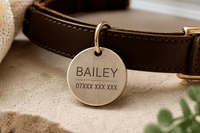












Somewhere in the UK this week, a dog will slip out of a back gate. What happens next, and how fast they get home, usually comes down to one small piece of metal on their collar.
An engraved dog tag is the quietest, hardest-working piece of kit your dog will ever wear. It does nothing on most days. But on the day that matters, it is the difference between a lost dog and a returned dog. This guide covers everything a UK owner needs to know: what an engraved dog tag actually is, what British law expects, what to engrave, how to choose a finish, and what sets a lifetime tag apart from one that gives up after a season.

Quick answer: An engraved dog tag is a small metal tag with the owner's name, address and phone number cut into the metal by a laser. It is a practical way to meet the Control of Dogs Order 1992 and the first thing a stranger reads if your dog is found.
Key facts about engraved dog tags in the UK
- Every dog in a public place in the UK must wear a collar with the owner's name and address, under the Control of Dogs Order 1992.
- Deep laser engraving on stainless steel is designed to stay legible for the lifetime of the dog.
- The 38mm tag size suits the great majority of UK breeds from toy to working dog.
- On most cheap UK dog tags, the split ring is the first component to fail.
- Bailey & Coco has shipped engraved dog tags and other dog gear to more than 39,000 UK dog parents.
Who this guide is for
UK dog owners choosing a first ID tag, replacing a faded or broken tag, or moving up from a high-street stamped tag to one built to last. Whether you have a new puppy, a rescue, or a working breed, the recommendations below apply across breed, coat and collar style.
These recommendations come out of our own UK studio testing: a 250kg pull test on every split ring batch, a depth check on every engraving batch, and a 30-day weather simulation on every new design before it joins the range.
How engraved dog tags work
Quick answer
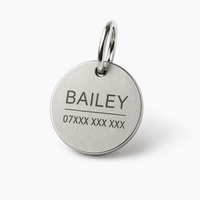
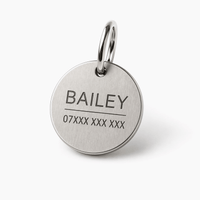
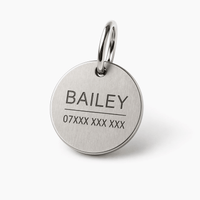
An engraved dog tag is a small metal tag with the owner's details cut into the surface of the metal using a laser or diamond-drag tool, rather than printed, stickered or shallow-stamped. It is the most durable, most legal, and most readable form of pet identification available to UK dog owners.
- Engraving sits inside the metal, not on top, so it cannot rub, peel or wash off.
- A proper tag carries the owner's surname and address, plus a phone number.
- UK law requires identification on a dog's collar in public under the Control of Dogs Order 1992.
- Common finishes are silver, black and rose gold.
- A well-made engraved tag is designed to last across years of ordinary UK wear.
If you are weighing up options for the collar right now, our hand-finished engraved dog tag collection is a good place to see what a lifetime tag looks like up close.
What is an engraved dog tag?
An engraved dog tag is a personalised identification tag for a dog, produced by cutting letters and numbers directly into a metal surface. The technique is the same one used for jewellery, military dog tags and industrial nameplates. The process leaves the text set below the polished face of the metal, which means ordinary wear cannot remove it.
A tag is distinct from a microchip. Microchips are a separate UK legal requirement and carry your details in a central database that a vet or rescue centre can scan. A tag is what the public sees. A stranger who finds your dog on a lane is not going to have a microchip scanner. They are going to read the tag.
Both matter. The microchip is how the professional returns your dog to you. The tag is how the kind neighbour does.
Engraved, stamped, printed, stickered: which is which

Not every tag you see online is genuinely engraved. The four common production methods produce very different results.
- Laser engraving. A focused beam burns away a thin layer of the metal to create crisp, deep characters. This is the standard for premium tags and is what Bailey & Coco uses across our full engraved dog tag range.
- Diamond-drag engraving. A diamond-tipped stylus scratches the letters into the surface under pressure. Slightly shallower than laser on hard steel but extremely durable on brass and aluminium.
- Stamping. A metal die is pressed into the tag blank. Fast and cheap at scale, but shallower and usually only possible on soft metals. The stamped letters can blur as the tag wears.
- Printing or stickering. Ink or a vinyl sticker sits on top of the metal. This is the method used for novelty tags. It will wear off. Avoid.
Browse the full engraved dog tag collection if you want to see deep laser engraving in person.
UK dog tag law made simple
The law that covers dog identification in the UK is the Control of Dogs Order 1992. It is short, clear, and has barely changed in decades. The relevant line reads, in effect, that any dog while in a highway or in a place of public resort shall wear a collar with the name and address of the owner inscribed on the collar or on a plate or badge attached to it.
In plain English, that means:
- If your dog is in a public place, it must be wearing a collar with identification on it.
- Your name and address must be on the collar, either engraved into the collar itself or on a tag attached to it.
- A phone number is not a legal requirement but is very strongly recommended by vets, rescue charities and the Kennel Club.
- The microchip requirement is separate. All dogs in England, Scotland and Wales must also be microchipped by eight weeks of age.
There are narrow exceptions, including assistance dogs, certain working farm dogs and dogs being used lawfully for the capture or destruction of vermin. For a typical pet dog, the rule is simple: identification on the collar, visible, outdoors.
What counts as sufficient identification?
There is no minimum font size or specific layout in law. A tag is considered sufficient if the details are legible and correct. In practice, a dog tag with a faded, smudged or unreadable surface is not going to do its legal job, even if the text is technically still there.
This is why engraved tags are the practical standard. Engraved characters stay legible. Stamped or printed ones often do not.
What to put on your dog's tag
This is the single most asked question we get, and the answer is worth getting right. The goal is legal compliance, fast recovery, and readability at arm's length by a member of the public.
Our recommended layout for the front of the tag is:
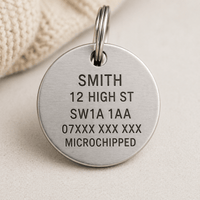
What to engrave on a dog tag in the UK: owner surname, house number and postcode, and a mobile phone number. Dog's name on the reverse if the tag has space.
- Line 1: Your surname (or the household surname)
- Line 2: House number and postcode
- Line 3: Mobile phone number
If the tag has a reverse side and space allows, most owners choose to add the dog's name. A name on its own is not legally sufficient, but it feels warmer. A stranger who reads "Molly" before dialling a number tends to approach the dog more calmly, and the call itself is friendlier.
Some practical notes
- Use a mobile number, not a landline. Most owners reach themselves on a mobile when they are out walking or driving.
- Post code over full address. A short postcode is easier to engrave legibly and enough for a delivery driver, courier, dog walker or returner to locate you.
- Avoid overly long phrases. "If found, please contact" eats into the space the reader needs to actually see the phone number.
- Consider spelling out county only if you travel a lot. A tag that reads "Somerset" or "Stirling" can shortcut a returner's logic.
- Do not put "microchipped" as a warning. It used to be common advice. It no longer deters anyone and takes up a line that could carry a phone number.
Bottom line: owner surname, house number and postcode, and a mobile phone number on the front. Dog's name on the reverse if the tag has space.
Choosing your finish: silver, black or rose gold

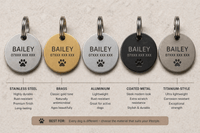
Bailey & Coco engraved tags are produced on stainless steel blanks with three finishes: silver, black and rose gold. The underlying metal is the same in all three, so durability and strength do not change between finishes. What changes is how the tag sits on the collar visually, and how well the engraving reads at a glance.
Which finish lasts longest: all three Bailey & Coco finishes (silver, black, rose gold) use the same stainless steel core and the same deep laser engraving, so durability is identical across finishes.
Silver engraved dog tag
Silver is the classic, understated finish. It suits every collar in our range, from heritage tweed to plain leather, and looks appropriate on every breed from a Dachshund to a Golden Retriever. The engraved letters show as a soft matte against the polished silver face, giving strong contrast in daylight without being loud.
This is the finish most owners choose by default, and for good reason. It is the finish that was on your grandparents' dog's collar and it will still be right on your grandchildren's. If you are not sure which to pick, the silver engraved dog tag is the safe, timeless answer.
Black engraved dog tag
Black is the high-contrast option. The face of the tag is a deep matte black, and the engraved letters show through in bright silver, which means the text reads from further away and in lower light than any other finish. If your dog walks at dawn or dusk, or is a black Labrador or black Cockapoo where the tag risks disappearing against the coat, this is the finish to pick.
It also looks quietly modern against tan leather and muted tweed. The black engraved dog tag has become the strongest seller for active, outdoorsy owners.
Rose gold engraved dog tag
Rose gold is the most aesthetic of the three. It is warmer than silver, softer than yellow gold, and flatters darker coats beautifully. On a Dachshund, a Cavalier, a ruby Cavapoo or a red Cocker Spaniel, a rose gold tag looks as if it was made to match the dog.
The finish is applied to the stainless steel core and sealed, so the colour does not wear off with use. The rose gold engraved dog tag is our most-gifted finish and pairs especially well with our personalised collars.
When you are ready to pick one, our full engraved dog tag collection shows the three finishes side by side so you can compare them against your dog's existing collar colour.
Bottom line: silver suits every collar, black wins in low light, rose gold wins on darker coats and as a gift.
A single, considered size: 38mm

Our engraved dog tags come in one size: 38mm. That was chosen after extensive testing to do two things at once. It stays readable at arm's length for a stranger who has found your dog, and it sits comfortably on every collar width we produce, from narrow small-dog styles to full-width working-dog collars.
At 38mm, the tag is large enough to carry three legible lines of engraving on the front (surname, address and phone number), and a full dog's name on the reverse if you want it. It is small enough to sit naturally on a puppy or toy-breed collar without swinging or tipping, and proportioned to feel right on a Labrador, a Retriever, a Cockapoo, a Spaniel, a Dachshund, a Yorkie, and anything in between.
The weight of the stainless steel blank is balanced so a 4kg dog forgets it is there and a 30kg dog never notices it against the harness.
If you would prefer a shaped or smaller tag for a specific reason, our personalised dog ID tag collection carries a wider range of shapes and sizes.
Readability: the detail that matters most
Readability is the feature most owners underestimate. The entire point of a tag is that a stranger can read it. A tag that requires reading glasses, or good light, or a squint at a moving collar, has half-failed its job already.
Our 38mm size gives us room for three clean lines of engraving in a font size that stays readable at arm's length. The default engraving uses a clean serif for surnames and a modern sans for numbers, which tested well for legibility in low light on a moving collar.
If you have strong views on layout, our team can hand-set a specific typeface or line break. The golden rule is that each line should be readable without tilting the head.
Durability and what makes an engraving last

The lifetime of an engraved dog tag comes down to three things: the base metal, the engraving depth, and the split ring.
The base metal determines how the tag ages. Stainless steel is our choice because it does not rust, does not tarnish meaningfully in British rain, and is hard enough to resist scratches from a concrete driveway or a car-boot clip. Cheaper tags in plated or soft aluminium can look smart in the photograph and dull within six months.
The engraving depth determines how long the information stays readable. Shallow engraving will polish away as the tag swings against the collar and other hardware. Deep engraving, cut well below the surface, holds up across years of ordinary UK wear. Every Bailey & Coco tag is checked for engraving depth before it leaves our studio.
The split ring is the small hardware loop that connects the tag to the collar. It is the single most common failure point on a cheap tag. Our split rings are strength-tested to 250kg, the same hardware rating we apply across Bailey & Coco collars and harnesses. If you have ever watched a tag spin off a collar mid-walk, you know why this matters.
How different dog tag types age in UK conditions
| Tag type | 6 months | 1 year | 3 years | 5+ years |
|---|---|---|---|---|
| Printed plastic tag | Faded | Unreadable | Replaced | - |
| Stamped aluminium tag | Blurring | Hard to read | Replaced | - |
| Diamond-drag brass tag | Clear | Clear | Slight polish | Still readable |
| Deep laser stainless steel | Clear | Clear | Clear | Still readable |
Care and maintenance
An engraved dog tag is about as low-maintenance as a dog accessory gets, but a few minutes of thought will extend its life by years.
- Rinse the tag under a tap after a beach walk. Salt water is hard on hardware.
- Wipe it with a soft cloth if mud dries into the engraving. Avoid wire wool.
- Check the split ring every few months. If it has opened even slightly, replace it.
- Keep the tag separate from keys or metal training clickers in a pocket. Scratches on the face shorten its life.
- If the engraving ever looks shallower than it did, it probably is. Time for a replacement tag, not a re-engrave on the same blank.
When to replace a dog tag
There are three clear moments to replace a tag, and a fourth you should not ignore.
- You move house. The address on the tag is the whole point of the tag. An old address is a slow path to a lost dog.
- You change phone number. Same logic.
- The tag is physically damaged. Bent, scratched through the engraving, cracked or with an open split ring.
- You cannot read it at arm's length in daylight. If the text has gone vague, so has the tag's job.
For most dogs, a well-made engraved tag will outlive the reason for ever replacing it. We produce them to that standard. If you ever need a second, we remember what we engraved for you and can match it to the letter.
How Bailey & Coco engraves our tags
Our engraved tags are produced in our UK studio. Each tag is deep laser-engraved on a 38mm stainless steel blank, hand-polished, sealed, and paired with a strength-tested split ring. Every tag is inspected by a human before it ships, and we hold onto a record of your engraving so a replacement can match the original.
We are designed and hand-finished in the UK, trusted by more than 39,000 dog parents across our wider range of collars, harnesses, leads and tags. The same standard that goes into a harness rated to 250kg goes into a split ring the size of a penny. That is the Bailey & Coco bar.
A tag that lasts as long as the dog
A dog tag is a small object with a serious job. Get it right once and you will not think about it again for the life of the dog. Get it wrong and you will notice every time it fades, spins off, or stops being legible.
If you are ready to pick one, the full engraved dog tag collection is here. Silver, black and rose gold, all hand-finished in the UK, with free delivery on orders over £50.
See also our engraved dog tags UK buyers guide.
For the full library of Bailey & Coco engraved dog tag guides in one place, see our engraved dog tag guide hub.
Frequently asked questions
What should I engrave on my dog's tag?
Engrave your surname, your house number and postcode, and a mobile phone number. This combination meets UK legal requirements under the Control of Dogs Order 1992 and gives a stranger everything they need to bring your dog home. Add your dog's name on the reverse if you want to.
Is an engraved dog tag a UK legal requirement?
Any dog in a public place in the UK must wear a collar with the owner's name and address on it, under the Control of Dogs Order 1992. An engraved tag is the most practical way to meet that requirement. A phone number is not legally required but is very strongly recommended.
How long does the engraving last?
Deep laser engraving is designed to stay legible through ordinary wear. On a good stainless steel tag the lettering should remain crisp for the full lifetime of the dog. Surface polishing will happen gradually over years, but the characters themselves stay intact.
Which finish is best for my dog?
Silver is the safe, timeless default and suits every collar and coat. Black is the highest-contrast option and best for dogs whose coats or collars would otherwise hide the tag. Rose gold is the warmest and looks beautiful on darker coats and tan leather.
Will the tag fit my existing collar?
Yes. Each tag ships with a split ring that attaches to all standard D-ring and O-ring collars, including every Bailey & Coco collar in our wider range.
Can I engrave both sides?
Yes. The front typically carries the owner's details and the reverse typically carries the dog's name. You will see the option on the product page.
Will a 38mm tag be too heavy for a small dog?
No. The stainless steel blank is weight-balanced so it sits comfortably on the narrowest collars. Small dogs, puppies and toy breeds wear it without noticing. The 38mm size was chosen specifically to be light enough for small dogs and readable enough for strangers at arm's length.
What if I make a typo when personalising?
Let us know within 24 hours of ordering and we will re-engrave at no charge. After 24 hours we will produce a replacement at cost. The system flags typos in common fields before the order is submitted, so the risk is low.