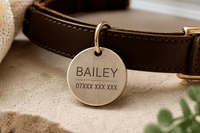












Brass dog tags are a traditional UK choice that still has a place on the right collar. They engrave cleanly, develop a warm patina over time, and pair beautifully with tan leather and heritage tweed. They also tarnish more visibly than stainless steel in British rain, and the solid-brass weight can sit heavy on narrow puppy and small-dog collars. For most UK owners, the question is not whether brass works. It is whether it suits the specific collar and dog in front of you.
Brass has been the default dog tag material for decades. Walk into a traditional saddlery or a town centre engraving kiosk and the sample tag is almost always brass. Walk around a UK park today and you see fewer of them than you used to. The shift has not been driven by fashion so much as by the real-world performance of stainless steel in British weather. This guide covers what brass dog tags do genuinely well, where they fall short, and how to decide whether a brass tag or a stainless steel one suits your dog.

Quick answer: brass dog tags are a classic, warm-toned option that suits traditional leather and tweed collars but tarnishes more visibly than stainless steel and weighs more per millimetre. For most UK owners today, stainless steel is the lower-maintenance long-term choice.
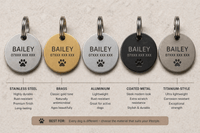
If you are weighing materials side by side, our engraved dog tag collection shows three stainless steel finishes (silver, black, rose gold) that give the look of brass without the patina upkeep.
Key facts about brass dog tags in the UK
- Brass has been the UK's traditional dog tag material for more than a century.
- Brass tags weigh around 1.5 to 2 times more per millimetre than equivalent stainless steel tags.
- Brass develops a natural patina and visible tarnish in British rain within months, unless sealed.
- Deep diamond-drag or laser engraving holds up well on brass, similar to stainless steel.
- Sealed stainless steel is the lower-maintenance modern alternative and the material we use across our engraved range.
Who this guide is for
UK owners weighing a brass dog tag against stainless steel, or choosing a material for the first time. Whether you are drawn to the traditional warm tone or wondering whether a brass tag will stay looking sharp after a year of muddy walks, the detail below covers the real trade-off. Our guidance draws on testing both materials in our UK studio across the same 30-day UK weather simulation.
What brass dog tags genuinely do well
Brass has practical strengths that have kept it on collars for generations. Three stand out.
The warm tone pairs beautifully with traditional collars
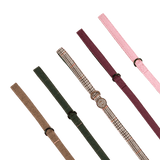
A brass tag against tan leather, Highland tweed, or British heritage plaid looks like it belongs. The warm yellow undertone complements brown, russet and earthy tones in a way cooler silver cannot match. On a golden retriever, a tan spaniel or a traditional working dog with a leather collar, brass sits visually correctly.
Deep engraving holds up on brass
Brass is a softer alloy than stainless steel, which makes deep diamond-drag engraving slightly easier to produce. The engraved channel stays crisp and readable for years on a well-made brass tag, especially when combined with a polished surface finish. Laser engraving also works on brass, though the visual effect is slightly different because brass reflects light differently to stainless steel.
Develops character with age
Brass takes on a mellow patina as it ages. Unsealed brass darkens, tones down, and develops a warm antique look that many owners genuinely prefer. On the right collar this reads as character rather than wear. Some owners polish it back; others leave it to age naturally with the dog.
Bottom line: brass has real aesthetic and engraving strengths that have kept it popular for good reason on the right collars.
Where brass dog tags fall short for modern UK owners

Three practical issues show up again and again on brass tags after a year of normal UK walks.
Tarnish in British rain
Brass reacts with moisture and air. In the UK's damp climate, unsealed brass develops visible tarnish within a few months. Some owners like the look; others find the tag goes from bright and clear to dull and dark in a way that feels like neglect. Sealed brass slows this down but does not stop it entirely, especially where the sealant wears thin at the edges.
Weight on narrow collars
A 38mm brass tag weighs noticeably more than a 38mm stainless steel tag of the same thickness. On narrow puppy collars (10-15mm wide) and small-breed collars, that extra weight swings more against the collar hardware on every step. Over time this accelerates wear on the split ring and D-ring.
Allergic reactions in sensitive dogs
Brass is an alloy of copper and zinc. A small minority of dogs are sensitive to prolonged copper contact and can develop mild skin irritation where the tag rests against the neck. Stainless steel contains no copper and eliminates this concern entirely.
For readers weighing brass against our preferred base metal, see the head-to-head brass vs stainless steel dog tag comparison.
Brass vs stainless steel at a glance
| Factor | Brass | Stainless steel |
|---|---|---|
| Warm tone out of the box | Yes | Rose gold only |
| Tarnish in UK rain | Visible within months | Minimal |
| Weight (per mm) | Heavier | Lighter |
| Copper allergy risk | Present in sensitive dogs | None |
| Engraving depth | Good with diamond-drag or laser | Excellent with laser |
| Maintenance | Occasional polishing if desired | Wipe clean |
| Typical UK retail price | £8-£18 | £12-£25 |
How Bailey & Coco approaches material choice

We tested brass and stainless steel blanks side by side in our UK studio across a 30-day weather simulation and a six-month real-world trial. Stainless steel came out ahead on three of the four criteria that matter most to UK owners: tarnish resistance, weight-to-strength ratio, and scratch resistance on everyday collar hardware. Brass won on warm-tone aesthetics and traditional feel.
Our engraved range sits on a 38mm stainless steel blank, sealed against tarnish, with three finishes to cover the aesthetic range:
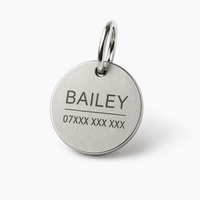
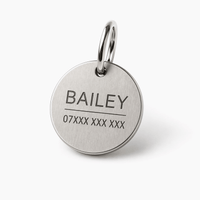
- The silver engraved dog tag - classic, neutral, and the closest stainless alternative to traditional polished brass.
- The black engraved dog tag - modern, high-contrast, best for low-light walkers.
- The rose gold engraved dog tag - warmest finish in the range, with the same patina-free durability as silver.
If the warm tone of brass is what draws you, rose gold on stainless steel delivers a similar visual effect without the tarnish maintenance.
When a brass dog tag still makes sense
Four situations where a brass tag can be the right call.
- You already have a traditional tan leather or heritage tweed collar and want a matching material look.
- You prefer the aged patina and plan to leave the tag unpolished to develop character.
- You are buying a second or memorial tag where the weathered look suits the occasion.
- You own a large-breed working dog where the extra brass weight is a non-issue and the tradition fits.
Bottom line: brass earns its place on traditional collars and working-dog setups. For most everyday UK owners choosing a tag for long-term readability and minimal upkeep, stainless steel is the easier pick.
Caring for a brass dog tag

If you do choose brass, a few simple habits keep it looking at its best.
- Wipe dry after wet walks to slow tarnish.
- Polish with a proper brass polish every three to six months if you prefer the bright look, or leave it to age naturally.
- Avoid cheap wipes and wire wool, which can scratch the face and thin the engraving over time.
- Rinse off salt water promptly after beach walks.
A brass tag that is cared for can look excellent for many years. A brass tag left to its own devices in a wet UK winter usually looks tired inside twelve months.
UK legal context for any dog tag material
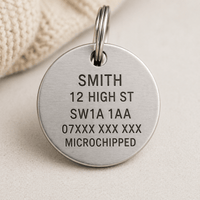
The Control of Dogs Order 1992 requires any dog in a public place in the UK to wear a collar with the owner's name and address on it. Brass, stainless steel, aluminium and silicone tags can all meet this requirement as long as the information is legible. For the detail of what to engrave on the front and back, see our guide to what to put on a dog tag, and for the full legal breakdown the UK dog tag law explained guide covers the Control of Dogs Order 1992 in plain English.
The modern brass alternative
Most UK owners choosing a new tag today want the classic look without the maintenance. Our rose gold engraved finish on stainless steel gives the warm tone of brass, engraves as cleanly as polished metal, and does not tarnish in British rain. Shop the full engraved dog tag collection, hand-finished in the UK in silver, black and rose gold, with free delivery on orders over £50.
How brass compares in the UK pet tag market today
Brass sits in a specific niche of the modern UK tag market: traditional engraving kiosks on market-town high streets, saddleries attached to country equestrian suppliers, and a handful of online specialists that lean into heritage branding. Supermarkets and large pet chains rarely stock brass tags anymore; their shelves are dominated by stamped aluminium and printed plastic at one end and premium stainless steel at the other. If you want a brass tag today, you usually have to seek it out.
That niche position is both a feature and a limitation. Brass tags from a traditional UK engraver come with the craft feel that goes with the material; the diamond-drag engraving, the mellow finish and the feel of the tag in the hand all carry the history the material brings. But the niche position also means price and availability vary more than for stainless steel. Quality of production across the UK brass market is wider-ranging than across the stainless market, where production has largely standardised around fibre laser engraving.
The traditional brass dog tag in UK history
Brass has been part of the UK dog collar for longer than most of the breeds we think of as British. The original working-dog brass plates of the eighteenth century were engraved with estate names and game-dog duties rather than owner contact details; the modern domestic-pet tag is a direct descendant, shrunk down and refocused on a phone number rather than a shooting estate. The warm tone, the weight, and the diamond-drag engraving that holds up on the softer metal all trace back to that tradition. Many of the traditional saddlers and kiosk engravers that still sell brass tags today use the same basic stamping and engraving techniques their Edwardian predecessors used.
That history is part of why brass still carries the feel it does on a traditional collar. A brass tag on tan bridle leather, against a working gundog or a farm dog, fits the visual story of a particular kind of British dog ownership. If that is the dog you are fitting a tag for, brass has the strongest aesthetic argument of any material on the market. The trade-off sits almost entirely in the practical maintenance of that warm tone through a UK winter.
How brass ages in British conditions
A new brass tag arrives polished bright and catches the light. After the first three to four weeks of daily walking, most unsealed brass tags start to show their first dulling across the face. The corners of the engraved channel darken slightly as oxidation begins in the deepest cut points. By three months, the face has visibly mellowed from bright yellow into a warmer old-gold tone. By six months in daily UK weather, most owners describe the tag as having a "lived-in" look. This is the stage where some owners start to reach for polish and others leave it and enjoy the character.
The rate of tarnish is not the same across the UK. Tags on dogs walking coastal paths in Cornwall, Wales or the North East tarnish faster because of the salt in the air and water spray during the winter. Tags on dogs walking inland city and suburban routes tarnish more slowly but still dull visibly within months. Moor and hill dogs sit somewhere in the middle; the cold slows the reaction, but the consistent damp sustains it.
Polishing routine for brass owners
If you plan to keep a brass tag bright, a quarterly routine keeps most tags looking fresh across a decade. Remove the tag from the collar, wash in warm soapy water, dry fully, then apply a small amount of a proper brass polish with a clean microfibre cloth in circular motions. Wipe off the residue, buff to a shine, and refit. The whole job takes under ten minutes per tag and leaves the surface looking close to new. Avoid household wipes and acidic cleaners; they strip the top layer of brass without protecting it, so the next round of tarnish arrives faster than it would have naturally.
What we tested in the studio
When we were choosing our own engraved tag material, we ran both brass and 316-grade stainless steel through a 30-day UK weather simulation: repeated salt-water immersion, freeze-thaw cycles, sustained high humidity, and UV exposure. Four measurements tracked the visible difference at day one, day fifteen, and day thirty.
At day thirty, the stainless steel tags looked the same as the starting photograph to within a visible margin we would struggle to explain to a customer. The brass tags showed a visible colour shift across the face, the early stage of patina forming in the engraved channels, and some darkening at the edges where the split ring had contacted the surface repeatedly. Neither material failed, but the difference was clearly visible side by side. The decision to build our range on sealed 316 stainless came out of that test, not out of any aesthetic preference for one material over the other.
When a customer comes back to brass
A handful of customers each year ask whether we will produce a brass version of our range. The answer has always been no, but for a specific reason: we would not be able to maintain the year-three consistency we aim for on every tag without either sealing the brass heavily (which changes the finish) or accepting that the tag will look different at month twelve than it did on day one. For a tag whose job is to stay legible across years of ordinary UK wear, the modern answer is usually the better fit. For owners who actively want the aged look and understand the maintenance, a traditional UK engraver making brass tags by hand is the right place to buy from.
Related reading
- Brass vs Stainless Steel Dog Tags: The UK Comparison
- Luxury Dog Tags UK: What Makes a Tag Genuinely Premium
- Engraved vs Printed Dog Tags: Which Lasts in the UK
- complete UK guide to engraved dog tags
- dog tag engraving guide
- engraved dog tags UK buyers guide
Frequently asked questions
Are brass dog tags still worth buying in the UK?
Yes, on the right collar and for owners who genuinely prefer the traditional look and the aged patina. For most UK owners choosing a tag today for minimal upkeep, a sealed stainless steel tag is the lower-maintenance choice.
Do brass dog tags tarnish?
Yes. Brass reacts with moisture and air. In UK rain an unsealed brass tag shows visible tarnish within a few months. Sealed brass tarnishes more slowly but is not fully tarnish-proof over several years of daily wear.
Are brass dog tags heavier than stainless steel?
Yes, noticeably so at equal thickness. A 38mm brass tag can weigh 50 to 100 per cent more than a 38mm stainless steel tag of the same dimensions, which can feel unbalanced on narrow puppy or small-breed collars.
Can brass cause allergies in dogs?
A small minority of dogs are sensitive to copper, which is a main component of brass. If you notice hair loss or redness on the neck under a brass tag, switch to stainless steel and the irritation usually resolves.
How do I clean a brass dog tag?
Wipe with a soft cloth after walks. Use a proper brass polish every few months if you want to keep it bright, or leave it to develop a natural patina. Avoid wire wool, scouring pads and harsh chemicals, which thin the metal and dull the engraving.
What is the closest stainless steel alternative to brass?
Rose gold on stainless steel gives a similar warm tone to polished brass with minimal maintenance. The underlying metal does not tarnish in UK rain and the finish is sealed against wear.
Is a brass dog tag legal in the UK?
Any tag material is legal under the Control of Dogs Order 1992 as long as the owner's name and address are legible on the tag. Brass, stainless steel and other durable materials all qualify.
What about hypoallergenic brass?
Some suppliers describe certain brass alloys as low-copper or hypoallergenic. In practice, the copper content in standard UK brass tags is enough to cause reactions in a small number of sensitive dogs. If allergy is a concern, stainless steel is the safer default.