























UK dog owners need both a microchip and a dog tag by law, and each does a different job. The microchip (required under the Microchipping of Dogs Regulations 2015) is a small implant that stores your details on a central database, readable only by a vet or rescue centre with a scanner. The dog tag (required under the Control of Dogs Order 1992) is the collar-mounted disc a member of the public reads if they find your dog. One is for professionals; one is for neighbours. Both matter, and they are not alternatives.
Microchip vs dog tag UK: both are legal requirements. The chip is for professionals with scanners; the tag is for the public finder of your dog.
A surprising number of UK owners assume that because their dog is microchipped, a collar tag is optional. It is not, legally or practically. The microchip and the tag solve different parts of the same problem: getting a lost dog home. This guide walks through what each one does, how they work together, and why every UK dog needs both on every walk.

Quick answer: Microchip vs dog tag in the UK: both are legal requirements and they solve different parts of the same problem. The microchip identifies a dog to vets and wardens; the tag identifies the dog to the member of the public who finds it first.
How UK tag law compares with microchip law
If you have the microchip handled and need the tag half of the equation, our engraved dog tag collection is a good place to start.
What a microchip does
A microchip is a rice-grain-sized implant inserted between the dog's shoulder blades. It carries a unique 15-digit ID number. That number corresponds to an entry in one of several UK microchip databases (Petlog, Petscanner, Microchip Central, and others). The database entry carries your contact details: name, phone number, address, backup contact.
Which gets your dog home faster: the tag. A finder can dial the mobile number in 10 seconds. A chip requires a vet or warden with a scanner.
A vet, rescue centre, or dog warden can scan the chip with a handheld reader and pull up the ID number. They then query the database to find your contact details. The process takes a few minutes at a vet clinic.
What a microchip is for
- Returning a lost dog via professional channels (vets, rescues, wardens)
- Proving ownership in disputed cases
- Reuniting dogs with owners after long-term losses where the tag may be gone
What a microchip is not for
- Direct contact between a passer-by and the owner (a member of the public does not carry a chip reader)
- Real-time location tracking (chips do not emit signals)
- Preventing a dog from going missing in the first place
What a dog tag does
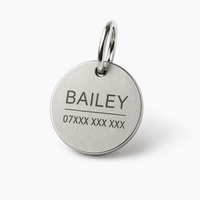
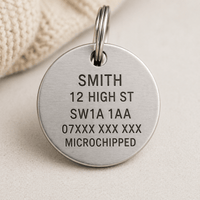
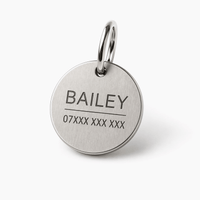
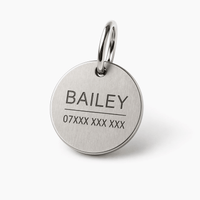
A dog tag is the collar-mounted identification that a member of the public reads on finding your dog. It carries your surname, address and phone number on the front, and (optionally) the dog's name on the reverse. The information is engraved, printed or stamped directly onto the tag.
Finding your dog with a readable tag takes the member of the public about 10 seconds: look, read, dial. Finding your dog without a tag takes them an hour, a car journey, and a vet's appointment. Finding your dog without a tag or a microchip can take days.
What a dog tag is for
- Immediate, direct contact from whoever finds your dog
- Meeting the Control of Dogs Order 1992
- Reuniting your dog with you within minutes rather than hours
What a dog tag is not for
- Surviving the chip scenario (if the tag is lost, the microchip is your backup)
- Proving ownership (microchip database entries carry legal weight; a tag does not)
- Tracking a dog's location
The UK legal position
Both are required. Full stop.
Microchip law: The Microchipping of Dogs (England) Regulations 2015 and equivalent legislation in Scotland, Wales and Northern Ireland require every dog to be microchipped by 8 weeks of age. The owner must keep the database entry up to date. Failing to comply can result in a 21-day notice to microchip, and a fine up to £500 if not complied with.
Tag law: The Control of Dogs Order 1992 requires any dog in a public place in the UK to wear a collar with the owner's name and address on it, either inscribed on the collar or on a tag attached to it. The maximum fine is Level 3 on the standard scale (currently £1,000). For deeper detail on the tag requirement, see our UK dog tag law guide.
These two pieces of legislation exist because they solve different parts of the same problem. Neither replaces the other.
Why the tag does something the chip cannot

Imagine the scenario. Your dog has slipped the back gate and is being held gently on a long lead by a neighbour two streets over. The neighbour does not have a microchip scanner. The neighbour does not know where the nearest vet is. The neighbour has a phone, a pair of eyes, and a willingness to help.
With a tag: the neighbour reads your surname, postcode and phone number. Rings you. You collect your dog in fifteen minutes.
Without a tag: the neighbour ties the dog to a lamp post (or worse, lets them go), phones the council's dog warden, waits. The dog is taken to a holding facility, eventually scanned, eventually matched to your details, eventually returned. Four hours, a bill, and a lot of stress.
The microchip is your backup when the tag has done all it can and the dog has still not been found by a member of the public. It is not the front-line tool.
How the tag and chip work together
The ideal scenario for a lost dog:
- Dog goes missing
- Dog is found by a member of the public (neighbour, dog walker, passer-by)
- Member of the public reads the tag, rings the owner, dog is reunited within the hour
When that does not work (dog is found at night, the finder cannot reach you immediately, or the tag has been lost in the escape):
- Dog is taken to a vet, rescue centre, or dog warden
- The microchip is scanned
- The owner's details are pulled from the database
- The owner is contacted through professional channels
The chip is the fallback. The tag is the first line. Both need to work for the system to function.
Microchip vs dog tag: side-by-side comparison
| Feature | Microchip | Dog tag |
|---|---|---|
| Visible to public | No | Yes |
| Readable without equipment | No (scanner required) | Yes (eyes only) |
| UK legal requirement | Yes (from 8 weeks) | Yes (in public places) |
| Can be lost | No (implanted) | Yes (if ring fails) |
| Updatable | Yes (via database) | Yes (new tag) |
| Typical reunite time | Hours to days | Minutes to hours |
| Replaces the other? | No | No |
Keeping the microchip database up to date
The microchip requirement has a catch: the chip is useless if the database entry is out of date. When you move house or change phone number, you need to update the database entry (most UK databases allow this online; most charge a small fee). Failing to do so can technically count as non-compliance with the regulations.
A rough estimate from UK rescue centres is that 10-20% of microchipped dogs in stray holding have out-of-date database entries. The chip scans fine; the contact details are useless. In these cases, the tag is what saves the day.
When the tag is lost in the escape
Split rings fail. Collars come off. Sometimes a dog escapes without any collar at all (many indoor dogs do not wear a collar at home). In these cases, the microchip is the only way to identify the dog.
This is why every dog needs both. The tag is the front line, but sometimes the front line fails. When it does, the chip picks up the job.
Does a QR tag replace the traditional engraved tag?
No. A QR tag can carry more information (link to an online profile, photos, emergency contact list) but it adds a technology dependency. A stranger needs a smartphone, a reliable signal, and a willingness to scan an unfamiliar QR code. The traditional engraved tag works with a pair of eyes and a phone.
QR tags are a useful supplement for some owners, not a replacement for the engraved details. The Control of Dogs Order 1992 does not mention QR codes and is unlikely to consider them sufficient identification on their own.
Common mistakes we see
- Relying on the chip alone. Legal risk, and practical risk if the dog is found by a member of the public.
- Not updating the chip database after moving house. The chip then points to an old address and phone number.
- Letting the tag fade over years. A faded tag is effectively no tag once it stops being readable.
- Choosing a cheap tag with an unrated split ring. The ring fails, the tag goes, and the dog is suddenly relying on the chip alone.
What UK delivery and returns should look like
A good UK dog tag brand dispatches from the UK, offers free delivery on a reasonable order value, and takes returns on a personalised item if the fit is not right. It also stands behind the durability of the engraving, so the tag continues to meet the law for years.
Bailey & Coco dispatches from our UK studio, with free delivery on orders over £50 and hassle-free returns within 30 days.
Both, every walk
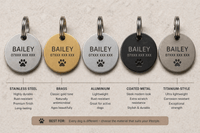
Microchip handled. Now make sure the tag does the other half of the job. Shop the full engraved dog tag collection, hand-finished in the UK in silver, black and rose gold, with free delivery on orders over £50.
Related reading
- UK Dog Tag Law Explained: The Control of Dogs Order 1992 in Plain English
- Why My Dog Tag Keeps Falling Off: 5 Real Fixes
- Personalised Dog Tags: The Complete UK Buyers Guide
- UK dog tag guide
- dog tag engraving guide
- engraved dog tags UK buyers guide
Real owner scenarios: when each identification method does the job
Four situations where one of the two identification methods saved the day.
The night escape
Border Collie slips out of a garden at 10pm. Found by a neighbour at 11pm walking on a lane. Neighbour rings the number on the tag; dog is home by 11:15pm. The tag did the work. Microchip would have required a vet visit in the morning.
The out-of-date chip
Small terrier lost in a park. Found two days later, taken to a vet. Chip scanned, but the database entry carried a phone number from three years and two house moves ago. The vet could not reach the owner through the chip. The dog then spent a week in a rescue holding before being matched through social media. The chip was legally there; the database entry was useless.
The collar-free escape
Labrador got out of the garden while wearing no collar (collar removed for a bath, then forgotten). Found by a dog walker who took the dog to a vet. The chip scanned perfectly and the details were current. Reunited in 4 hours. The tag would have been faster, but the chip still did its job when the tag was not there.
The rescue adoption
New rescue dog with microchip registered to the charity. Dog wanders off on day three in new home. A neighbour finds the dog wearing the temporary tag the charity issued. Rings the charity; charity rings new owner; dog home in 30 minutes. Tag and chip both did what they do best.
Common mistakes with microchip and tag management
Five mistakes that compromise the identification system.
- Not updating the microchip database after a move. The commonest failure. The chip scans fine but returns the old phone or address.
- Assuming a QR code tag is a "digital chip". A QR code is a public-facing label like an engraved tag. It is not a substitute for the chip.
- Putting the microchip number on the tag as "extra info". The chip number on the tag provides no help to a finder (they cannot scan from the number alone) and uses a line that could carry contact details.
- Removing the tag because "the chip is enough". Not in law. Not in practice. A finder on a country lane cannot scan your dog.
- Not checking the chip database entry at vet visits. The annual vet visit is the natural point to verify the database is current. Most vets can read the chip number in seconds and remind the owner to update.
Decision guide: maintaining both identification methods
A complete identification setup has both the microchip and the tag working. Use this annual check.
January (or at annual vet visit)
- Ask the vet to scan the chip
- Confirm the chip number reads
- Log into the microchip database and verify name, address, and phone number
Every six months
- Check the tag reads clearly at arm's length
- Check the split ring for any gap or stretch
- Confirm the collar D-ring is sound
At any life change
- Move house: update chip database AND order a new tag
- Change phone: update chip database AND order a new tag
- Change of ownership (adoption, gift, rehoming): update chip database AND produce new tag
Most owners keep the chip updated because the database sends reminders. The tag is the part that gets overlooked. A calendar reminder twice a year solves this.
What to do if your dog is found or goes missing
A practical sequence for both scenarios, covering what tag and chip do in each case.
If your dog is found by a member of the public
The finder reads the tag, phones you, and returns the dog. The tag does all the work. Chip never gets scanned in this scenario, which is the most common scenario for UK lost-dog events.
If your dog is found at a vet or rescue
The vet scans the chip, looks up the database, calls you from the registered number. The chip does the work here. Tag also gets checked as a cross-reference; both should match.
If your dog goes missing and has not been found
Report missing to the local dog warden, your microchip database, and major lost-dog networks (DogLost, local Facebook groups). Good tag and up-to-date chip both increase recovery odds by reducing the time between "found" and "owner contacted".
If the tag is lost before the dog is found
Rare but possible. The dog is identified by chip only. Reunite takes longer (hours vs minutes) but still works. This is why both systems matter.
The identification both-and
Microchip and tag is not an either-or in UK dog ownership. Both are legal requirements, both solve different parts of the same problem, and both need keeping up to date as your details change. An owner who keeps the chip database current and replaces the tag when it fades is doing the complete job. Most lost-dog reunites happen through the tag; the chip is the crucial backup when the tag has done all it can.
See also our UK dog tag law explained.
Frequently asked questions
Do I need a dog tag if my dog is microchipped?
Yes. Both are UK legal requirements and they do different jobs. The microchip is for professionals with scanners; the tag is for the public who find your dog first.
Is the microchip or the tag more important?
Neither. The tag gets your dog home faster when found by the public. The microchip is the backup when the tag has failed. You need both working together.
What happens if my dog is found without a tag?
The finder typically contacts a vet, rescue centre or dog warden. The dog is scanned for a microchip, the database entry is looked up, and you are contacted through professional channels. This usually takes hours rather than minutes.
What happens if the microchip database has my old details?
The chip scans fine, but the contact details are useless. This is a common failure mode. Update the database whenever you move house or change phone number.
Is a QR code tag enough to meet UK law?
Unlikely. The Control of Dogs Order 1992 predates QR codes and requires the owner's name and address on the tag. A QR code alone adds technology dependency. A QR tag combined with engraved details is better than either alone.
Can a vet scan my dog's microchip for free?
Most UK vets will scan a found dog for free. Some database lookups carry a small fee but most are included.
What is the difference between microchip registration and the tag?
Microchip registration is the database entry linking the chip number to your details. The tag is the physical piece of ID on the collar. They work together: one is queried, one is read.
Does my puppy need a tag and a chip?
Microchip from 8 weeks is legally required. The tag is required whenever the dog is in a public place, so from the first walk. Our puppy collars guide covers the full set-up.
What happens if the chip migrates inside my dog?
Chip migration is rare but possible. The chip can move from the original shoulder-blade site. Scanning still works because scanners check the whole dog; it just takes slightly longer. This is one more reason the tag remains the front-line tool.
Can I use an international microchip database?
Yes. UK databases feed into international ISO-compliant systems for dogs that travel. The tag does not have an international equivalent beyond what you engrave on it, which is why holiday-specific tags with local phone numbers sometimes make sense.
Should I put my microchip number on the tag?
Usually not. A finder cannot scan a chip from just its number. They need a reader and the physical dog. Using the line for a phone number gives the finder something actionable.