












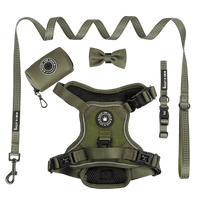

If you have ever owned a Greyhound, Whippet, or any breed with a slender neck, you have probably encountered the frustrating moment when your dog simply backs out of their flat collar. It is a common problem, and it is exactly the problem that martingale collars were designed to solve. But what is a martingale collar, how does it actually work, and is it the right choice for your dog? In this comprehensive guide, we cover everything from the clever loop mechanism to proper fitting, training tips, safety considerations, and which breeds benefit most from this specialist collar type.
Whether you are a sighthound owner looking for a secure walking solution or simply curious about the different collar options available for your dog, read on for the complete lowdown on martingale collars.
What Is a Martingale Collar?
A martingale collar, sometimes called a limited-slip collar or a Greyhound collar, is a type of dog collar designed to tighten slightly when the dog pulls but only up to a predetermined limit. Unlike a standard slip lead or choke chain that can tighten indefinitely, a martingale collar has a built-in stopping point that prevents it from ever becoming tight enough to choke the dog. This makes it significantly safer than a slip collar while still providing the security of a snug fit when needed.
The collar consists of two loops. The larger loop goes around the dog's neck. The smaller loop, sometimes called the control loop or adjustment loop, is connected to the larger loop by two metal rings. The lead clips onto the smaller loop. When the dog pulls forward or tries to back out, the tension on the lead causes the smaller loop to pull the two rings together, which in turn tightens the larger loop around the neck, but only to the extent that the smaller loop allows.
The result is a collar that sits comfortably loose when there is no tension, gently tightens to prevent escape when the dog pulls, and can never become dangerously tight. It is a simple, elegant piece of engineering that has been keeping sighthounds safe for decades.
How Martingale Collars Work: The Loop Mechanism Explained
To truly understand why martingale collars are so effective, it helps to break down the mechanics step by step.
When Relaxed
When your dog is walking calmly by your side with no tension on the lead, the martingale collar sits loosely around the neck. The two metal rings on the smaller control loop are spread apart, and the larger loop hangs comfortably with room to spare. At this point, it looks and feels much like a regular flat collar.
When Tension Is Applied
The moment your dog pulls forward, lunges, or tries to reverse out of the collar, the lead pulls on the smaller control loop. This draws the two metal rings together, which tightens the larger loop around the dog's neck. The collar snugs up evenly around the entire circumference of the neck, distributing pressure rather than concentrating it at a single point.
The Built-In Limit
Here is the critical safety feature: the collar can only tighten as far as the smaller loop allows. Once the two metal rings meet (or nearly meet), no further tightening is possible. This predetermined maximum tightness is set by the collar's size and the length of the control loop. When properly fitted, this maximum tightness is snug enough to prevent the dog from slipping out but loose enough to avoid any choking or discomfort.
When the tension is released, the collar immediately loosens back to its relaxed state. There is no ratchet, no locking mechanism, no sustained pressure. It is entirely self-correcting.
A Brief History: From Greyhounds to the Mainstream
Martingale collars have their roots in the sighthound community, particularly among Greyhound rescue organisations. Greyhounds, with their distinctive narrow heads and thick necks, are notorious for being able to slip out of standard flat collars. When a Greyhound lowers its head and pulls backward, its narrow skull passes straight through a collar that was seemingly well fitted moments earlier.
The martingale design was developed specifically to address this anatomical challenge. By tightening gently when the dog pulls, it eliminates the escape route without resorting to the dangerous sustained pressure of a choke chain.
Over the years, the martingale collar has expanded beyond the sighthound community. It is now used by owners of many breeds, particularly those with narrow or tapered heads, dogs that are nervous or flight-prone, and dogs in training who need a little extra security. The name "martingale" itself comes from a type of horse tack that works on a similar principle of limited restriction.
Which Breeds Benefit Most from Martingale Collars?
While any dog can wear a martingale collar, certain breeds benefit from the design far more than others. The common thread is head shape: breeds whose heads are narrower than their necks are natural candidates for the martingale's limited-slip action.
Sighthounds
This is the bread and butter of the martingale collar. Sighthounds have a very distinctive build, with long, narrow heads and relatively thick, muscular necks. This combination makes standard flat collars unreliable because the dog can easily back out of them.
Breeds in this category include Greyhounds (including retired racing Greyhounds), Whippets, Italian Greyhounds, Salukis, Afghan Hounds, Borzoi, Irish Wolfhounds, Scottish Deerhounds, and Lurchers (Greyhound or Whippet crosses).
For these breeds, a martingale is not just a preference; it is often considered essential for safe walking.
Other Narrow-Headed Breeds
Some non-sighthound breeds also have narrower skulls relative to their necks. Dobermanns, Bull Terriers, and some Collie types can benefit from the added security a martingale provides.
Escape Artists and Nervous Dogs
Regardless of breed, any dog that has a tendency to back out of their collar, whether through fear, excitement, or sheer determination, can benefit from a martingale. Rescue dogs that are still building confidence, reactive dogs that may bolt when startled, and clever dogs that have learned they can reverse out of a flat collar are all good candidates.

Martingale Collar vs Flat Collar: A Detailed Comparison
Understanding the differences between a martingale collar and a standard flat collar helps you decide which is right for your dog. Here is a side-by-side comparison.
| Feature | Martingale Collar | Flat Collar (Adjustable Buckle) |
|---|---|---|
| Mechanism | Limited-slip tightening via control loop | Fixed size, buckle or clip fastening |
| Escape Prevention | Excellent; tightens when dog pulls back | Good for most breeds; narrow-headed dogs may slip out |
| Safety | Cannot overtighten; limited-slip design | Cannot overtighten; fixed at set size |
| Best For | Sighthounds, narrow-headed breeds, escape artists | Most breeds with standard head-to-neck proportions |
| Everyday Wear | Not recommended unsupervised (loop can snag) | Safe for supervised daily wear with ID tag |
| ID Tag Attachment | Usually via the D-ring on the main loop | Standard D-ring; easy tag attachment |
| Styles Available | Moderate range, often nylon or fabric | Huge range; fabric, tweed, leather, biothane |
| Price Range | Moderate to high | Budget to premium |
For the vast majority of dog breeds, a well-fitted adjustable flat collar is perfectly secure and comfortable. Martingale collars fill an important niche, but they are a specialist tool rather than a universal necessity.
Martingale Collar vs Slip Collar: Key Safety Differences
It is crucial not to confuse a martingale collar with a slip collar (also called a slip lead or choke chain). While they share the concept of tightening when pulled, the safety profiles are vastly different.
A slip collar or slip lead has no stopping mechanism. When the dog pulls, the collar tightens continuously with no upper limit. If the dog continues to pull, the collar continues to tighten, potentially restricting the airway and causing injury to the trachea, neck muscles, or cervical vertebrae. Slip collars require experienced handling and constant vigilance.
A martingale collar, by contrast, has that critical built-in limit. No matter how hard the dog pulls, the collar cannot tighten beyond its predetermined maximum. This makes it dramatically safer for the dog and far more forgiving of handler error.
If you are considering a slip collar because your dog escapes from flat collars, a martingale is almost always the better, safer choice. And if your dog does not have a narrow head shape, a properly fitted adjustable flat collar may be all you need.
How to Fit a Martingale Collar Properly
Correct fitting is absolutely essential with a martingale collar. Too loose and the dog can still escape; too tight and you lose the limited-slip benefit entirely. For broader guidance on collar fitting, our guide on how tight a dog collar should be covers the fundamentals, but martingales have their own specific fitting process.
Step 1: Measure Your Dog's Neck
Measure the narrowest point of your dog's head (just behind the ears) and the widest point of the neck (at the base, near the shoulders). You need both measurements. For a detailed walkthrough of measuring techniques, see our dog collar size guide.
Step 2: Size the Collar
The martingale collar needs to be large enough to slip over the widest part of the dog's head when fully loosened, but small enough that when fully tightened (with the control loop pulled taut), it is snug around the narrowest point of the neck without being restrictive.
Step 3: Check the Tightened Position
With the collar on your dog and the control loop pulled to simulate lead tension, the collar should be snug but not tight. You should still be able to fit one to two fingers between the collar and the neck. The two rings on the control loop should be close together but not touching. If the rings are touching, the collar is too large, and the dog may still be able to slip out.
Step 4: Check the Relaxed Position
When there is no tension on the control loop, the collar should sit comfortably around the neck with some slack. It should not be so loose that it slides down the neck or can be caught on objects.
Key Fitting Tip
Many first-time martingale owners make the mistake of fitting the collar like a flat collar, with the two-finger rule in the relaxed state. This results in a collar that is far too loose when relaxed and still too loose when tightened. Remember: with a martingale, the fit check happens in the tightened position, not the relaxed position.
When to Use a Martingale Collar (And When Not To)
Martingale collars are purpose-built tools. They excel in certain situations and are unsuitable for others.
Ideal Uses
Lead walks: This is the primary use case. The martingale provides secure, escape-proof walking for sighthounds and other breeds that can slip standard collars.
Training sessions: The gentle tightening action provides a subtle communication cue that can aid loose-lead training. The momentary snugging of the collar signals to the dog that they are pulling, without causing pain or distress.
Vet visits and high-stress environments: When a nervous or reactive dog is more likely to try to bolt, a martingale adds an extra layer of security.
When Not to Use a Martingale
Unsupervised wear: Never leave a martingale collar on an unsupervised dog. The control loop and extra rings create more snag points than a flat collar. If the loop catches on a fence, crate, or branch, the tightening action could become a strangulation risk.
Off-lead exercise: When your dog is running free, the dangling control loop can catch on undergrowth, sticks, or other dogs' teeth during play. Switch to a flat collar or remove the collar entirely (provided you are in a secure area).
Swimming: The extra fabric and hardware of a martingale collar absorb more water and add weight. A wet martingale can become heavy and uncomfortable. Most owners remove all collars for swimming.
Overnight or crate use: As with all collars, but especially true for martingales, remove the collar at bedtime and during crate time.
Safety Considerations
Martingale collars are inherently safer than slip collars and choke chains, but they still require responsible use. Here are the key safety points to keep in mind.
Supervise at all times. A martingale should only be worn when you are present and actively supervising your dog, typically during walks.
Check the fit regularly. Weight changes, coat growth, and collar wear can all affect the fit. Check the tightened fit every few weeks.
Inspect the hardware. The rings and stitching on the control loop are under regular stress. Check for bent rings, fraying, or loose stitching.
Use a backup for high-risk situations. If you are walking a new rescue dog, a reactive dog, or any dog in an unfenced area near traffic, consider using both a martingale collar and a harness attached to a double-ended lead for redundancy.
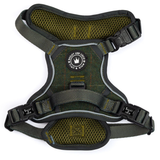
Our adjustable dog harnesses pair well with martingale collars for this dual-attachment setup.
Never use with a retractable lead. The constant light tension from a retractable lead can keep the martingale in a semi-tightened state, which defeats the purpose and can cause irritation over time.
Martingale Collar Materials and Styles
Martingale collars come in a range of materials, though the selection tends to be narrower than what is available for flat collars.
Nylon webbing: The most common material. It is durable, affordable, easy to clean, and available in a huge range of colours and widths. Look for nylon with finished edges to prevent fraying.
Fabric and patterned: Fabric martingales offer more visual variety, with prints, tweeds, and designer patterns. They tend to be slightly softer than plain nylon and can look very smart.
Leather: Leather martingales exist but are less common. They look elegant but are stiffer and heavier, which can affect the smoothness of the tightening action.
Chain control loop: Some martingales use a short chain section for the control loop instead of fabric. The chain provides a distinctive jingling sound that can serve as an auditory cue for the dog. However, chain control loops are noisier and can pinch long-coated breeds.
Sizing Guide for Martingale Collars
Martingale sizing differs from flat collar sizing because you need to account for the tightening range. Here is a general guide by breed type.
| Breed Type | Typical Neck Size | Recommended Martingale Size | Width |
|---|---|---|---|
| Italian Greyhound | 20-28 cm | Small (check head clearance) | 1.5-2.0 cm |
| Whippet | 28-35 cm | Medium | 2.5-3.8 cm |
| Greyhound | 35-45 cm | Large | 3.8-5.0 cm |
| Saluki / Afghan Hound | 33-43 cm | Large | 3.8-5.0 cm |
| Irish Wolfhound / Deerhound | 45-55 cm | Extra Large | 3.8-5.0 cm |
| Lurcher (varies widely) | 30-45 cm | Medium to Large | 2.5-5.0 cm |
Always check both the head measurement and the neck measurement before purchasing. The collar must be able to slip over the head when fully loosened while still being effective when tightened.
Training with a Martingale Collar
While a martingale collar is not a training tool in the same way as a head halter or front-clip harness, it does provide a useful communication channel during loose-lead training.
The gentle tightening action when the dog pulls serves as natural feedback. The dog feels the slight increase in pressure and, over time, learns that walking with a loose lead is more comfortable. This is not about correction or punishment; it is about the collar providing a clear, consistent physical sensation that the dog can respond to.
For effective training with a martingale, pair the collar's feedback with positive reinforcement. When the dog walks nicely with a loose lead, reward with treats, praise, and continued forward movement. When the dog pulls and the collar tightens, stop walking and wait for the dog to ease the pressure before moving forward again. The combination of the collar's physical feedback and your consistent training response is what creates lasting behaviour change.
It is worth noting that a martingale collar is not a substitute for proper training. A collar alone will not teach a dog to walk nicely. It is one tool in a broader training approach that should always prioritise positive reinforcement and patience.
Do You Actually Need a Martingale Collar?
Here is the honest assessment. Martingale collars are an excellent, purpose-built solution for a specific problem: dogs with narrow heads that can escape from flat collars. If you own a Greyhound, Whippet, Saluki, or similar sighthound breed, a martingale collar is likely an essential part of your walking kit.
However, for the vast majority of dog breeds, a well-fitted adjustable flat collar provides all the security you need. If your dog has standard head-to-neck proportions (meaning their head is wider than their neck, as is the case for most breeds), a flat collar is not going anywhere when properly sized. Modern adjustable collars with quality buckle mechanisms are extremely reliable.
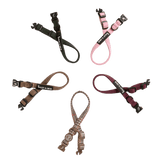
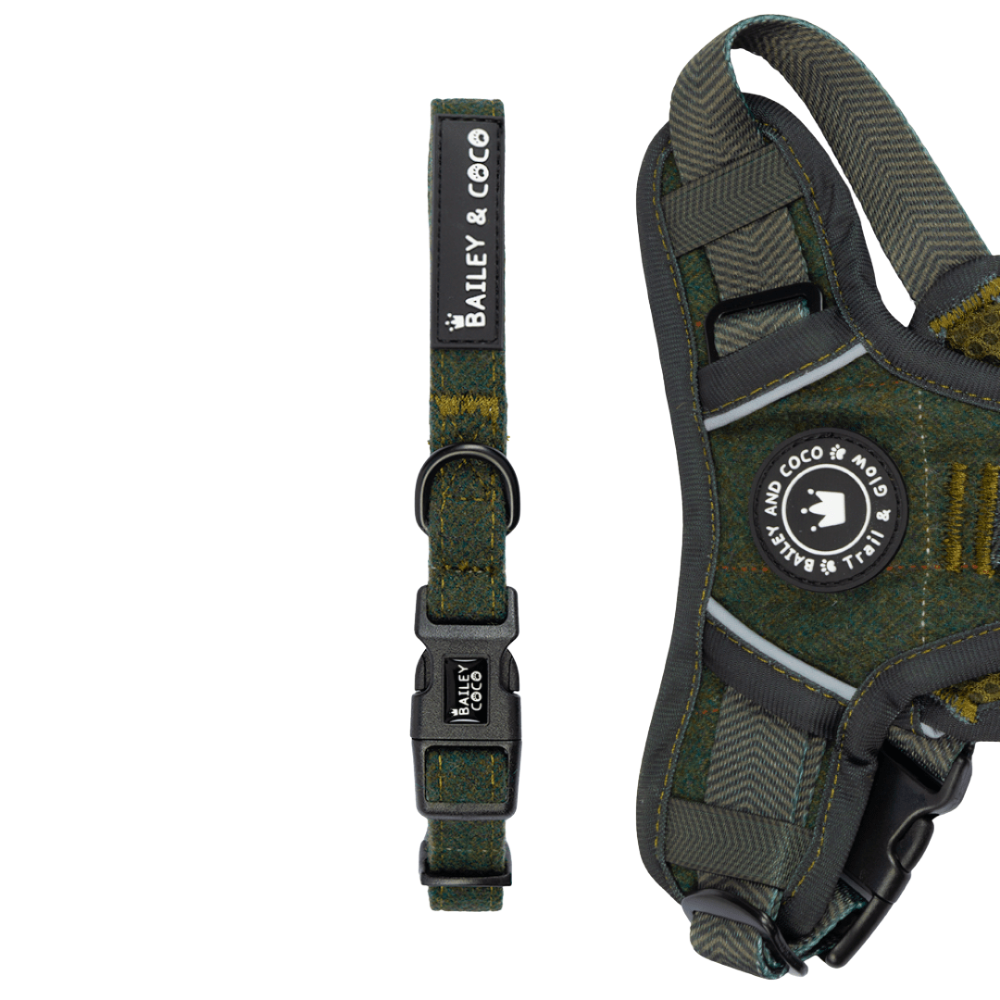
Bailey and Coco's range of adjustable fabric collars are designed with exactly this in mind. They feature a wide adjustment range for a precise fit, soft fabric that sits comfortably against the coat, and secure quick-release buckles. For breeds like Labradors, Spaniels, Terriers, Dachshunds, Poodles, and the vast majority of crossbreeds, an adjustable flat collar is the smarter, more versatile choice. It can be worn all day (supervised), used for walks, and paired with a harness when additional control is needed.
If you are unsure whether your dog needs a martingale or would be better served by a standard adjustable collar, consider this simple test: with your dog's current collar fitted snugly, gently try to pull it forward over their ears. If it slips off, your dog has a narrower head-to-neck ratio and would benefit from a martingale. If the collar stays firmly in place, a flat collar is working perfectly. For smaller breeds in particular, a lightweight adjustable collar is usually the ideal choice.
Caring for Your Martingale Collar
Martingale collars have more moving parts than a flat collar, so they benefit from a little extra maintenance.
Clean regularly. Fabric and nylon martingales can be hand-washed with mild soap and warm water. Rinse thoroughly and air dry. Avoid machine washing as it can weaken stitching over time.
Inspect the control loop. Check the smaller loop for signs of wear. The stitching where the control loop meets the main loop bears the most stress. If you see fraying or loose threads, replace the collar.
Check the rings. The metal rings should move freely and show no signs of bending or corrosion. Stiff or bent rings can affect the collar's tightening and loosening action.
Replace when worn. Even the best martingale collar has a finite lifespan. If the collar shows significant wear, does not tighten and loosen smoothly, or has any compromised stitching, replace it promptly. A martingale that does not function correctly is a safety risk.
Finding Your Dog's Perfect Collar
The right collar depends entirely on your dog's breed, build, and lifestyle. For sighthound owners, martingale collars are a proven, safe solution to the narrow-head escape problem. For everyone else, a quality adjustable flat collar delivers comfort, security, and style in one package.
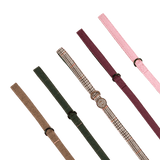
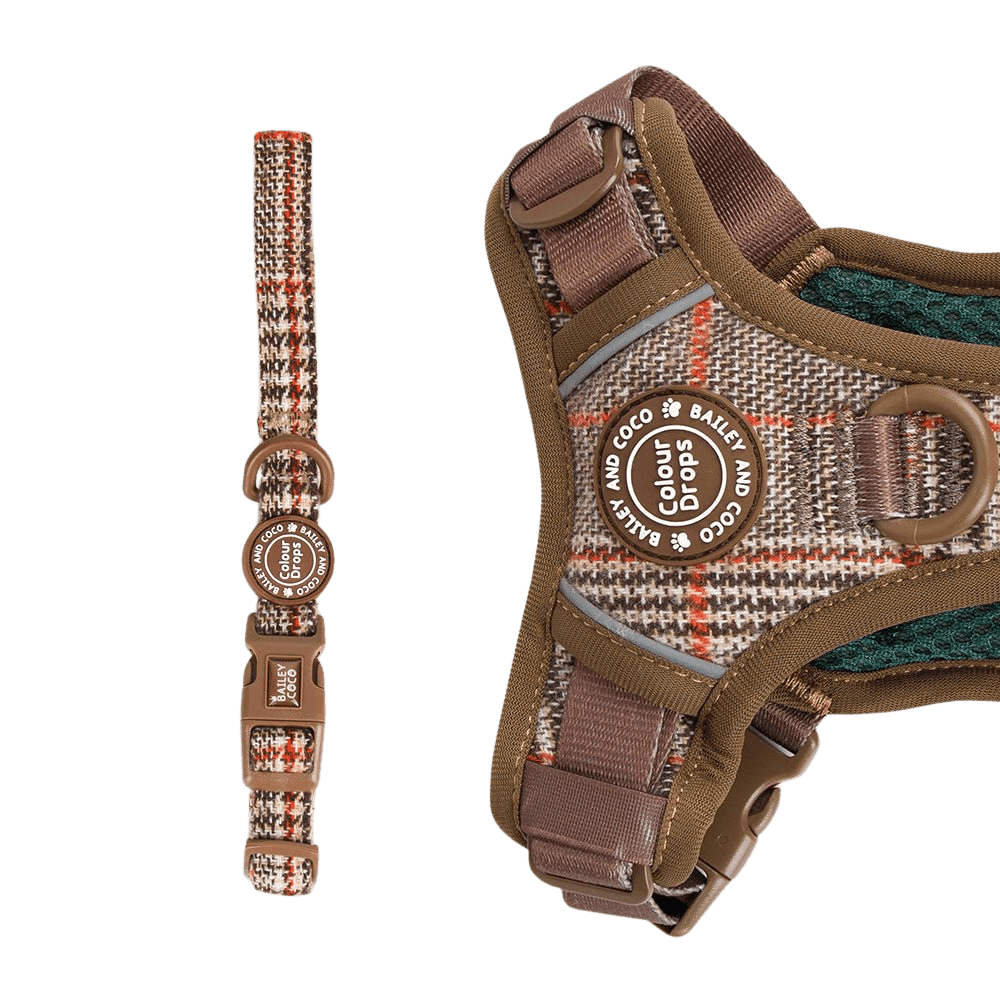
If you are shopping for a personalised collar or simply want something that looks as good as it functions, explore Bailey and Coco's range of adjustable collars. Crafted from soft fabrics and premium tweeds in colours from Lavender to Heritage Plaid, they are designed for dogs who deserve something a little special.
Frequently Asked Questions
What is a martingale collar used for?
A martingale collar is a limited-slip collar designed to prevent dogs from backing out of their collar during walks. It tightens gently when the dog pulls but has a built-in limit that stops it from becoming dangerously tight. They are primarily used for sighthound breeds like Greyhounds, Whippets, and Salukis, whose narrow heads allow them to slip out of standard flat collars.
Are martingale collars safe?
Yes, when used correctly. Martingale collars are significantly safer than slip collars or choke chains because they have a built-in stopping point that prevents choking. However, they should only be worn during supervised activities like walks and training. Never leave a martingale collar on an unsupervised dog, in a crate, or overnight, as the control loop creates additional snag points.
Can any dog wear a martingale collar?
Technically, any dog can wear a martingale collar, but they are specifically designed for breeds with narrow heads relative to their necks. For most breeds with standard proportions, a well-fitted adjustable flat collar provides equal security and is more versatile for everyday wear. Test by gently trying to pull your dog's current flat collar over their head; if it stays put, a flat collar is fine.
How should a martingale collar fit?
When the control loop is pulled tight (simulating lead tension), you should be able to fit one to two fingers between the collar and the dog's neck. The two rings on the control loop should be close together but not touching. When relaxed, the collar should sit comfortably with some slack. Crucially, the collar must be loose enough to slip over the dog's head when fully loosened for putting on and taking off.
Can my dog wear a martingale collar all day?
No. Martingale collars should only be worn during supervised activities, primarily walks and training sessions. The control loop and extra hardware create more potential snag points than a flat collar, making them unsuitable for unsupervised wear, off-lead play, crate time, or sleeping. Use a standard flat collar or no collar for other times.
What is the difference between a martingale collar and a slip lead?
The critical difference is the limit. A slip lead tightens indefinitely when the dog pulls, which can restrict breathing and cause injury. A martingale collar has a built-in stopping point that prevents it from tightening beyond a safe level. Martingale collars are dramatically safer than slip leads and are the recommended alternative for dogs that need escape-proof walking equipment.
Does my dog need a martingale collar or a regular collar?
If your dog is a sighthound (Greyhound, Whippet, Saluki, etc.) or has a narrow head that allows them to slip out of flat collars, a martingale is the right choice for walks. For most other breeds, a properly fitted adjustable flat collar is perfectly secure and more practical for everyday use. Bailey and Coco's adjustable collars are designed to provide a snug, reliable fit for a wide range of breeds.
For a full comparison of every collar type available in the UK, see our best dog collars guide. You can also find the right lead to pair with your martingale in our best dog leads guide, and explore our harness buying guide if you are considering a harness for walks as well.


